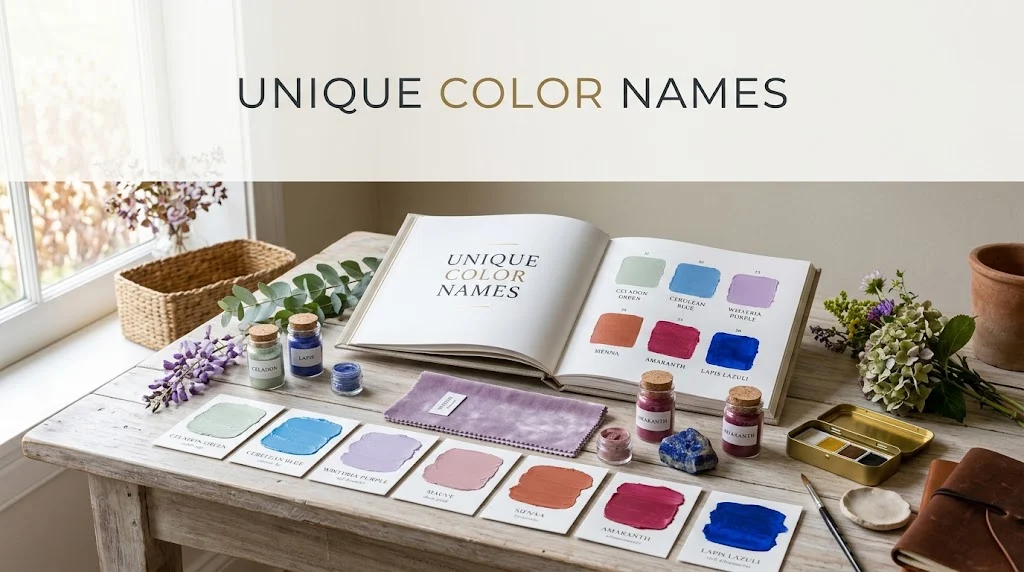
Unique color names are uncommon or creative names used to describe distinctive shades. Examples include Celadon, Viridian, Periwinkle, Cerulean, Mauve, Sienna, Amaranth, and Wisteria.
Color has a language of its own. A simple blue can become Cerulean, a soft green can become Celadon, and a warm pink can take on the romantic character of Amaranth. These names make colors feel more memorable and expressive.
If you are searching for unique color names, you have probably moved beyond ordinary color words and want shades with personality. Perhaps you need a beautiful name for a design palette, artwork, website, fashion collection, character, craft project, or social media post.
The world of color offers thousands of fascinating shades, and many have names connected to flowers, gemstones, minerals, places, nature, food, history, and artistic traditions.
Below, you will find a carefully selected collection of distinctive color names, along with the feeling, style, and inspiration behind each one. Some are established color terms, while others are familiar descriptive names used creatively.
🌿 Celadon
Color Family: Soft green
Meaning and Inspiration: Celadon is a pale, muted green traditionally associated with a type of ceramic glaze.
Origin: The color name comes from the world of ceramics and was influenced by the character Céladon in a French pastoral romance.
Personality: Celadon feels calm, refined, natural, and understated. It has the peaceful quality of soft greenery without appearing overly bright.
Style: Elegant, earthy, vintage, minimalist
Best For: Interior design, stationery, fashion, branding, wedding palettes
Popularity: Celadon has remained a recognizable color term among artists, designers, and people interested in ceramics.
Emotional Appeal: Its muted quality makes it easy on the eyes and gives designs a sophisticated natural feeling.
Why It Still Works Today: Celadon fits beautifully with modern minimalist and nature-inspired aesthetics. It pairs particularly well with cream, beige, brown, and other soft greens.
🌸 Amaranth
Color Family: Pink-red
Meaning and Inspiration: Amaranth is associated with the amaranth plant and describes a rich reddish-pink shade.
Origin: The name comes from the amaranth flower and plant family.
Personality: Amaranth feels expressive, confident, romantic, and vibrant without being as intense as some very bright reds.
Style: Botanical, bold, romantic, artistic
Best For: Fashion, floral designs, invitations, branding, illustrations
Popularity: Amaranth is less common than basic pink or red names, making it attractive for creative palettes.
Emotional Appeal: The unusual name adds personality while its pink-red appearance creates warmth and energy.
Why It Still Works Today: Amaranth works well when you want a color that feels feminine and dramatic without relying on an ordinary color label.
🌊 Cerulean
Color Family: Blue
Meaning and Inspiration: Cerulean describes a deep or moderately bright sky-blue shade.
Origin: The word has Latin roots connected with the color of the sky or sea.
Personality: Cerulean feels peaceful, expansive, fresh, and imaginative.
Style: Coastal, artistic, clean, dreamy
Best For: Ocean-themed designs, artwork, bedrooms, travel graphics, branding
Popularity: Cerulean is an established color term and is particularly familiar in artistic and design contexts.
Emotional Appeal: It instantly suggests open skies and clear water, making it naturally calming.
Why It Still Works Today: Blue remains one of the most versatile color families, and Cerulean gives a more distinctive alternative to simply calling a shade blue.
💜 Wisteria
Color Family: Purple
Meaning and Inspiration: Wisteria is inspired by the soft purple color commonly associated with wisteria flowers.
Origin: The name comes from the flowering plant.
Personality: Wisteria feels graceful, dreamy, delicate, and creative.
Style: Floral, pastel, romantic, whimsical
Best For: Weddings, stationery, bedrooms, fashion, illustrations, social media graphics
Popularity: Wisteria is recognizable as both a plant and a color-inspired name.
Emotional Appeal: Its floral connection gives it an especially gentle and romantic character.
Why It Still Works Today: Wisteria fits beautifully into modern pastel palettes and works well with lavender, cream, dusty pink, and soft gray.
🍇 Mauve
Color Family: Purple-pink
Meaning and Inspiration: Mauve is a soft purple color with pinkish or grayish qualities.
Origin: The word became associated with a synthetic purple dye developed in the nineteenth century.
Personality: Mauve feels sophisticated, soft, mature, and romantic.
Style: Vintage, elegant, muted, feminine
Best For: Fashion, interiors, wedding designs, beauty branding
Popularity: Mauve has remained popular because it sits comfortably between pink and purple.
Emotional Appeal: Its muted quality gives it an elegant appearance without feeling overly bright.
Why It Still Works Today: Mauve is ideal for people who want a refined alternative to traditional pink or purple.
🍂 Sienna
Color Family: Warm reddish brown
Meaning and Inspiration: Sienna is associated with an earthy reddish-brown pigment.
Origin: The name is connected with Siena, Italy, where natural earth pigments were historically associated with the region.
Personality: Sienna feels warm, grounded, artistic, and confident.
Style: Earthy, rustic, artistic, warm
Best For: Interior design, autumn palettes, artwork, fashion, photography
Popularity: Sienna is an established color name and is also familiar as a personal name.
Emotional Appeal: Its earthy appearance creates a sense of warmth and connection with nature.
Why It Still Works Today: Earth tones have remained popular in contemporary design, making Sienna an excellent choice for warm, natural palettes.
🌱 Viridian
Color Family: Blue-green
Meaning and Inspiration: Viridian is a green pigment with a blue undertone.
Origin: The term comes from Latin viridis, meaning green.
Personality: Viridian feels sophisticated, natural, mysterious, and artistic.
Style: Jewel-like, botanical, rich, artistic
Best For: Painting, graphic design, fashion, nature-themed branding
Popularity: Viridian is better known in artistic and pigment-related contexts than in everyday color vocabulary.
Emotional Appeal: The combination of green and blue creates a distinctive color that feels both peaceful and dramatic.
Why It Still Works Today: Viridian is perfect for palettes that need a deeper alternative to ordinary green or teal.
🪻 Periwinkle
Color Family: Blue-purple
Meaning and Inspiration: Periwinkle is a soft color inspired by the flowers of the periwinkle plant.
Origin: The color name comes from the flowering plant.
Personality: Periwinkle feels playful, gentle, dreamy, and youthful.
Style: Pastel, floral, whimsical, soft
Best For: Baby designs, stationery, bedrooms, illustrations, spring themes
Popularity: Periwinkle has long been familiar as a color name and continues to appear in pastel palettes.
Emotional Appeal: Its delicate balance between blue and purple gives it a charming, peaceful quality.
Why It Still Works Today: Periwinkle is an excellent choice when you want something softer and more distinctive than ordinary blue or lavender.
💎 Lapis Lazuli
Color Family: Deep blue
Meaning and Inspiration: Lapis lazuli is associated with the rich blue appearance of the semi-precious stone.
Origin: The name comes from the gemstone, which has been valued for centuries.
Personality: Lapis Lazuli feels luxurious, mysterious, artistic, and powerful.
Style: Jewel tone, dramatic, luxurious, historical
Best For: Jewelry branding, artwork, luxury designs, interiors, cultural themes
Popularity: The gemstone has a long artistic history, particularly because powdered lapis was historically used as a pigment.
Emotional Appeal: Its deep blue quality suggests richness and depth.
Why It Still Works Today: Lapis Lazuli offers a memorable alternative to ordinary navy or royal blue and works beautifully in sophisticated palettes.
🌙 Ecru
Color Family: Pale beige
Meaning and Inspiration: Ecru describes the natural color of unbleached linen or silk.
Origin: The word comes from French and refers to something raw or unbleached.
Personality: Ecru feels peaceful, natural, understated, and sophisticated.
Style: Minimalist, neutral, natural, elegant
Best For: Interiors, fashion, stationery, websites, minimalist branding
Popularity: Ecru is well established in fashion and design vocabulary.
Emotional Appeal: Its soft neutral appearance creates a calm and timeless atmosphere.
Why It Still Works Today: Ecru fits perfectly with modern neutral aesthetics and offers more character than simply calling a shade beige.
📊 Quick Comparison Table
| Color Name | Color Family | Style | Best For |
|---|---|---|---|
| Celadon | Soft green | Elegant, earthy | Interiors |
| Amaranth | Pink-red | Bold, romantic | Fashion |
| Cerulean | Blue | Dreamy, artistic | Art |
| Wisteria | Purple | Floral, soft | Weddings |
| Mauve | Purple-pink | Vintage, elegant | Fashion |
| Sienna | Reddish brown | Earthy, warm | Interiors |
| Viridian | Blue-green | Artistic, rich | Design |
| Periwinkle | Blue-purple | Pastel, whimsical | Stationery |
| Lapis Lazuli | Deep blue | Luxurious, dramatic | Branding |
| Ecru | Pale beige | Minimalist, natural | Interiors |
🌈 More Unique Color Names to Explore
If you want an even bigger palette, these unusual color names are worth exploring:
- Aegean
- Alabaster
- Apricot
- Azure
- Burgundy
- Carmine
- Chartreuse
- Cinnabar
- Claret
- Cornflower
- Fuchsia
- Gamboge
- Indigo
- Jade
- Juniper
- Lilac
- Marigold
- Ochre
- Olive
- Opal
- Persimmon
- Pomegranate
- Saffron
- Sage
- Sepia
- Teal
- Topaz
- Turquoise
- Ultramarine
- Vermilion
💡 How to Choose the Perfect Unique Color Name
Start with the mood you want the color to create.
For something peaceful, consider soft shades such as Celadon, Periwinkle, Ecru, or Wisteria. For something dramatic, Lapis Lazuli, Viridian, Carmine, or Cinnabar can create more visual impact.
Think about the setting, too. A color name that works beautifully for a wedding palette may not suit a technology brand.
Nature can also provide excellent inspiration. Flowers, gemstones, plants, minerals, skies, oceans, and landscapes all offer memorable naming ideas.
If you are naming your own custom color, describe what makes the shade different. Is it dusty? Warm? Cool? Muted? Bright? Does it resemble a particular flower, stone, fruit, or landscape?
Finally, choose a name that is easy to remember. A beautiful color name becomes even more useful when people can pronounce and recognize it.
⭐ Most Popular Unique Color Names
Some distinctive color names have become especially familiar because of their use in art, fashion, design, and everyday language:
- Indigo
- Mauve
- Teal
- Turquoise
- Coral
- Sienna
- Cerulean
- Periwinkle
- Olive
- Fuchsia
- Maroon
- Lavender
- Ochre
- Vermilion
- Jade
🕰️ Vintage Color Names Making a Comeback
Vintage-inspired color names can give modern designs an old-world personality.
Some beautiful options include:
- Sepia
- Mauve
- Sienna
- Ochre
- Ecru
- Celadon
- Burgundy
- Olive
- Rust
- Terracotta
These shades work particularly well in retro branding, photography, fashion, wedding stationery, and interior design.
📱 Modern Color Naming Trends
Modern color naming often focuses on emotion and storytelling rather than simple visual description.
Instead of calling something “light pink,” a designer may use a name inspired by flowers, sunsets, gemstones, desserts, landscapes, or seasons. This makes the palette feel more memorable.
Nature-inspired names remain especially useful because they immediately create an image in the reader’s mind. Names such as Sage, Juniper, Wisteria, and Dahlia can communicate a mood before someone even sees the color.
Another popular approach is using sophisticated neutral names. Ecru, Alabaster, Sand, Stone, and similar names fit minimalist design trends.
🎨 What Makes a Color Name Unique?
A color name feels unique when it is memorable, descriptive, and different from everyday color vocabulary.
For example, “blue” gives a broad idea, while “Cerulean” creates a more specific artistic impression. Similarly, “purple” is general, while “Wisteria” suggests a soft floral shade.
Unique names often come from nature, materials, places, food, gemstones, plants, historical pigments, or cultural references.
However, uniqueness does not necessarily mean inventing a completely new word. An established but less frequently used color name can be just as distinctive.
🌍 Where Do Color Names Come From?
Color names have surprisingly diverse origins. Some come from plants and flowers, such as Wisteria and Periwinkle. Others are linked to minerals and gemstones, such as Lapis Lazuli and Topaz.
Many colors also developed through artistic pigments, textiles, dyes, ceramics, or regional materials.
Language plays an important role as well. Words such as Mauve and Ecru entered English through French, while Viridian has Latin roots.
Because color history can be complicated, exact origins should be checked against reliable dictionaries, art references, and historical sources when accuracy matters.
❓ FAQs
What are some unique color names?
Some distinctive color names include Celadon, Cerulean, Viridian, Wisteria, Amaranth, Sienna, Mauve, Periwinkle, Ecru, and Lapis Lazuli.
What is the rarest color name?
There is no single officially recognized “rarest” color name because color naming varies between systems, cultures, industries, and historical periods.
What are pretty color names?
Pretty color names include Wisteria, Periwinkle, Lavender, Rose, Coral, Celadon, Lilac, Amaranth, and Marigold.
What are aesthetic color names?
Aesthetic color names often include soft, atmospheric, natural, or sophisticated words. The best choice depends on the visual mood you want to create.
What color names are inspired by nature?
Many color names come from nature. Examples include Wisteria from a flower, Periwinkle from a plant, Sienna from an earth pigment associated with Siena, and Sage from the herb.
Conclusion
Unique color names add personality and creativity to the way we describe the world around us. From soft and dreamy shades to bold, mysterious, and nature-inspired tones, these names can make ordinary colors feel much more memorable. Whether you are looking for inspiration for a design project, artwork, branding, writing, or simply exploring beautiful color vocabulary, discovering unusual color names can be surprisingly fun.
Ultimately, unique color names are more than creative labels they are a way to make colors easier to remember and more enjoyable to express. Whether you prefer elegant, cute, aesthetic, rare, or nature-inspired names, there are countless shades waiting to spark your imagination. We hope this collection helped you discover new favorites and gave you plenty of colorful inspiration for your next creative project.
Discover More Related Articles:
- 16+ Names That Mean Ocean | Themed Baby Names You’ll Love In 2026
- 15+ Names Meaning Sun | Bright & Beautiful Names In 2026