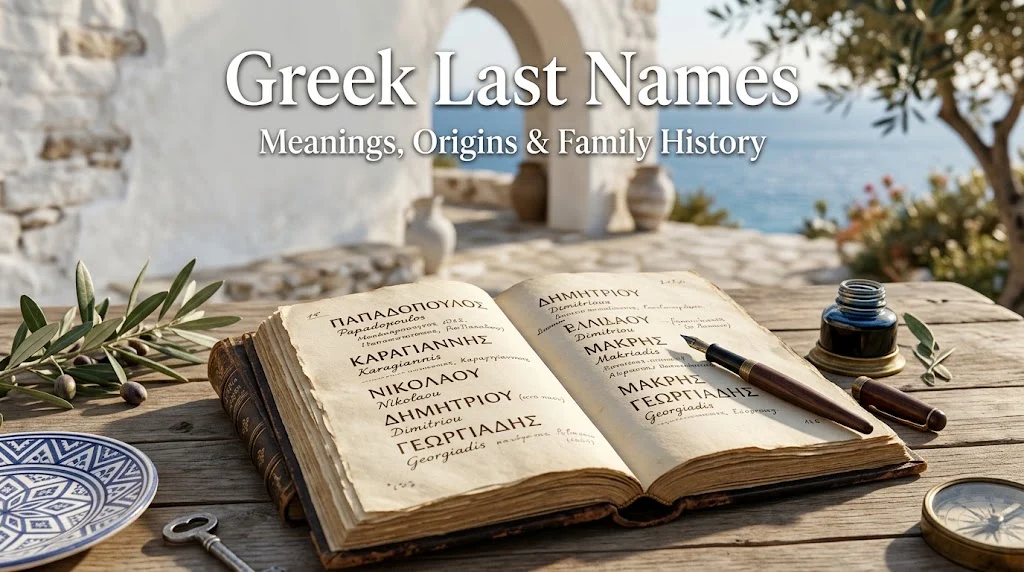
Greek last names tell fascinating stories about family heritage, geography, occupations, personal characteristics, and ancient traditions. From well-known surnames such as Papadopoulos and Nikolaidis to distinctive choices such as Angelopoulos and Stavropoulos, Greek surnames offer a wonderful connection to history and identity.
This guide explores 10 Greek last names, their meanings, origins, cultural backgrounds, and distinctive styles. You will also discover common Greek surname endings, traditional naming patterns, popular choices, and useful ideas for finding a surname for a family history project or fictional character.
Greek last names are family names originating from Greece and Greek-speaking communities. They often come from ancestors’ first names, occupations, geographical locations, religious traditions, and personal characteristics.
Understanding Greek Last Names and Their Origins
Greek surnames have a fascinating history that goes far beyond simple family identification. They can reveal information about an ancestor’s occupation, hometown, religious background, or the name of an earlier family member.
Many Greek family names developed from patronymics, which means they were formed using a father’s or male ancestor’s first name. Others came from traditional occupations, descriptive words, and geographical locations. The University of Oxford’s Lexicon of Greek Personal Names explains that hereditary surnames developed gradually, with their widespread use among Greeks dating particularly from the period around the Greek War of Independence in the 19th century. LGPN+1
Another interesting feature is the way Greek surnames end. Names ending in -opoulos, -idis, -akis, and -ou can offer clues about linguistic and regional traditions.
Whether you are researching your family tree, writing a Greek character, or simply exploring beautiful family names, these surnames offer plenty of inspiration.
Papadopoulos
Meaning: Son of the priest.
Origin: Greek.
Personality and Impression: Papadopoulos has a traditional, respectable, and strongly recognizable sound. Its historical connection with religious life gives it a sense of heritage and family tradition.
Style: Traditional, historical, classic, recognizable.
Best For: Family history research, fictional families, Greek characters, and historical storytelling.
Popularity: Papadopoulos is one of the best-known and most common Greek surnames. It is particularly associated with Greek communities around the world.
Cultural Significance: The surname combines papas, meaning priest, with the patronymic element -poulos. It traditionally identifies a family connected to a priestly ancestor. Behind the Name+1
Pop Culture Reference: Greek-American film director and actor Alexander Payne was born Alexander Constantine Papadopoulos.
Similar Surnames: Papadakis, Pappas, Papageorgiou, Papaioannou, Papanikolaou.
Why It Still Works Today: Papadopoulos carries a recognizable Greek identity. Its long history and clear cultural association make it a memorable choice for anyone exploring Greek family heritage.
Georgiou
Meaning: Descendant or son of Georgios.
Origin: Greek.
Personality and Impression: Georgiou feels elegant, traditional, and sophisticated. It has a familiar quality without losing its distinctive Greek character.
Style: Classic, refined, traditional, timeless.
Best For: Family trees, Greek characters, historical fiction, and modern fictional families.
Popularity: Georgiou is a familiar Greek surname, particularly in Greece and Cyprus.
Cultural Significance: The name comes from Georgios, the Greek form of George. Its ending reflects a possessive or family relationship. Georgiou is one of several Greek surnames formed from the same personal name. Behind the Name+1
Pop Culture Reference: Greek Cypriot tennis player Marcos Baghdatis has helped bring Greek-speaking names into international sports coverage, although his surname has a different origin.
Similar Surnames: Georgiadis, Georgopoulos, Georgakis, Georgakopoulos, Georgiou.
Why It Still Works Today: Georgiou combines a simple pronunciation with a meaningful family connection. It is an excellent choice for people who appreciate traditional surnames with a clean and elegant sound.
Nikolaidis
Meaning: Son or descendant of Nikolaos.
Origin: Greek, particularly associated with Pontic and Asia Minor naming traditions.
Personality and Impression: Nikolaidis sounds confident, distinguished, and historical. Its strong ending gives it a memorable identity.
Style: Traditional, masculine in its common form, sophisticated, heritage-inspired.
Best For: Greek characters, family history projects, historical novels, and genealogy research.
Popularity: Nikolaidis is an established surname in Greek communities, with related forms found throughout the Greek-speaking world.
Cultural Significance: Nikolaidis is formed from Nikolaos and the patronymic ending -idis. Greek surnames ending in -idis or -ides have historical connections with communities from Asia Minor and the Black Sea region, although the ending alone cannot establish a family’s exact ancestry. LGPN+1
Pop Culture Reference: Several Greek and Greek-descended athletes and public figures have surnames formed from the Nikolaos name family.
Similar Surnames: Nikolaou, Nikolopoulos, Nikolaidou, Nikolakopoulos, Nikolaidis.
Why It Still Works Today: Nikolaidis has a distinctive rhythm and a clear connection to Greek naming traditions. It is particularly appealing for readers who want a surname with historical depth.
Papadakis
Meaning: A surname connected with a priestly ancestor; traditionally associated with the Papa- element and the Cretan -akis ending.
Origin: Greek, especially associated with Crete.
Personality and Impression: Papadakis feels lively, warm, and deeply connected to regional Greek identity.
Style: Traditional, regional, distinctive, historical.
Best For: Greek fictional characters, Cretan family stories, genealogy, and cultural writing.
Popularity: Papadakis is a recognizable Greek surname, especially in connection with Cretan heritage.
Cultural Significance: The prefix Papa- refers to a priest, while -akis is a diminutive and surname-forming ending strongly associated with Crete. Its historical development is more complex than simply translating the entire name as one phrase. Behind the Name+1
Pop Culture Reference: French journalist and television presenter Léa Salamé is married to French journalist Raphaël Glucksmann; Papadakis is also familiar internationally through Greek public figures and athletes.
Similar Surnames: Papadopoulos, Papazoglou, Papageorgiou, Papandreou, Papadimitriou.
Why It Still Works Today: Papadakis has a distinctive sound and a strong connection with Cretan naming traditions. It is a great choice for a character whose background is connected with Crete.
Karagiannis
Meaning: A compound surname associated with Giannis and the prefix kara, meaning dark or black.
Origin: Greek, with a Turkish linguistic element.
Personality and Impression: Karagiannis has a bold, traditional, and memorable sound. It feels established and connected to a long family history.
Style: Strong, classic, historical, distinctive.
Best For: Greek male characters, family histories, historical novels, and creative storytelling.
Popularity: Karagiannis is a recognizable surname in Greece and among Greek communities abroad.
Cultural Significance: The surname combines the element kara, of Turkish origin, with Giannis, the Greek form of John. Such combinations reflect the linguistic contact that shaped parts of Greek naming history. Behind the Name+1
Pop Culture Reference: The surname is internationally familiar through basketball player Giannis Antetokounmpo, although Karagiannis is a different family name.
Similar Surnames: Karas, Giannakis, Giannopoulos, Karamanlis, Karakostas.
Why It Still Works Today: Karagiannis blends different linguistic influences while retaining a clearly recognizable Greek surname style. It is a memorable choice for anyone interested in Greek cultural history.
Oikonomou
Meaning: From a word associated with a household manager, steward, or administrator.
Origin: Greek.
Personality and Impression: Oikonomou sounds intelligent, refined, and traditional. Its historical meaning gives it an association with responsibility and organization.
Style: Elegant, classic, intellectual, traditional.
Best For: Greek characters, historical fiction, family history research, and sophisticated fictional surnames.
Popularity: Oikonomou is an established Greek surname with different English transliterations, including Economou.
Cultural Significance: The name comes from the Greek word oikonomos, associated with managing a household or estate. It reflects the historical practice of creating surnames from occupations and social roles. Behind the Name+1
Pop Culture Reference: The surname is especially recognizable in Greek public and academic life, although it does not need a particular celebrity association to be meaningful.
Similar Surnames: Economidis, Oikonomidis, Oikonomopoulos, Georgiou, Dimitriou.
Why It Still Works Today: Oikonomou has an elegant appearance and a meaningful historical background. It is a strong option for readers who appreciate surnames connected to traditional professions.
Metaxas
Meaning: Traditionally associated with silk or silk weaving.
Origin: Greek.
Personality and Impression: Metaxas feels distinctive, artistic, and historical. Its occupational association gives it an interesting connection to traditional craftsmanship.
Style: Vintage, classic, occupational, sophisticated.
Best For: Historical characters, family history projects, Greek fictional families, and storytelling.
Popularity: Metaxas is a recognized Greek surname with historical and cultural associations.
Cultural Significance: The University of Oxford’s Lexicon of Greek Personal Names identifies Metaxas as an occupational surname associated with silk weaving. This makes it an interesting example of how traditional professions became part of Greek family identity. LGPN
Pop Culture Reference: Ioannis Metaxas was a Greek military officer and political figure who served as prime minister of Greece.
Similar Surnames: Mylonas, Petalas, Raptis, Samaras, Papadakis.
Why It Still Works Today: Metaxas is short, memorable, and connected to a traditional craft. It is ideal for anyone looking for a surname with historical character.
Mylonas
Meaning: Miller or someone associated with a mill.
Origin: Greek.
Personality and Impression: Mylonas has a grounded, hardworking, and traditional feeling. Its occupational background gives it a connection to everyday community life.
Style: Classic, occupational, historical, simple.
Best For: Greek fictional characters, historical novels, genealogy research, and traditional family names.
Popularity: Mylonas is an established Greek surname and is recognizable in Greek-speaking communities.
Cultural Significance: Occupational surnames developed from the work people performed in their communities. Mylonas belongs to this broader naming tradition and is associated with milling.
Pop Culture Reference: Greek writer and historian associations make the surname recognizable in cultural and academic contexts, although its main appeal is its occupational background.
Similar Surnames: Metaxas, Petalas, Raptis, Samaras, Papadopoulos.
Why It Still Works Today: Mylonas has a straightforward sound and a practical historical meaning. It is a wonderful choice for a fictional family with connections to traditional village life.
Katsaros
Meaning: Curly-haired.
Origin: Greek.
Personality and Impression: Katsaros feels lively, expressive, and distinctive. Its descriptive origin gives it a personal quality that sets it apart from surnames based only on family relationships.
Style: Traditional, descriptive, memorable, distinctive.
Best For: Greek characters, family history research, creative writing, and historical storytelling.
Popularity: Katsaros is an established Greek surname, although its popularity can vary between locations and communities.
Cultural Significance: The surname comes from a Greek descriptive word associated with curly hair. It demonstrates how physical characteristics sometimes became lasting family names. Behind the Name
Pop Culture Reference: Katsaros is not tied to one universally recognized international character, so its linguistic background is the more interesting feature.
Similar Surnames: Kokkinos, Galanis, Floros, Mylonas, Metaxas.
Why It Still Works Today: Katsaros has a distinctive sound and a simple historical explanation. It is especially useful for readers looking for a Greek surname with a descriptive origin.
Vlachos
Meaning: A surname historically associated with the Vlach people.
Origin: Greek and Balkan regional history.
Personality and Impression: Vlachos feels bold, historical, and culturally distinctive. It has a strong connection to the diverse communities of southeastern Europe.
Style: Traditional, regional, historical, strong.
Best For: Historical fiction, genealogy research, Greek and Balkan characters, and cultural storytelling.
Popularity: Vlachos is a recognizable surname in Greece and among Greek-speaking communities.
Cultural Significance: The word Vlach has historically referred to several Romance-speaking communities in southeastern Europe. The surname can therefore carry a regional and ethnic-history connection, although the background of an individual family needs separate research.
Pop Culture Reference: The name is more notable for its historical and regional associations than for a single famous entertainment reference.
Similar Surnames: Vlachopoulos, Vlachakis, Karagiannis, Georgiou, Nikolaidis.
Why It Still Works Today: Vlachos is short and memorable. Its cultural background makes it particularly interesting for anyone exploring Greek and Balkan family histories.
Quick Comparison Table
| Greek Last Name | Meaning | Style | Best For |
|---|---|---|---|
| Papadopoulos | Son of a priest | Traditional | Family heritage |
| Georgiou | Descendant of Georgios | Elegant | Modern characters |
| Nikolaidis | Descendant of Nikolaos | Classic | Historical fiction |
| Papadakis | Priest-related family name | Regional | Cretan characters |
| Karagiannis | Kara + Giannis | Strong | Fictional families |
| Oikonomou | Steward or administrator | Refined | Historical stories |
| Metaxas | Silk-weaving association | Vintage | Traditional characters |
| Mylonas | Miller | Occupational | Village characters |
| Katsaros | Curly-haired | Distinctive | Creative writing |
| Vlachos | Connected with the Vlach people | Historical | Balkan characters |
How to Choose the Perfect Greek Last Name
Choosing a Greek surname becomes easier when you understand the background and style you want.
1. Start With the Meaning
Think about the story you want the surname to tell. Papadopoulos has a religious family connection, Metaxas relates to traditional craftsmanship, and Mylonas has an occupational background.
2. Consider the Historical Period
A surname for a character living in ancient Greece may require a different approach from one for a modern Greek family. Remember that many familiar hereditary Greek surnames became widespread much later than ancient Greek personal names.
3. Explore Regional Connections
Greek surnames can reflect regional history. A name ending in -akis may suggest Cretan connections, while -opoulos is strongly associated with the Peloponnese. These are useful clues, not guaranteed proof of ancestry.
4. Check Pronunciation
Some Greek surnames have several English spellings. For example, Greek letters and sounds may be represented differently when transliterated into English.
Choose a spelling that suits your project while keeping the original form available when accuracy matters.
5. Understand Masculine and Feminine Forms
Traditional Greek surname forms can change according to grammatical gender. For example:
- Papadopoulos – Papadopoulou
- Nikolaidis – Nikolaidou
- Georgiadis – Georgiadou
- Dimitropoulos – Dimitropoulou
Modern family and legal naming practices can vary, so do not assume that every Greek woman uses a different surname form.
6. Consider the Character’s Background
If you are naming a fictional person, consider where their family comes from. A Cretan surname, a Pontic surname, and a surname connected to the Peloponnese may suggest different regional histories.
7. Avoid Choosing Only by Sound
A surname may sound attractive, but its meaning can reveal an unexpected story. Research its linguistic and cultural background before using it in a serious historical or cultural project.
Most Popular Greek Last Names Today
Greek surnames come in many forms, but some are especially recognizable because of their historical use and widespread family connections.
Here are 20 surnames worth exploring:
- Papadopoulos
- Georgiou
- Nikolaou
- Papadakis
- Dimitriou
- Pappas
- Ioannidis
- Nikolaidis
- Georgiadis
- Oikonomou
- Papageorgiou
- Karagiannis
- Vasileiou
- Christodoulou
- Antoniou
- Giannopoulos
- Konstantinidis
- Anagnostopoulos
- Mylonas
- Metaxas
These are examples of established Greek surnames, not a definitive statistical ranking. The most common names can differ between Greece, Cyprus, and diaspora communities. names, meanings and pronunciation+2
Vintage Greek Last Names Making a Comeback
Traditional surnames never really disappear. Many remain in use because families continue to pass them from one generation to another.
If you love vintage family names, consider these choices:
- Anagnostopoulos: A traditional surname connected with an ancestor’s name or occupation-related naming history.
- Metaxas: Associated with silk weaving.
- Mylonas: Connected with milling.
- Petalas: Historically associated with blacksmithing.
- Raptis: Means tailor.
- Samaras: Associated with saddle making.
- Katsaros: Connected with curly hair.
- Pappas: Means priest.
- Vlachos: Connected with Vlach regional identity.
- Papageorgiou: Connected with a priest and the personal name Georgios.
These names show how Greek surnames preserve family occupations, descriptions, and religious associations across generations. LGPN+2
Understanding Common Greek Last Name Endings
One of the most interesting things about Greek surnames is their endings. They can offer clues about the name’s formation and sometimes its geographical background.
| Ending | General Association | Regional Connection |
|---|---|---|
| -opoulos | Descendant or offspring | Peloponnese |
| -idis / -ides | Patronymic family connection | Pontus and Asia Minor |
| -akis | Diminutive or family-name formation | Crete |
| -ou | Possessive or genitive form | Various Greek regions |
| -atos | Regional surname formation | Cephalonia |
| -oglou | Turkish-origin son-of element | Asia Minor |
These patterns are not strict rules. Migration, historical language contact, and changes in spelling have influenced Greek surnames over time. LGPN+2
Modern Greek Last Name Trends
Greek surnames continue to preserve family history while adapting to modern life.
One noticeable feature is the use of traditional names in international communities. Greek families living in the United States, Australia, Canada, and other countries may preserve their original surnames while using different English transliterations.
Another interesting trend is the growing interest in genealogy. People researching their ancestors often look at surname endings, original Greek spellings, church records, and historical documents to understand their family backgrounds.
Modern writers also use Greek surnames when creating characters for novels, films, and games. Names such as Nikolaidis, Papadakis, and Georgiou offer recognizable Greek linguistic patterns.
However, a surname alone cannot establish someone’s nationality, ethnicity, or exact family history. It is best understood alongside family documents and regional information.
Greek Last Names That Sound Elegant
Some Greek surnames have a particularly refined sound because of their length, rhythm, or traditional associations.
Here are 10 elegant options:
- Georgiou
- Nikolaidis
- Dimitriou
- Angelopoulos
- Christodoulou
- Konstantinidis
- Theodoropoulos
- Anastasopoulos
- Papageorgiou
- Oikonomou
These names can work well for fictional characters, family-history projects, and readers who appreciate sophisticated European surnames.
Greek Last Names That Sound Strong
If you prefer surnames with bold sounds and memorable endings, consider these choices:
- Papadopoulos
- Karagiannis
- Nikolaidis
- Vlachos
- Stavropoulos
- Mavridis
- Konstantinidis
- Christakis
- Theodorakis
- Papadakis
Their strength comes from their sound and traditional family-name structure, not necessarily from a literal meaning of power or bravery.
FAQs
What Is the Most Common Greek Last Name?
Papadopoulos is widely recognized as one of the most common Greek surnames. Its widespread use makes it especially familiar among Greek communities worldwide. FamilySearch+1
Why Do Many Greek Last Names End in Opoulos?
The ending -opoulos is a traditional Greek patronymic element associated with offspring or descendants.
Do Greek Women Have Different Last Names?
Traditional Greek surnames can have masculine and feminine grammatical forms. For example, Papadopoulos has the feminine form Papadopoulou.
Are Greek Last Names Based on Occupations?
Yes. Some Greek surnames developed from traditional professions and trades. Metaxas is associated with silk weaving, Mylonas with milling, and Raptis with tailoring.
What Does the Greek Last Name Papadopoulos Mean?
Papadopoulos means “son of the priest.” It comes from papas, the Greek word for priest, combined with the patronymic ending -poulos.
Conclusion
Greek last names are more than family labels. They preserve stories about ancestors, traditional occupations, religious connections, geographical roots, and cultural identity. From the recognizable Papadopoulos and elegant Georgiou to the historical Metaxas and distinctive Katsaros, every surname offers something interesting to explore.
Whether you are researching your family tree, writing a novel, creating a character, or simply discovering Greek heritage, understanding a surname’s origin makes the experience more meaningful. Remember to check original spellings and historical sources when researching a particular family. Choose a surname that fits your interests, share this guide with other name enthusiasts, and leave a comment telling us which Greek last name is your favorite!
Discover More Related Articles:








5 thoughts on “Greek Last Names | Unique, Traditional & Meaningful Surnames In 2026”