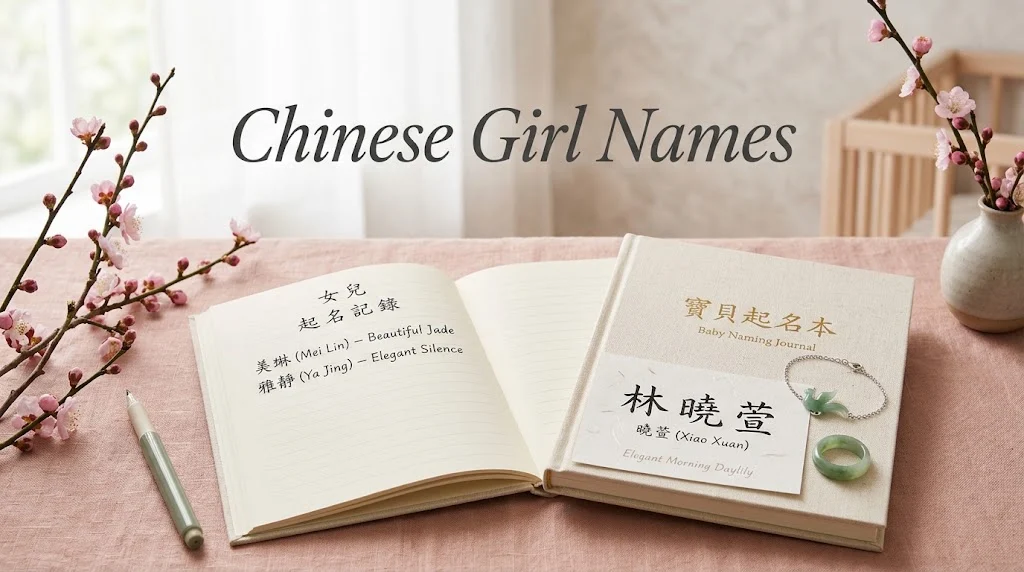
Chinese girl names often express beauty, wisdom, happiness, grace, and connections to nature. Names such as Meilin, Lihua, Xue, and Mingzhu offer distinctive possibilities, although their exact meanings depend on the Chinese characters used.
A beautiful name can carry a wish for happiness, a connection to family, or a reminder of something precious. Chinese girl names are especially interesting because their meanings can reflect nature, beauty, wisdom, kindness, and personal aspirations. From delicate flower-inspired names to elegant choices associated with the moon and precious stones, Chinese names offer many possibilities for parents seeking something meaningful.
One fascinating feature of Chinese naming is that a name’s meaning often depends on the characters used to write it. Two names may share the same pronunciation but have different meanings because they use different Chinese characters. This gives families many ways to express their hopes and values through a name.
Whether you are searching for a name for your baby girl, developing a character for a story, or exploring Chinese culture, there is plenty of inspiration to discover.
In this guide, you will find ten beautiful names, their cultural and linguistic background, their style, and ideas for choosing the right one. You will also discover additional name ideas, practical naming tips, and answers to common questions about Chinese names.
1. Meilin (美琳)
Meaning: Beautiful jade, when written with 美 (beautiful) and 琳 (fine jade).
Origin: Chinese.
Personality: Meilin has a graceful, gentle, and refined feeling. It may appeal to families who want a name associated with beauty and preciousness.
Style: Elegant, feminine, classic, and sophisticated.
Best For: Baby girls, fictional characters, and people looking for a Chinese-inspired name with a graceful sound.
Popularity: Meilin is recognizable as a Chinese-style given name, although popularity varies by region and generation.
Emotional Appeal: Jade has a long cultural association with beauty and value in Chinese art and traditions. Combining the idea of beauty with fine jade creates a name with an elegant image.
Pop Culture Reference: The spelling Meilin is used by Chinese characters in modern entertainment, although fictional characters may use different Chinese characters.
Similar Names: Meiyu, Meihua, Yilin, Xuelin.
Why It Still Works Today: Meilin combines a soft sound with an appealing meaning. It is also relatively easy for many English speakers to read and remember.
Note: This interpretation assumes the characters 美琳. Other characters can produce different meanings.
2. Lihua (丽华)
Meaning: Beautiful and splendid, when written with 丽 (beautiful) and 华 (splendor or magnificence).
Origin: Chinese.
Personality: Lihua feels elegant, composed, and traditional. It may suit someone who appreciates names with a graceful and dignified quality.
Style: Classic, feminine, traditional, and refined.
Best For: Baby girls, historical-fiction characters, and people interested in traditional Chinese names.
Popularity: Lihua is an established Chinese given-name form. Its popularity can vary considerably across generations and communities.
Emotional Appeal: The combination of beauty and splendor gives Lihua a positive, celebratory meaning.
Pop Culture Reference: Lihua appears in Chinese-language historical and fictional settings, but it should not be associated with one particular character without checking the spelling and context.
Similar Names: Liying, Lihong, Huaying, Meihua.
Why It Still Works Today: Lihua has a traditional character that can appeal to families interested in cultural heritage. Its meaning is positive without being overly complicated.
Note: The meaning above is based on 丽华. Different characters can change the interpretation.
3. Xiaomei (小美)
Meaning: Little beauty, when written with 小 (little) and 美 (beautiful).
Origin: Chinese.
Personality: Xiaomei feels friendly, cheerful, and affectionate.
Style: Cute, approachable, traditional, and playful.
Best For: Fictional characters, affectionate nicknames, and creative projects. It can also be a given name, depending on the family and naming context.
Popularity: Xiaomei is a recognizable Chinese name form. The character 小 is also frequently used in familiar forms of address.
Emotional Appeal: The combination of “little” and “beautiful” can sound warm and affectionate, making Xiaomei memorable.
Pop Culture Reference: Xiaomei appears in various Chinese-language stories and media. The name’s meaning depends on its written characters and context.
Similar Names: Xiaoyu, Xiaoling, Xiaohua, Meimei.
Why It Still Works Today: Xiaomei has a lively, accessible sound. It may be especially appealing to people who want a cute name for a fictional character or an affectionate nickname.
Note: Xiaomei is a possible name, but 小美 can also function as a familiar form of address rather than a formal given name.
4. Xue (雪)
Meaning: Snow.
Origin: Chinese.
Personality: Xue suggests calmness, delicacy, simplicity, and a connection to the natural world.
Style: Minimalist, poetic, elegant, and nature-inspired.
Best For: Baby girls, fictional characters, and people looking for a short Chinese name with a clear meaning.
Popularity: Xue is a familiar Chinese word and name element. Its use as a given name depends on individual and regional preferences.
Emotional Appeal: Snow can evoke peaceful landscapes, winter beauty, and a fresh beginning. These associations give Xue a quiet, poetic quality.
Pop Culture Reference: Xue is used in Chinese-language fiction and media, but the character 雪 should be verified when a specific reference is important.
Similar Names: Xueying, Xuehua, Xuelan, Bing.
Why It Still Works Today: Short names can feel distinctive and modern. Xue offers a clear natural meaning and a simple written form.
Pronunciation Note: In Mandarin, 雪 is pronounced xuě, with the third tone. The sound does not exactly match the English word “shoe.”
5. Mingzhu (明珠)
Meaning: Bright pearl or shining pearl.
Origin: Chinese.
Personality: Mingzhu feels thoughtful, precious, elegant, and confident.
Style: Classic, poetic, refined, and meaningful.
Best For: Baby girls, literary characters, and people who prefer names with imagery connected to precious objects.
Popularity: Mingzhu is an established Chinese name form, though its popularity varies by generation.
Emotional Appeal: Pearls often symbolize something precious and beautiful. The character 明 adds the idea of brightness or clarity, creating a memorable combination.
Pop Culture Reference: Mingzhu may appear as a personal name or name element in Chinese-language works. Specific character associations depend on the context.
Similar Names: Mingyue, Minghui, Zhenzhu, Yuzhu.
Why It Still Works Today: Mingzhu combines a meaningful image with a traditional Chinese character structure. It can appeal to families looking for a name with depth and elegance.
6. Yuting (雨婷)
Meaning: Rain and grace or elegance, when written with 雨 (rain) and 婷 (graceful).
Origin: Chinese.
Personality: Yuting feels gentle, composed, and expressive.
Style: Modern, feminine, soft, and elegant.
Best For: Baby girls, fictional characters, and people interested in contemporary Chinese-style names.
Popularity: Yuting is a familiar form of Chinese given name. Its popularity changes across regions and generations.
Emotional Appeal: Rain can suggest renewal and nourishment, while 婷 is associated with graceful appearance or manner. Together, these characters create a delicate image.
Pop Culture Reference: Yuting is used as a personal name in Chinese-language contexts. Its meaning should be connected to the actual characters rather than pronunciation alone.
Similar Names: Yuxin, Yuhan, Tingting, Yutong.
Why It Still Works Today: Yuting balances a natural image with a graceful meaning. It also has a contemporary sound that works well in modern settings.
Note: This interpretation assumes the characters 雨婷. Other spellings may have different meanings.
7. Jingyi (静怡)
Meaning: Quiet or peaceful, and joyful or harmonious, when written with 静 (quiet) and 怡 (pleasant or joyful).
Origin: Chinese.
Personality: Jingyi feels calm, kind, balanced, and thoughtful.
Style: Elegant, peaceful, modern, and understated.
Best For: Baby girls, literary characters, and people who appreciate names associated with harmony.
Popularity: Jingyi is a recognizable Chinese given-name form. Its frequency depends on the region and generation.
Emotional Appeal: The combination of calmness and happiness creates a reassuring meaning. It suggests a peaceful nature without implying that a person’s personality is fixed by their name.
Pop Culture Reference: Jingyi is used in Chinese-language media and personal naming. Specific references should be checked against the relevant Chinese characters.
Similar Names: Jingwen, Yijing, Yiran, Yixin.
Why It Still Works Today: Jingyi offers a balance between a traditional character structure and a modern sound. Its meaning is positive, thoughtful, and easy to explain.
8. Liling (丽玲)
Meaning: Beautiful and the clear, delicate sound of jade, when written with 丽 (beautiful) and 玲 (the clear sound of jade).
Origin: Chinese.
Personality: Liling has a bright, graceful, and friendly feeling.
Style: Feminine, traditional, melodic, and elegant.
Best For: Baby girls, fictional characters, and people who like names with a flowing sound.
Popularity: Liling is a recognizable Chinese name form, although its popularity varies across communities and generations.
Emotional Appeal: The characters combine beauty with an association with the delicate sound of jade. The result feels refined and expressive.
Pop Culture Reference: Liling is used in Chinese-language settings, but a specific character reference should be verified rather than assumed.
Similar Names: Lingling, Lihua, Yuling, Meiling.
Why It Still Works Today: Liling has a melodic quality and a traditional foundation. It may appeal to families looking for a name that feels graceful without being excessively long.
Note: The meaning given here assumes 丽玲. Different characters may create other interpretations.
9. Yuxin (雨欣)
Meaning: Rain and happiness or delight, when written with 雨 (rain) and 欣 (joyful or pleased).
Origin: Chinese.
Personality: Yuxin feels optimistic, gentle, creative, and warm.
Style: Modern, soft, natural, and cheerful.
Best For: Baby girls, fictional characters, and people who prefer names with a positive meaning.
Popularity: Yuxin is a recognizable contemporary Chinese-style given name. Exact popularity varies by region and period.
Emotional Appeal: Rain can symbolize renewal, while 欣 expresses happiness or delight. Together, the characters create an uplifting image.
Pop Culture Reference: Yuxin may be used by people and characters in Chinese-language contexts. Its meaning depends on the characters selected.
Similar Names: Yuting, Yuhan, Xinyu, Yixin.
Why It Still Works Today: Yuxin has a modern sound and combines nature with a positive emotion. It is an appealing option for families who want a meaningful contemporary name.
Note: This meaning assumes the characters 雨欣. Other written forms may have different meanings.
10. Zihan (子涵)
Meaning: A name with associations that depend on its characters; 子 can mean child or son and appears in many names, while 涵 can mean to contain, encompass, or hold depth.
Origin: Chinese.
Personality: Zihan feels thoughtful, balanced, and modern.
Style: Contemporary, elegant, versatile, and understated.
Best For: Baby girls, gender-flexible character naming, and people looking for a modern Chinese name.
Popularity: Zihan is used in contemporary Chinese naming and can be given to children of different genders, depending on family preference.
Emotional Appeal: The character 涵 can evoke depth and breadth, making the name appealing to families who value learning, thoughtfulness, and inner qualities.
Pop Culture Reference: Zihan is used as a personal name in Chinese-language contexts. Specific references should be checked against the original characters.
Similar Names: Zixuan, Zihan, Yihan, Ziyu.
Why It Still Works Today: Zihan has a contemporary sound and a flexible feel. It also illustrates an important feature of Chinese names: a name’s written characters, rather than pronunciation alone, shape its meaning.
Quick Comparison Table
| Name | Meaning | Style | Best For |
|---|---|---|---|
| Meilin (美琳) | Beautiful jade | Elegant, classic | Baby girls |
| Lihua (丽华) | Beautiful and splendid | Traditional, refined | Babies, characters |
| Xiaomei (小美) | Little beauty | Cute, playful | Nicknames, characters |
| Xue (雪) | Snow | Minimalist, poetic | Babies, characters |
| Mingzhu (明珠) | Bright pearl | Classic, meaningful | Baby girls |
| Yuting (雨婷) | Rain and grace | Soft, modern | Baby girls |
| Jingyi (静怡) | Peace and joy | Calm, elegant | Baby girls |
| Liling (丽玲) | Beauty and the sound of jade | Melodic, traditional | Baby girls |
| Yuxin (雨欣) | Rain and happiness | Modern, cheerful | Baby girls |
| Zihan (子涵) | Meaning depends on characters | Contemporary, versatile | Babies, characters |
More Beautiful Chinese Girl Names
If you would like additional ideas beyond the ten featured names, the following options offer a range of styles and meanings. These interpretations are based on the specific characters shown; other character combinations may produce different meanings.
| Chinese Name | Characters | Meaning |
|---|---|---|
| Meihua | 梅花 | Plum blossom |
| Xiaoyu | 小雨 | Light rain |
| Mingyue | 明月 | Bright moon |
| Xuehua | 雪花 | Snowflake |
| Yuxuan | 雨萱 | Rain and daylily |
| Yilin | 依琳 | Meaning depends on character interpretation |
| Shanshan | 珊珊 | Often associated with graceful movement or coral-related imagery |
| Huixin | 慧心 | Wise heart or intelligent mind |
| Yating | 雅婷 | Elegant and graceful |
| Qinglan | 青岚 | Blue-green mountain mist |
| Anran | 安然 | Peaceful and safe |
| Xinyi | 欣怡 | Joyful and content |
| Ruoxi | 若曦 | A poetic combination associated with dawn or sunlight, depending on interpretation |
| Lingyu | 灵玉 | Spiritual or delicate jade |
| Yumei | 玉梅 | Jade and plum blossom |
| Huilan | 惠兰 | Kindness and orchid, depending on the characters |
| Xiaolan | 小兰 | Little orchid |
| Zhenzhu | 珍珠 | Pearl |
| Yuhan | 雨涵 | Rain and depth or breadth |
| Mengyao | 梦瑶 | Dream and precious jade |
How to Choose the Perfect Chinese Girl Name
Choosing a Chinese name can be an enjoyable way to explore language, meaning, and family identity. These tips can help you make a thoughtful choice.
Start with the meaning. Decide which ideas matter most to you. You might prefer beauty, wisdom, kindness, happiness, nature, or strength. A clear preference will make it easier to narrow your options.
Check the Chinese characters. Do not choose a name based on its English spelling alone. Many Chinese names share the same pronunciation but use different characters. Those characters can change the meaning completely.
Learn the Mandarin pronunciation. Pinyin helps readers understand how Mandarin sounds are represented using the Latin alphabet. However, Mandarin tones matter, and some sounds do not match their closest English equivalents.
Consider the full name. In many Chinese naming traditions, the family name comes before the given name. Check how the proposed given name works with the family name and whether the full combination sounds natural.
Think about cultural context. If you have Chinese heritage, family preferences and regional traditions may help guide your choice. If you do not have that background, take time to learn about the name’s usage and cultural significance.
Look for a timeless meaning. Trends change, but qualities such as kindness, wisdom, and happiness remain meaningful to many families.
Verify the characters with a reliable speaker or source. A native Mandarin speaker or a knowledgeable Chinese-language resource can help confirm pronunciation, written form, and whether a proposed combination sounds natural.
Popular Chinese Girl Name Styles
Chinese girl names can be grouped into several broad styles. These categories are useful for exploring options, although individual preferences and regional patterns vary.
Nature-inspired names: These names draw on flowers, rain, snow, the moon, jade, and other natural images. Examples include Meihua (梅花), Xue (雪), and Mingyue (明月).
Elegant names: These names often use characters associated with grace, beauty, refinement, or wisdom. Meilin (美琳) and Yating (雅婷) are examples of this style.
Names expressing happiness: Families may choose characters associated with joy, contentment, or good fortune. Xinyi (欣怡) and Yuxin (雨欣) illustrate this approach.
Traditional names: Some names have been used across generations and carry a classic feel. Their popularity can change over time, so it is worth checking current naming data when popularity matters.
Modern names: Contemporary Chinese names may combine familiar characters in fresh ways. Zihan (子涵) and Yuting (雨婷) illustrate modern-style combinations.
Vintage Chinese Girl Names Making a Comeback
Vintage naming styles can be appealing because they connect a child with earlier generations, family memories, and established cultural traditions.
Names such as Lihua (丽华), Liling (丽玲), and Meihua (梅花) have a classic feel. Their appeal may depend on the age group, region, and community in which they are used.
If you like vintage names, consider asking relatives about names used by older family members. A name with a real family connection may feel more meaningful than one chosen solely because it sounds old-fashioned.
You can also explore traditional literature and historical records for inspiration. Always verify the characters and historical context before assuming that a name has a particular origin or social association.
Modern Chinese Girl Name Trends
Modern Chinese naming reflects a mix of family preferences, language, cultural heritage, and changing tastes.
Meaningful characters remain important. Parents may choose characters that express happiness, wisdom, beauty, or other positive qualities.
Nature continues to inspire names. Flowers, rain, the moon, snow, and precious materials offer vivid images that can be expressed through Chinese characters.
Shorter names can be appealing. Names with one or two given-name characters can be concise and easy to remember, although naming preferences differ among families.
Gender flexibility is possible. Some names are used for children of different genders. The impression created by a name depends on its characters, regional conventions, and individual preferences.
Pronunciation matters internationally. Families living in multilingual communities may consider how a name works in Mandarin, another Chinese language, and the languages spoken where they live.
There is no single naming style that represents every Chinese family. The best choice balances personal preference, accurate meaning, and cultural understanding.
FAQs
What Are the Most Beautiful Chinese Girl Names?
Beauty is subjective, but names such as Meilin (美琳), Mingzhu (明珠), Yuting (雨婷), and Jingyi (静怡) have appealing meanings. They are associated with ideas such as jade, pearls, grace, peace, and happiness.
What Chinese Girl Names Mean Beautiful?
The character 美 means beautiful and appears in names such as Meilin (美琳) and Xiaomei (小美). Other characters may express elegance or grace.
What Are Some Cute Chinese Girl Names?
Xiaomei (小美), Xiaoyu (小雨), and Meimei (妹妹, often meaning younger sister) can have cute or affectionate associations.
What Chinese Girl Names Are Inspired by Nature?
Nature-inspired options include Xue (雪), meaning snow; Meihua (梅花), meaning plum blossom; Mingyue (明月), meaning bright moon; and Xiaoyu (小雨), meaning light rain.
Are Chinese Girl Names Written With One or Two Characters?
Chinese given names commonly contain one or two characters, although naming conventions and individual cases vary.
Conclusion
Choosing from the many Chinese girl names available can be a wonderful opportunity to explore meaningful words, cultural traditions, and beautiful imagery. Names such as Meilin, Mingzhu, Xue, and Jingyi offer different styles, from elegant and traditional to simple and nature-inspired.
The most important step is to look beyond the romanized spelling. Chinese characters shape a name’s meaning, and the same pronunciation can represent different ideas. Take time to check the characters, pronunciation, cultural background, and suitability of your favorite choice.
Whether you prefer a name connected to flowers, pearls, snow, happiness, or wisdom, the right name should feel meaningful to you. Choose your favorite, share this guide with someone searching for name inspiration, and leave a comment telling us which Chinese girl name you love most.
Discover More Related Articles:









5 thoughts on “Chinese Girl Names | Beautiful Names With Meanings In 2026”