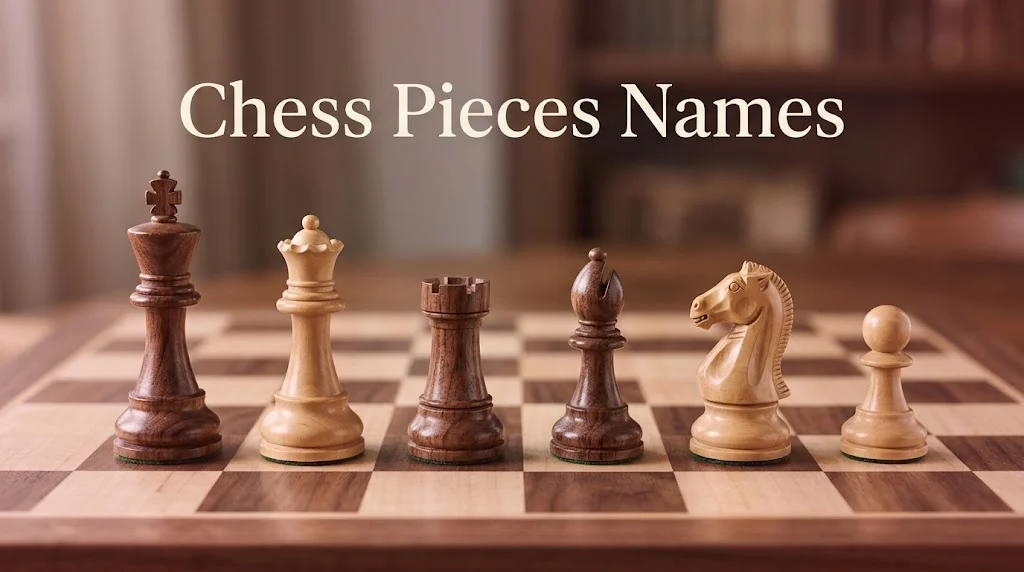
The six chess pieces are the king, queen, rook, bishop, knight, and pawn. Each has different movement rules and strategic roles. Every player starts with 16 pieces: one king, one queen, two rooks, two bishops, two knights, and eight pawns.
Learning chess starts with understanding the pieces. Before you can plan a clever move, protect your king, or capture an opponent’s piece, you need to know what each piece is called and how it moves.
The six chess pieces names are king, queen, rook, bishop, knight, and pawn. Each piece has a unique purpose. The king is the most important piece, the queen has the greatest range of movement, and the smaller pieces help control the board and create opportunities.
If you are new to chess, these names might seem confusing at first. However, once you learn the basic movements and roles, the game becomes much easier to follow.
This guide explains every chess piece in simple language. You will discover its movement, standard point value, starting position, special abilities, and strategic importance. We will also explore how the pieces work together, answer common questions, and share practical tips to help you recognize them quickly.
Whether you are learning chess at school, teaching a child, or returning to the game after years away, this guide will help you understand the pieces with confidence.
King: The Most Important Chess Piece
Meaning: The king represents the central royal figure in chess.
Origin: The king is one of the oldest and most important figures in the history of chess. The modern game developed from earlier chess-like games played in Asia and later spread through Persia and Europe.
Personality: The king represents importance, responsibility, and survival. It may move only one square at a time, but protecting it determines the outcome of the game.
Style: Essential, strategic, defensive, royal.
Best For: Players learning chess rules, understanding checkmate, and developing defensive strategies.
Movement: The king moves one square in any direction: horizontally, vertically, or diagonally. It cannot move onto a square occupied by one of its own pieces or onto a square where an opponent could capture it.
Value: The king has no ordinary point value because losing it through checkmate ends the game. In practical terms, protecting the king is more important than preserving any other piece.
Popularity: The king is a permanent symbol of chess and is essential in every standard game.
Special Ability: The king can participate in a special move called castling, provided all the required conditions are met.
Similar Pieces: Queen, rook, bishop, knight, and pawn.
Why It Still Matters Today: Every chess strategy revolves around the king’s safety. A player may have more pieces than an opponent but still lose if the king is checkmated. Learning when to protect the king, move it to safety, and use it actively in the endgame is a fundamental chess skill.
Queen: The Most Powerful Chess Piece
Meaning: The queen represents the most mobile and versatile piece on the board.
Origin: The queen became the powerful piece familiar to modern players during the development of European chess. Earlier versions of chess used a more limited piece in this position.
Personality: The queen represents flexibility, power, and opportunity. It can attack from long distances and support several areas of the board.
Style: Powerful, versatile, aggressive, strategic.
Best For: Attacking, defending, controlling open lines, and creating checkmate threats.
Movement: The queen can move any number of squares horizontally, vertically, or diagonally, provided its path is clear. It cannot jump over other pieces.
Value: The queen is commonly valued at approximately nine points in beginner chess guides. This is a guideline rather than an official rule.
Popularity: The queen is one of the most recognizable chess pieces because of its movement range and strategic importance.
Special Ability: The queen has no separate special move, but its combination of rook-like and bishop-like movement makes it extremely flexible.
Similar Pieces: Rook and bishop, whose movement patterns together resemble the queen’s.
Why It Still Matters Today: The queen can create powerful attacks, protect important squares, and support checkmate combinations. However, moving it too early without a clear plan can expose it to attacks. Strong players balance its attacking power with careful protection.
Rook: The Straight-Line Chess Piece
Meaning: The rook represents a powerful piece that controls ranks and files.
Origin: The rook developed from an older chess piece associated with a chariot in the game’s historical ancestors. Its modern name and design reflect changes that occurred as chess spread between cultures.
Personality: The rook represents strength, reliability, and direct action. Its movement is simple, but it can become very powerful when the board opens up.
Style: Strong, direct, defensive, strategic.
Best For: Controlling open files, protecting the king, supporting pawns, and attacking along ranks and files.
Movement: The rook moves any number of unobstructed squares horizontally or vertically. It cannot move diagonally or jump over another piece.
Value: A rook is commonly valued at approximately five points.
Popularity: The rook is a standard piece in every chess set and plays an important role throughout the game.
Special Ability: The rook participates in castling with the king. During castling, the king and rook move as part of the same special move, subject to specific rules.
Similar Pieces: Queen and bishop. The queen shares the rook’s straight-line movement, while the bishop moves diagonally.
Why It Still Matters Today: Rooks become especially effective when files are open and fewer pieces block their movement. They are often important in endgames, when they can support passed pawns and restrict the opposing king.
Bishop: The Diagonal Chess Piece
Meaning: The bishop is a long-range piece that moves diagonally.
Origin: The bishop’s historical predecessor had different names and forms in earlier versions of chess. The familiar bishop design became established in European chess.
Personality: The bishop represents patience, precision, and long-range planning. Its strength often comes from controlling diagonal paths across the board.
Style: Strategic, precise, defensive, long-range.
Best For: Controlling diagonals, supporting attacks, protecting important squares, and coordinating with other pieces.
Movement: A bishop moves any number of unobstructed squares diagonally. It cannot move horizontally, vertically, or jump over pieces.
Value: A bishop is commonly valued at approximately three points, although its practical strength depends on the position.
Popularity: Bishops are essential pieces in every standard chess game. Each player begins with two bishops.
Special Ability: A bishop remains on the same color squares throughout the game. One bishop travels only on light squares, while the other travels only on dark squares.
Similar Pieces: Queen and rook. The queen can also move diagonally, while the rook cannot.
Why It Still Matters Today: Bishops can become extremely effective when long diagonals are open. They often work well in pairs because the two bishops can control both light and dark squares. Their effectiveness depends on pawn structure and the amount of open space available.
Knight: The L-Shaped Chess Piece
Meaning: The knight represents a mounted warrior and is usually shaped like a horse’s head.
Origin: The knight developed from the horse-mounted piece found in earlier forms of chess. Its familiar movement has remained a distinctive feature of the game.
Personality: The knight represents creativity, surprise, and unusual angles of attack. It can reach squares that other pieces cannot access in the same way.
Style: Tactical, unpredictable, flexible, creative.
Best For: Forks, attacks from unexpected angles, defending central squares, and maneuvering around blocked positions.
Movement: The knight moves in an L shape: two squares horizontally and one vertically, or two vertically and one horizontally. It is the only standard chess piece that can jump over other pieces.
Value: A knight is commonly valued at approximately three points. Its practical strength depends on the position.
Popularity: The knight is one of the most distinctive chess pieces because of its unique movement.
Special Ability: Its ability to jump over pieces makes the knight particularly useful in crowded positions.
Similar Pieces: Bishop and queen, although neither shares the knight’s jumping ability.
Why It Still Matters Today: Knights can attack several targets at once and create forks, where one move threatens two or more enemy pieces. They are often strong in closed positions because pawns and other pieces can limit the movement of long-range pieces while knights can jump over them.
Pawn: The Smallest Chess Piece
Meaning: The pawn is the basic foot-soldier piece in chess.
Origin: Pawns have existed since early forms of chess. Their role has changed over time, but they remain the foundation of many chess strategies.
Personality: The pawn represents persistence, teamwork, and gradual progress. It may have limited movement, but its position can shape the entire game.
Style: Fundamental, defensive, strategic, adaptable.
Best For: Controlling squares, protecting other pieces, creating pawn chains, opening lines, and promoting to a stronger piece.
Movement: A pawn usually moves one square forward into an empty square. On its first move, it may move one or two squares forward if both squares are clear. It captures one square diagonally forward.
Value: A pawn is commonly valued at approximately one point.
Popularity: Pawns are the most numerous pieces on the board. Each player starts with eight.
Special Ability: A pawn can promote when it reaches the farthest rank. It is usually promoted to a queen, but it may also become a rook, bishop, or knight. Pawns can also capture en passant in specific circumstances.
Similar Pieces: No other piece moves exactly like a pawn. Its combination of forward movement and diagonal captures makes it unique.
Why It Still Matters Today: Pawns shape the structure of a chess position. They control important squares, protect pieces, and can create passed pawns that become dangerous near promotion. Even though a pawn has a low standard point value, its position can decide the game.
Quick Comparison Table
| Chess Piece | Standard Value | Movement | Main Role |
|---|---|---|---|
| King | No ordinary point value | One square in any direction | Avoid checkmate |
| Queen | 9 points | Any distance horizontally, vertically, or diagonally | Attack and defend |
| Rook | 5 points | Any distance horizontally or vertically | Control ranks and files |
| Bishop | 3 points | Any distance diagonally | Control diagonals |
| Knight | 3 points | L shape; can jump over pieces | Tactics and forks |
| Pawn | 1 point | Forward movement; diagonal captures | Control squares and promote |
Note: These point values are common beginner guidelines, not official chess rules. A piece’s practical value depends on the position.
How to Choose the Right Chess Piece for a Move
Chess is not about choosing one favorite piece and using it for every attack. Each piece has strengths and weaknesses, and the best move depends on the position.
Look at the king’s safety. Before attacking, check whether your own king is protected. A powerful attack is rarely worth ignoring a serious threat to your king.
Use the queen carefully. The queen can reach many squares, but bringing it out too early can expose it to attacks from smaller pieces.
Find open lines for rooks. Rooks become more effective when their paths are clear. Look for open files where they can attack or support a pawn.
Place bishops on useful diagonals. Bishops need open diagonals to reach their full potential. Consider how your pawns affect their movement.
Look for knight forks. Knights can threaten more than one target at once. Check whether a knight move creates a double attack.
Protect your pawns. Pawns may be the smallest pieces, but losing too many can weaken your position. Keep their structure in mind as you plan.
Coordinate your pieces. A queen supported by a rook or a knight protected by a pawn can be more effective than a piece acting alone.
Most Important Chess Pieces for Beginners
Every piece matters, but beginners often benefit from learning their roles in this order:
- King: Learn how check, checkmate, and king safety work.
- Queen: Understand its wide range of movement and how to avoid losing it unnecessarily.
- Rook: Practice moving along open ranks and files.
- Bishop: Learn to spot diagonal attacks.
- Knight: Practice the L-shaped movement and jumping over pieces.
- Pawn: Understand forward movement, captures, promotion, and en passant.
This is a learning order, not a ranking of importance. The king determines whether you win or lose, while the queen, rooks, bishops, knights, and pawns work together to create opportunities.
Vintage Chess Pieces and Their Historical Names
Chess has a long history, and some pieces have changed names or appearances as the game spread between regions.
King: The king has remained a central figure across many forms of chess.
Queen: The queen developed into the powerful modern piece over the course of European chess history.
Rook: The rook has historical connections to a chariot-like piece in earlier chess traditions.
Bishop: The bishop’s predecessor had different names and forms in older versions of the game.
Knight: The knight represents the horse-mounted piece and has retained its distinctive movement.
Pawn: The pawn represents the basic foot-soldier unit and has been part of chess since its early development.
Chess pieces may look different in traditional, themed, luxury, or collectible sets. However, their official movements remain the same in standard chess, regardless of the design.
Modern Chess Piece Trends
Modern chess sets come in many designs. Some follow the classic Staunton style, while others use minimalist shapes, artistic carvings, themed characters, or digital representations.
Classic Staunton sets: These are widely used in competitive chess because their shapes make the pieces easy to recognize.
Magnetic travel sets: These help keep pieces in place during travel and are popular for casual games.
Themed chess sets: Some feature historical figures, fantasy characters, or decorative designs. They can be attractive collectibles, but beginners should ensure that the pieces are easy to distinguish.
Digital chess pieces: Online chess platforms use simplified icons or traditional piece symbols. Learning the standard names makes it easier to understand these interfaces.
Educational chess sets: Some sets include movement guides or color-coded pieces to help children and beginners learn the rules.
Although chess piece designs continue to evolve, the six standard piece types and their movement rules remain consistent.
Chess Pieces Names and Their Symbols
Chess notation uses specific letters to identify most pieces. These letters help players record moves and study games.
| Chess Piece | English Name | Standard Notation Letter |
|---|---|---|
| King | King | K |
| Queen | Queen | Q |
| Rook | Rook | R |
| Bishop | Bishop | B |
| Knight | Knight | N |
| Pawn | Pawn | No letter |
The knight uses N because the letter K is already used for the king. Pawns have no letter in standard algebraic chess notation; their moves are recorded using the destination square, with additional notation for captures and special moves.
For example, Nf3 means a knight moves to the square f3, while Qd5 means a queen moves to d5.
Chess notation allows players to record games, study famous matches, and communicate moves without needing to describe every piece’s appearance.
FAQs
What are the names of all six chess pieces?
The six chess pieces are the king, queen, rook, bishop, knight, and pawn. Each player starts with one king, one queen, two rooks, two bishops, two knights, and eight pawns, for a total of 16 pieces.
How many chess pieces are there in total?
A standard chess game begins with 32 pieces on the board: 16 white pieces and 16 black pieces.
Which chess piece is the most powerful?
The queen is generally considered the most powerful chess piece because it can move any distance horizontally, vertically, or diagonally along clear paths.
Which chess piece is worth the most points?
The queen is commonly assigned a value of about nine points, making it the highest-valued ordinary piece in beginner guides.
Which chess piece is the weakest?
The pawn is usually considered the least powerful piece because it has limited movement and is commonly valued at one point.
Conclusion
Learning the chess pieces names is the first step toward understanding how chess works. The king, queen, rook, bishop, knight, and pawn each have unique movement rules and strategic purposes. Once you understand these differences, you can begin planning attacks, protecting important squares, and recognizing opportunities.
Remember that the queen is the most powerful piece by standard movement, but the king is the most important. Rooks control straight lines, bishops dominate diagonals, knights create surprising attacks, and pawns help shape the board.
You do not need to master every strategy at once. Start by learning each piece’s movement, then practice simple games to see how the pieces work together.
If this guide helped you learn the names and roles of chess pieces, share it with a friend who is learning chess. Leave a comment with your favorite piece and why you enjoy using it!
Discover More Related Articles:
- Orange Cat Names | Cute, Funny & Unique Ideas In 2026
- Popular Girl Names | Beautiful Ideas With Meanings In 2026