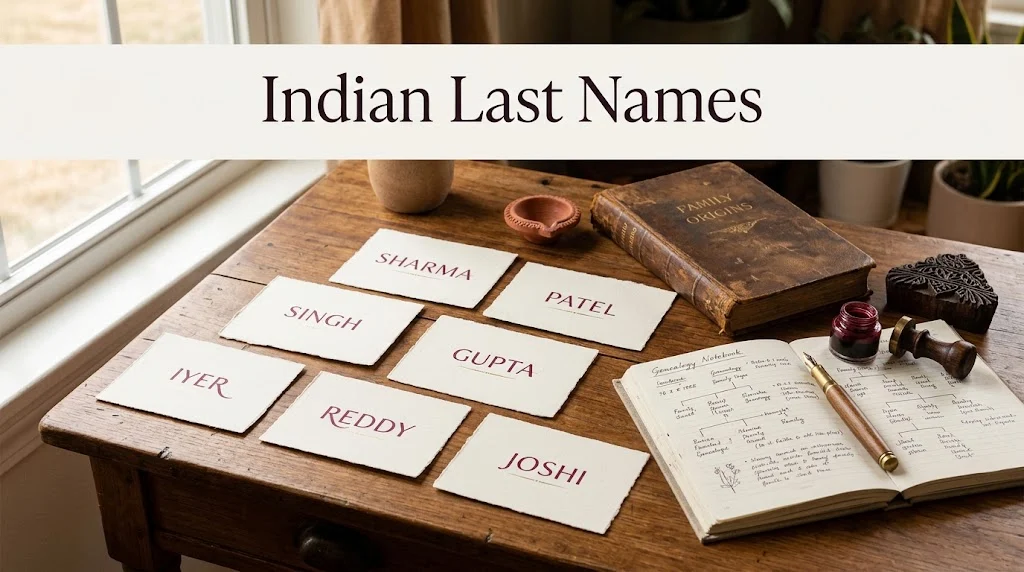
Indian last names are family names used across India’s many linguistic and cultural communities. Examples include Sharma, Patel, Singh, Gupta, Iyer, Reddy, Nair, Das, Kapoor, and Chatterjee.
Their origins may reflect regional traditions, occupations, ancestral connections, or historical naming practices.
A last name can tell an interesting story about a family’s history, language, and cultural roots. In India, surnames are especially diverse because the country is home to many languages, religions, regional communities, and naming traditions. Some family names are connected to traditional occupations, while others have historical, geographical, religious, or community-based origins.
Indian last names can also differ significantly from one region to another. A surname commonly associated with northern India may be less familiar in the south, where different languages and naming customs influence how families identify themselves. Some communities use hereditary surnames, while others use a father’s name, a village name, an initial, or another family identifier.
Learning about Indian surnames offers a fascinating way to explore the country’s cultural diversity. Names such as Sharma, Patel, Singh, Gupta, Iyer, and Reddy are familiar examples, but each has its own historical context and regional associations.
In this guide, we explore ten Indian surnames, their possible origins, cultural connections, and continued use today. We will also look at naming traditions, modern trends, and how to research a surname without making assumptions about someone’s identity.
Sharma
Meaning: Traditionally associated with Sanskrit-derived ideas of comfort, happiness, or protection.
Origin: Sanskrit; widely used in several parts of India, especially northern India.
Personality and Cultural Associations: Sharma is a well-established Indian surname with a long history of use. Its traditional Sanskrit associations give it a connection to India’s classical linguistic heritage. However, a surname does not determine an individual’s personality or beliefs.
Style: Traditional, recognizable, established, culturally rooted.
Best For: Family-history research, fictional characters, genealogy projects, and people exploring Indian surname origins.
Popularity: Sharma is among the widely recognized Indian surnames. Its distribution varies by state, community, and family history.
Emotional Appeal: For many families, a surname represents continuity between generations. Sharma can serve as a link to family traditions and regional heritage.
Cultural Reference: The surname appears across Indian public life, including education, literature, entertainment, politics, and sports.
Similar Surnames: Verma, Mishra, Tiwari, Tripathi, Joshi.
Why It Still Works Today: Sharma remains familiar across India and among Indian communities abroad. Its established history makes it useful for genealogical research, cultural writing, and understanding the variety of Indian family names.
Patel
Meaning: Historically associated with a village headman or local landholder in certain Gujarati contexts.
Origin: Gujarat, western India, with wider use among Indian communities.
Personality and Cultural Associations: Patel is often discussed in connection with Gujarati social and economic history. Its historical associations relate to local administration and landholding in particular contexts, although the surname is now used by people with different family histories.
Style: Traditional, regional, recognizable, established.
Best For: Family-history research, learning about Gujarati heritage, and creating culturally grounded fictional characters.
Popularity: Patel is a widely recognized Indian surname, particularly associated with Gujarat. It is also common among the Gujarati diaspora in countries such as the United Kingdom, the United States, and Canada.
Emotional Appeal: Surnames can connect families to places, ancestors, and shared memories. Patel may hold particular importance for people tracing their Gujarati roots.
Cultural Reference: The surname is well known internationally through business, public service, sports, and entertainment.
Similar Surnames: Shah, Desai, Mehta, Modi, Joshi.
Why It Still Works Today: Patel is short, easy to recognize, and strongly associated with Gujarati heritage. Its widespread use also demonstrates how a surname can become familiar across national borders while retaining regional connections.
Singh
Meaning: Lion.
Origin: Sanskrit-derived; widely used among Sikhs and also found among many Hindu and other communities across India and neighboring regions.
Personality and Cultural Associations: Singh has a strong historical and cultural presence. In Sikh tradition, Singh is an important name adopted by initiated Sikh men as part of the Khalsa identity established by Guru Gobind Singh in 1699. It is also used outside Sikh communities, so its meaning and significance depend on the individual and family context.
Style: Strong, traditional, historical, widely recognized.
Best For: Cultural research, genealogy, historical writing, and understanding South Asian naming practices.
Popularity: Singh is one of the most recognizable surnames and name elements across India and the wider South Asian region.
Emotional Appeal: The lion symbolism can evoke courage and strength. For many Sikh families, the name also carries deep religious and historical significance.
Cultural Reference: Singh appears in Sikh history, Indian public life, literature, cinema, and sports.
Similar Surnames: Kaur, Gill, Sandhu, Dhillon, Grewal.
Why It Still Works Today: Singh remains meaningful across generations. Its historical associations, religious importance in Sikhism, and widespread use make it an important surname to understand when exploring Indian names.
Gupta
Meaning: Commonly connected to the Sanskrit root gupta, meaning protected, guarded, or concealed.
Origin: Sanskrit; historically associated with several communities in northern and central India.
Personality and Cultural Associations: Gupta has a long-standing presence in Indian naming traditions. The surname is also associated with the ancient Gupta dynasty, which ruled large parts of the Indian subcontinent during a period often remembered for achievements in art, literature, mathematics, and science. However, sharing the surname does not establish descent from that dynasty.
Style: Classic, traditional, established, historically rich.
Best For: Genealogy, historical research, fictional character naming, and exploring Indian family names.
Popularity: Gupta is a widely used surname, particularly in northern and central India.
Emotional Appeal: The connection to protection and the surname’s long history can make Gupta interesting to people researching family heritage.
Cultural Reference: The Gupta dynasty is an important subject in Indian history, although the modern surname has many independent family histories.
Similar Surnames: Agarwal, Bansal, Goyal, Mittal, Singhal.
Why It Still Works Today: Gupta is familiar across India and among overseas Indian communities. It combines a recognizable sound with linguistic and historical connections that make it a useful subject for cultural research.
Iyer
Meaning: A title and surname associated with Tamil Brahmin communities; it should not be reduced to one universal literal translation.
Origin: Tamil Nadu and other parts of southern India.
Personality and Cultural Associations: Iyer is closely associated with Tamil cultural and religious history. The name is connected with particular Tamil Brahmin communities, but individuals with this surname have varied occupations, beliefs, and lifestyles.
Style: Traditional, regional, concise, culturally distinctive.
Best For: Researching Tamil surnames, exploring South Indian genealogy, and developing culturally informed fictional characters.
Popularity: Iyer is a recognizable surname among Tamil communities, including families living outside India.
Emotional Appeal: For many people, family names preserve connections to language, ancestry, and the places where earlier generations lived.
Cultural Reference: Iyer appears in Tamil literature, music, public life, education, and other areas of Indian culture.
Similar Surnames: Iyengar, Pillai, Nair, Menon, Subramanian.
Why It Still Works Today: Iyer remains an important example of regional surname diversity in India. It illustrates why Indian family names should be understood through their linguistic and community contexts rather than treated as interchangeable labels.
Reddy
Meaning: The surname has historical associations with regional communities and traditional leadership roles in parts of southern India; a single literal meaning is not universally established.
Origin: Primarily associated with Andhra Pradesh and Telangana, with use elsewhere.
Personality and Cultural Associations: Reddy is an established surname connected to the history of the Telugu-speaking region. Historical records associate the name with landholding, local administration, and ruling families in certain periods. These associations do not describe every modern family bearing the surname.
Style: Traditional, regional, recognizable, established.
Best For: South Indian genealogy, regional history, cultural writing, and exploring Telugu surnames.
Popularity: Reddy is widely recognized in Andhra Pradesh and Telangana and is also found among Telugu-speaking communities worldwide.
Emotional Appeal: For people with roots in the Telugu-speaking region, a surname can provide a connection to family history and regional identity.
Cultural Reference: The surname appears throughout Telugu public life, including politics, business, cinema, sports, and education.
Similar Surnames: Rao, Naidu, Chowdary, Varma, Goud.
Why It Still Works Today: Reddy remains an established surname with strong regional associations. Its history illustrates how family names can preserve traces of earlier social structures while continuing to be used in modern and diverse communities.
Nair
Meaning: A community name and surname associated with Kerala; its precise historical development is complex.
Origin: Kerala, southwestern India.
Personality and Cultural Associations: Nair is associated with communities historically connected with Kerala’s social, political, and military history. Its meaning is best understood through regional history rather than a simple personality description.
Style: Traditional, concise, regional, established.
Best For: Kerala family-history research, exploring Malayalam naming traditions, and culturally informed writing.
Popularity: Nair is a recognized surname among people with roots in Kerala and the Malayali diaspora.
Emotional Appeal: A surname can help people trace family connections to a particular region. For many people with Malayali heritage, Nair carries a recognizable connection to Kerala’s history.
Cultural Reference: Nair communities feature in historical accounts of Kerala’s social organization, regional politics, and military traditions.
Similar Surnames: Menon, Pillai, Panicker, Kurup, Varma.
Why It Still Works Today: Nair remains a familiar name in Kerala and among Malayali communities abroad. Its regional identity makes it a useful example of India’s diverse surname traditions.
Das
Meaning: Traditionally derived from a Sanskrit word meaning servant or devotee, often in a religious context.
Origin: Sanskrit-derived; used across several regions and communities, including Bengal, Odisha, Assam, and other parts of India.
Personality and Cultural Associations: Das has varied regional and religious associations. In some contexts, it has a devotional meaning, while its use as a surname differs across communities and historical periods. Its presence in multiple regions means it should not be assigned one uniform social identity.
Style: Simple, traditional, widely distributed, culturally adaptable.
Best For: Genealogy, regional surname research, and exploring Bengali, Odia, Assamese, and other naming traditions.
Popularity: Das is a common surname in several eastern and northeastern Indian communities, as well as elsewhere in South Asia.
Emotional Appeal: Its linguistic connection to devotion can be meaningful for some families, while others may value it primarily as an inherited family name.
Cultural Reference: Das appears among writers, artists, academics, musicians, and public figures from different Indian regions.
Similar Surnames: Dutta, Datta, Ghosh, Bose, Roy.
Why It Still Works Today: Das is short and familiar, yet its history is diverse. It shows how one surname can have different meanings and associations depending on the region, community, and family that uses it.
Kapoor
Meaning: The surname has historical roots in northern India; its exact etymology is not definitively established in every account.
Origin: Primarily associated with Punjabi and broader North Indian communities.
Personality and Cultural Associations: Kapoor is a well-known surname with connections to Punjabi family histories and modern Indian popular culture. It is especially recognizable in Hindi cinema, but its use extends beyond the entertainment industry.
Style: Traditional, recognizable, established, culturally prominent.
Best For: Researching Punjabi surnames, studying Indian cinema, and exploring North Indian family names.
Popularity: Kapoor is a recognizable surname in India and among overseas Indian communities.
Emotional Appeal: For some people, the name evokes family heritage and regional identity. Others may recognize it because of its long association with Indian film history.
Cultural Reference: Several generations of the Kapoor family have made significant contributions to Hindi cinema. These public associations are notable but do not represent every family bearing the surname.
Similar Surnames: Khanna, Malhotra, Mehra, Sethi, Arora.
Why It Still Works Today: Kapoor remains familiar across generations and regions. Its cultural visibility makes it easy to recognize, while its continued use reflects the enduring role of family names in personal and public identity.
Chatterjee
Meaning: Commonly associated with a Bengali surname historically connected with the Sanskrit-derived title Chattopadhyay.
Origin: Bengal, especially West Bengal and Bengali-speaking communities.
Personality and Cultural Associations: Chatterjee is an established Bengali surname. It is an anglicized form associated with Chattopadhyay, illustrating how surnames can change in spelling through historical language contact and administrative practices.
Style: Traditional, scholarly in some cultural associations, regional, recognizable.
Best For: Bengali genealogy, researching regional naming conventions, and writing culturally grounded characters.
Popularity: Chatterjee is a recognizable surname among Bengali communities in India and abroad.
Emotional Appeal: For families researching Bengali heritage, the surname may provide a link to language, family history, and earlier generations.
Cultural Reference: The surname is associated with Bengali writers, academics, artists, and public figures. Not everyone with the surname shares the same ancestry or professional background.
Similar Surnames: Banerjee, Mukherjee, Bhattacharya, Ganguly, Chakraborty.
Why It Still Works Today: Chatterjee remains a familiar Bengali surname. Its relationship with Chattopadhyay also makes it a useful example of how pronunciation, transliteration, and regional history shape modern family names.
Quick Comparison Table
| Surname | General Origin or Association | Style | Regional Connection |
|---|---|---|---|
| Sharma | Sanskrit-derived surname | Traditional | Northern India and elsewhere |
| Patel | Historical village leadership association | Established | Gujarat |
| Singh | Sanskrit-derived word meaning lion | Strong and traditional | Multiple regions and communities |
| Gupta | Sanskrit-derived word associated with protection | Classic | Northern and central India |
| Iyer | Community surname and title | Regional and traditional | Tamil Nadu |
| Reddy | Historical regional surname | Established | Andhra Pradesh and Telangana |
| Nair | Community surname | Traditional | Kerala |
| Das | Sanskrit-derived devotional association | Simple and classic | Eastern India and elsewhere |
| Kapoor | Punjabi and North Indian surname | Recognizable | Northern India |
| Chatterjee | Related to Chattopadhyay | Traditional | Bengal |
How to Choose or Research an Indian Last Name
Choosing a surname for a fictional character or researching your family history takes more than finding a name that sounds appealing. These steps can help you understand a surname more accurately.
1. Identify the region.
Start by considering the region associated with the family. India has many linguistic regions, and a surname’s distribution can offer useful clues. For example, Iyer is strongly associated with Tamil communities, while Nair is associated with Kerala.
2. Check the language.
Many surnames have roots in Sanskrit, Tamil, Telugu, Bengali, Gujarati, Punjabi, and other languages. Understanding the relevant language can help you avoid inaccurate translations.
3. Explore the historical context.
Some surnames developed from occupations, honorifics, places, religious traditions, or community identities. Their meanings may have changed over time.
4. Avoid assumptions about caste or religion.
A surname may be associated historically with a particular community, but it cannot reliably establish an individual’s caste, religion, beliefs, or personal identity. Surnames may also be shared by unrelated communities.
5. Consider spelling variations.
Regional languages can be written in different scripts, and names may have several English spellings. Chatterjee and Chattopadhyay are one example of related surname forms.
6. Research family records.
If you are tracing your own ancestry, family documents, birth and marriage records, historical records, and conversations with relatives may provide more useful evidence than a generic surname list.
7. Use names respectfully in fiction.
When creating a character, choose a surname that fits the character’s family and regional background. Avoid using a surname as a shortcut for personality, wealth, occupation, or social status.
Most Popular Indian Last Names
India has no single surname ranking that applies equally to every state, language, religion, and community. However, the following surnames are widely recognizable:
- Sharma
- Patel
- Singh
- Gupta
- Das
- Yadav
- Kumar
- Verma
- Reddy
- Rao
- Nair
- Iyer
- Mehta
- Joshi
- Agarwal
- Khan
- Roy
- Kapoor
- Chatterjee
- Mukherjee
This list is illustrative, not a definitive ranking. Some entries are surnames in many contexts, while others, such as Kumar, can function as a given name, a middle name, or a surname depending on the family and region.
Traditional Indian Last Names With Historical Connections
Traditional Indian surnames can preserve clues about regional language, family history, occupation, religious practice, or community traditions. However, these connections are not always straightforward.
Examples include:
- Sharma: A surname with Sanskrit linguistic roots and long-standing use in India.
- Patel: Associated historically with village leadership and landholding in certain Gujarati contexts.
- Singh: A name meaning lion, with particular religious importance in Sikh tradition.
- Gupta: A surname connected linguistically with the Sanskrit idea of protection.
- Iyer: A surname associated with Tamil Brahmin communities.
- Nair: A community surname closely associated with Kerala.
- Chatterjee: A Bengali surname related to Chattopadhyay.
- Reddy: A surname with historical associations in Telugu-speaking regions.
These examples demonstrate why surname history should be studied individually. A name’s origin does not automatically describe the identity or circumstances of everyone who carries it today.
Modern Indian Surname Trends
Indian naming practices continue to evolve as families move between states, countries, languages, and cultural environments.
Regional names in global communities: Indian surnames are now used across large diaspora communities. Families may preserve their original spelling or adopt a spelling that is easier to use in another language.
Changing family-name practices: Some people retain a traditional surname, while others use a parent’s given name, a shortened form, or a different family identifier. Practices differ by community and individual preference.
Hyphenated surnames: Some families combine two surnames to preserve both sides of their family history. Others choose different arrangements that reflect their personal preferences.
Simplified spellings: A surname may have multiple Roman-script spellings because of differences in transliteration, pronunciation, and historical recordkeeping.
Greater interest in genealogy: Online family-history projects and digitized records have encouraged more people to investigate the origin of their surnames.
There is no single modern naming trend that represents all of India. The country is too diverse for one pattern to describe every community.
Indian Last Names by Region
Regional context can make surname research much more informative.
North India: Sharma, Gupta, Verma, Kapoor, and several other surnames are widely associated with communities across northern states. Their distribution and meaning vary.
Western India: Patel, Shah, Mehta, and Desai are recognizable surnames associated with Gujarat and other western Indian communities.
South India: Iyer, Iyengar, Reddy, Rao, Nair, and Menon illustrate some of the naming diversity found across southern states. They should not be treated as interchangeable because their linguistic and cultural histories differ.
Eastern India: Das, Chatterjee, Banerjee, Mukherjee, and Ghosh are familiar examples in eastern Indian naming traditions, especially in Bengali-speaking communities.
Across multiple regions: Singh, Kumar, Das, and other names can be found across different communities and geographical areas. Their meaning and use depend on local history and family convention.
These categories are broad examples rather than strict boundaries. Migration, intermarriage, and changing naming practices mean that a surname’s present-day location may differ from its historical origin.
FAQs
What are the most common Indian last names?
Some widely recognized Indian surnames include Sharma, Patel, Singh, Gupta, Kumar, Das, Yadav, Verma, Reddy, and Rao. Their prevalence varies by region and community.
What is the oldest Indian surname?
There is no single surname that can confidently be identified as the oldest Indian surname. Naming practices changed over thousands of years, and many modern hereditary surnames developed through complex linguistic, regional, religious, and social histories.
What do Indian last names mean?
Indian surnames can refer to occupations, places, ancestral connections, titles, religious ideas, or community traditions.
Are Indian surnames based on caste?
Some Indian surnames have historical associations with particular caste or community groups, but not all surnames work this way.
Why do Indian surnames vary by region?
India has many languages, cultural traditions, and historical naming systems. Migration and language changes have also contributed to regional variation.
Conclusion
Indian last names offer a fascinating look at the country’s languages, regional histories, and family traditions. Surnames such as Sharma, Patel, Singh, Gupta, Iyer, Reddy, Nair, Das, Kapoor, and Chatterjee each have their own cultural associations and historical contexts.
Some names have linguistic meanings that can be traced with reasonable confidence, while others have more complicated histories. Their significance can also vary from one family or community to another. That is why it is important to research a surname instead of assuming that it reveals someone’s identity.
Whether you are exploring your ancestry, choosing a surname for a fictional character, or simply learning about Indian culture, start with the name’s language, region, and historical background.
Choose a surname that interests you, share this guide with someone who enjoys name research, and leave a comment with the Indian surname you would like to learn more about.
Discover More Related Articles:
- Orange Cat Names | Cute, Funny & Unique Ideas In 2026
- Popular Girl Names | Beautiful Ideas With Meanings In 2026