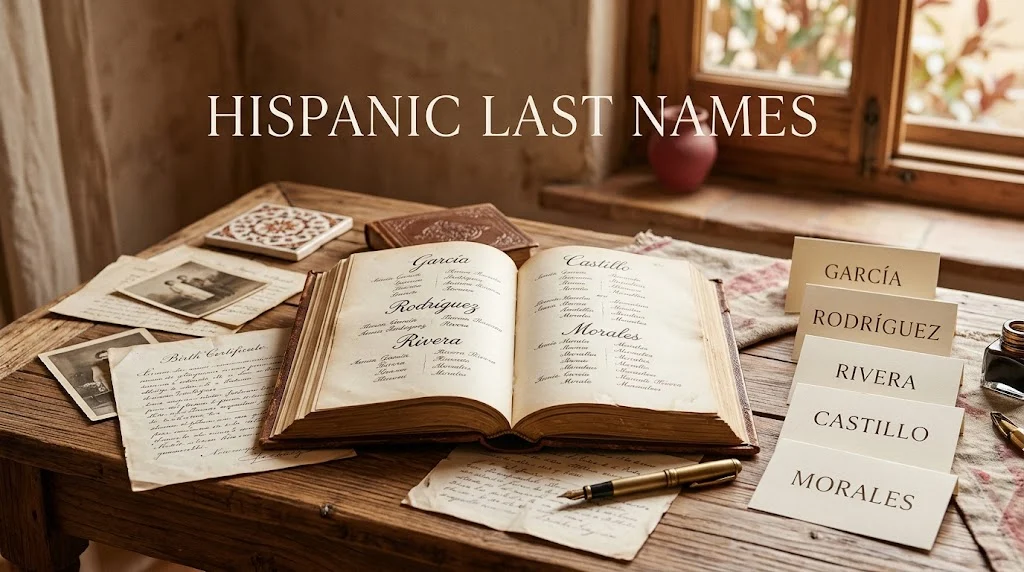
Hispanic last names are surnames commonly found in Spanish-speaking communities, including Spain, Mexico, and Latin America. Many have Spanish origins and reflect family ancestry, occupations, geographical locations, personal characteristics, or historical traditions.
A last name can tell a fascinating story about family, culture, and generations of history. Some surnames come from ancient places, while others began as descriptions of someone’s personality, occupation, or family connection. Hispanic last names are especially interesting because they reflect centuries of Spanish language, regional traditions, and cultural influences across the world.
From familiar surnames such as Garcia and Rodriguez to distinctive choices such as Del Valle and Montoya, Hispanic family names come in many styles. Some sound elegant and traditional, while others have strong connections to nature, geography, or ancient family histories.
These surnames are found throughout Spain, Mexico, Central America, South America, and Hispanic communities around the globe. Although many share Spanish linguistic roots, their histories can differ depending on the country and family.
Whether you are researching your ancestry, choosing a surname for a fictional character, or simply exploring beautiful family names, this guide will introduce you to ten interesting Hispanic surnames and their meanings.
García
Meaning: The deeper meaning is uncertain; García originated as a medieval personal name.
Origin: Spanish, with possible older Basque linguistic connections.
Personality and Style: García has a classic, confident, and elegant sound. It feels familiar without losing its historical character.
Best For: Fictional characters, family-history research, baby-name inspiration, and stories with Spanish-speaking backgrounds.
Popularity: García is one of the most recognizable Spanish surnames and is widely found throughout Spain and Latin America.
Emotional Appeal: Its long history and familiar sound make it feel connected to family heritage and tradition.
Pop Culture Reference: It is shared by many well-known people in sports, entertainment, literature, and public life.
Similar Surnames: Garza, González, Guerrero, Guzmán, Gallegos.
Why It Still Works Today: García is easy to recognize and has a strong cultural identity. Its historical roots make it an excellent example of a traditional Hispanic family name. Its exact original meaning should not be presented as settled fact. Surname Origin+1
Rodríguez
Meaning: Son of Rodrigo.
Origin: Spanish patronymic surname.
Personality and Style: Rodríguez sounds strong, traditional, distinguished, and confident. It has a familiar rhythm that works well in both Spanish and international settings.
Best For: Family-history projects, fictional characters, historical stories, and people exploring Spanish ancestry.
Popularity: Rodríguez is a widely recognized surname across Spain and Latin America.
Emotional Appeal: Its connection to an ancestor named Rodrigo gives it a meaningful family-history background.
Pop Culture Reference: It is associated with many personalities in music, sports, film, and television.
Similar Surnames: Hernández, Fernández, González, Martínez, Ramírez.
Why It Still Works Today: Rodríguez combines a traditional Spanish structure with a memorable sound. The ending -ez is a common feature of Spanish patronymic surnames, although its historical development is more complex than a simple modern translation. SpanishDictionary.com+1
Hernández
Meaning: Son of Hernando.
Origin: Spanish patronymic surname.
Personality and Style: Hernández feels bold, classic, and distinguished. It has a strong traditional character and is easily recognizable in many Spanish-speaking communities.
Best For: Fictional families, historical characters, genealogy research, and Spanish or Mexican-inspired storytelling.
Popularity: Hernández is especially familiar in Mexico and other Latin American countries, as well as Hispanic communities worldwide.
Emotional Appeal: Its connection to an older personal name makes it interesting for people exploring ancestral traditions.
Pop Culture Reference: Hernández is shared by numerous athletes, musicians, artists, and public figures.
Similar Surnames: Fernández, Martínez, Ramírez, Méndez, Domínguez.
Why It Still Works Today: Hernández is a timeless surname with a clear historical naming pattern. It also demonstrates how medieval personal names became hereditary family names over generations. SpanishDictionary.com+1
López
Meaning: Son of Lope.
Origin: Spanish patronymic surname.
Personality and Style: López has a short, stylish, and confident sound. It feels traditional but remains easy to recognize across different languages.
Best For: Baby-name inspiration, fictional characters, family-history research, and creative writing.
Popularity: López is widely found in Spain, Mexico, and other Spanish-speaking countries.
Emotional Appeal: The surname connects modern families with the older personal name Lope. It also demonstrates how a simple family relationship could become a permanent surname.
Pop Culture Reference: López is shared by many well-known personalities in entertainment, sports, and music.
Similar Surnames: Pérez, Gómez, Ruiz, Díaz, Muñoz.
Why It Still Works Today: López is short, memorable, and deeply connected to Spanish naming history. It is a particularly good choice for readers who prefer traditional surnames that are easy to pronounce. SpanishDictionary.com+1
Martínez
Meaning: Son of Martín.
Origin: Spanish patronymic surname.
Personality and Style: Martínez has a refined, traditional, and distinguished style. It feels equally suitable for a modern fictional character or a historical family.
Best For: Family-history projects, Spanish-inspired characters, and readers interested in traditional surnames.
Popularity: Martínez is among the widely recognized Spanish surnames in Spain and Latin America.
Emotional Appeal: Its meaning connects the surname to the personal name Martín, giving it a simple but interesting ancestral story.
Pop Culture Reference: Many famous people in sports and entertainment share this surname.
Similar Surnames: Rodríguez, Hernández, Fernández, Ramírez, González.
Why It Still Works Today: Martínez has remained recognizable across generations because of its traditional structure and widespread cultural use. It is a strong example of a surname that developed from an ancestor’s given name. SpanishDictionary.com+1
González
Meaning: Son of Gonzalo.
Origin: Spanish patronymic surname.
Personality and Style: González has a bold, energetic, and traditional sound. It carries a strong connection to Spanish family naming history.
Best For: Fictional characters, family-history research, Spanish-language stories, and heritage-inspired naming.
Popularity: González is widely used throughout Spain and Latin America, with many families carrying different and unrelated González family histories.
Emotional Appeal: Its connection to the medieval given name Gonzalo gives it historical depth.
Pop Culture Reference: The surname appears among numerous well-known athletes, entertainers, writers, and public figures.
Similar Surnames: Gómez, Rodríguez, Fernández, Ramírez, Méndez.
Why It Still Works Today: González is memorable and has a recognizable Spanish identity. Its traditional patronymic structure makes it particularly interesting to people researching the history of Hispanic surnames. SpanishDictionary.com+1
Castillo
Meaning: Castle or fortified building.
Origin: Spanish, derived from the word castillo.
Personality and Style: Castillo sounds elegant, powerful, and traditional. Its meaning creates associations with historic buildings, architecture, and old European landscapes.
Best For: Fictional families, historical characters, fantasy stories, and readers who enjoy surnames with architectural meanings.
Popularity: Castillo is found in Spain and throughout Latin America, including Mexico.
Emotional Appeal: A castle is often associated with history, heritage, and architecture. This gives Castillo a memorable visual quality.
Pop Culture Reference: The surname is shared by various figures in literature, sports, and entertainment.
Similar Surnames: Castro, Torres, Mendoza, Medina, Montoya.
Why It Still Works Today: Castillo has a strong meaning and an easy-to-recognize structure. It is an excellent choice for anyone who enjoys place-related and architecture-inspired surnames. FamilySearch+1
Rivera
Meaning: Riverbank or riverside.
Origin: Spanish, generally associated with geographical features and places near rivers.
Personality and Style: Rivera feels graceful, natural, modern, and elegant. Its flowing sound makes it especially appealing to readers who enjoy nature-inspired family names.
Best For: Fictional characters, creative writing, family-history research, and modern Spanish-inspired names.
Popularity: Rivera is a familiar surname in Spain, Mexico, Puerto Rico, and other Hispanic communities.
Emotional Appeal: Its connection with rivers creates images of movement, nature, and peaceful landscapes.
Pop Culture Reference: Rivera is shared by recognizable personalities in music, entertainment, sports, and public life.
Similar Surnames: Ríos, Del Río, Vega, Valle, Arroyo.
Why It Still Works Today: Rivera combines a beautiful geographical association with a simple, memorable sound. It is especially suitable for people who prefer surnames inspired by nature. ThoughtCo+1
Morales
Meaning: Associated with mulberry trees or mulberry-growing places.
Origin: Spanish geographical surname.
Personality and Style: Morales feels classic, warm, sophisticated, and nature-inspired. It has a traditional sound without feeling overly formal.
Best For: Fictional families, historical novels, genealogy research, and people interested in botanical surname meanings.
Popularity: Morales is widely found in Spain and Latin American countries.
Emotional Appeal: Its connection with mulberry trees gives it a natural and distinctive background. It also shows how the landscape surrounding an early family could influence its surname.
Pop Culture Reference: The surname is shared by various public figures, entertainers, and athletes.
Similar Surnames: Flores, Ramos, Vega, Rivera, Molina.
Why It Still Works Today: Morales is a wonderful example of a surname with geographical and botanical associations. Its meaning gives it a special appeal for readers who enjoy names connected to nature. FamilyTreeDNA Blog+1
Navarro
Meaning: A person from Navarre.
Origin: Spanish geographical or regional surname, referring to Navarre in northern Spain.
Personality and Style: Navarro sounds sophisticated, strong, and distinctive. Its regional connection gives it a historical quality.
Best For: Fictional characters, genealogy projects, historical writing, and people exploring Spanish regional heritage.
Popularity: Navarro is found in Spain and across several Latin American countries.
Emotional Appeal: Unlike surnames based directly on an occupation or personal name, Navarro can preserve a connection to a particular geographical region.
Pop Culture Reference: Navarro is shared by personalities in sports, entertainment, and other public fields.
Similar Surnames: Gallego, Catalán, Serrano, Mendoza, Castro.
Why It Still Works Today: Navarro has a polished sound and a clear geographical association. It is a great option for readers who want a surname connected to Spanish regional history. Behind the Name+1
Quick Comparison Table
| Last Name | Meaning | Style | Best For |
|---|---|---|---|
| García | Uncertain medieval name origin | Classic | Families, characters |
| Rodríguez | Son of Rodrigo | Strong | Traditional characters |
| Hernández | Son of Hernando | Traditional | Family heritage |
| López | Son of Lope | Simple | Modern characters |
| Martínez | Son of Martín | Elegant | Families, stories |
| González | Son of Gonzalo | Bold | Historical characters |
| Castillo | Castle | Powerful | Fictional families |
| Rivera | Riverbank | Natural | Modern characters |
| Morales | Mulberry trees | Classic | Nature-inspired stories |
| Navarro | From Navarre | Distinguished | Historical characters |
How to Choose the Perfect Hispanic Last Name
Choosing a surname can be just as meaningful as choosing a first name. Whether you are researching your family background or creating a character, a little research can help you find the right option.
1. Explore the meaning
Start by understanding what the surname represents. Some names come from occupations, while others describe geographical locations or family relationships. For example, Castillo refers to a castle, while Rodríguez means son of Rodrigo.
2. Consider the cultural background
Hispanic communities include people with different regional, linguistic, and ancestral backgrounds. A surname from Spain may have a different historical journey from a surname associated with Mexico, Puerto Rico, or another Latin American country.
3. Think about pronunciation
Choose a surname that sounds natural alongside the first name. Consider Spanish pronunciation, spelling, and accent marks. Names such as Rivera, Castillo, and Navarro are memorable choices.
4. Look at the family connection
If you are researching your ancestry, investigate birth certificates, marriage records, immigration documents, and historical family records. A surname alone cannot establish a person’s complete ancestry.
5. Choose a suitable style
Some surnames feel traditional, while others have a geographical, elegant, or nature-inspired quality. Think about the atmosphere you want the name to create.
6. Understand double surnames
Many Spanish-speaking naming traditions use two surnames, commonly the first surname from each parent. For example, someone might be named María García López. Customs and legal rules differ across countries and families. files.lib.byu.edu+1
7. Verify the historical meaning
Online surname lists sometimes provide simplified or disputed meanings. Check reputable dictionaries and genealogy resources before treating an explanation as established fact.
Most Popular Hispanic Last Names
Some Hispanic surnames are particularly recognizable because of their long history and widespread use.
Here are 15 familiar examples:
- García
- Rodríguez
- Hernández
- López
- Martínez
- González
- Pérez
- Sánchez
- Ramírez
- Torres
- Flores
- Gómez
- Díaz
- Cruz
- Morales
These surnames appear in different Spanish-speaking communities. Their popularity varies by country and region, so this is a general inspiration list rather than a universal ranking. Mexican Name Finder+1
Vintage Hispanic Last Names Making a Comeback
Traditional surnames have a special appeal because they connect modern families with earlier generations.
Here are some interesting vintage-style Hispanic surnames:
- Del Valle: Of the valley; a geographical surname.
- De León: Of León; associated with the Spanish city or region.
- Montoya: A Spanish surname associated with place names; its deeper etymology requires care.
- Salazar: A surname associated with a place name in the Basque Country.
- Molina: Connected with a mill or places named Molina.
- Cervantes: A historic Spanish surname with an uncertain deeper etymology.
- Serrano: Associated with mountains or mountainous regions.
- Aguilar: Associated with places connected to eagles.
- Medina: A geographical surname associated with several Spanish place names.
- Vega: Meadow or fertile lowland.
These surnames work particularly well for historical fiction, family-history research, and people who appreciate traditional Spanish naming styles. Behind the Name+2
Modern Hispanic Last Name Trends
Modern interest in Hispanic surnames often comes from genealogy, cultural storytelling, entertainment, and the growing popularity of heritage-inspired character names.
Several naming styles are worth exploring.
Nature-inspired surnames: Rivera, Vega, Flores, and Morales have connections with geographical features or plants. They appeal to people who enjoy natural imagery.
Strong traditional surnames: Rodríguez, González, Hernández, and Martínez have recognizable historical structures and remain familiar across generations.
Geographical surnames: Navarro, Castillo, Castro, and Medina reflect connections with places, buildings, or landscapes.
Elegant compound surnames: Names such as De la Cruz, Del Valle, and De León have a distinctive traditional style.
Heritage-focused naming: More people are exploring family records and ancestral stories to understand where their surnames originated. This is especially useful for genealogy and cultural research.
One important point: a surname does not automatically identify someone’s nationality, ethnicity, or complete family history. Different families can share the same surname without having a common ancestor.
Understanding Hispanic Surname Traditions
Hispanic surname traditions are not limited to one country or one naming system. They reflect different historical experiences, regional languages, family customs, and cultural influences.
Many Spanish surnames developed from four broad sources:
- Patronymic: Derived from a parent’s or ancestor’s personal name, such as Martínez and Rodríguez.
- Geographical: Connected to a place or landscape, such as Navarro and Rivera.
- Occupational: Based on a historical profession or trade.
- Descriptive: Developed from a nickname or personal characteristic.
Spanish-speaking countries also have varied traditions regarding the use and order of family names. In many communities, people traditionally receive two surnames, one associated with each parent.
It is also important to recognize that Hispanic surnames are not exclusively Spanish in origin. Indigenous American, African, European, and other ancestral influences are part of the broader history of Hispanic communities.
For example, Indigenous surnames remain important in several parts of Mexico and Latin America. These names can reflect languages and cultural traditions that existed long before Spanish colonization. files.lib.byu.edu+2
FAQs
What are the most common Hispanic last names?
Some widely recognized Hispanic surnames include García, Rodríguez, Hernández, López, Martínez, González, Pérez, Sánchez, and Ramírez.
What is the most popular Hispanic last name?
There is no single surname that ranks first across every Hispanic country. García, Hernández, Rodríguez, and Martínez are among the widely recognized names.
Why do many Hispanic last names end in EZ?
The ending -ez is a common feature of Spanish patronymic surnames. It historically indicates a family relationship, often interpreted as “son of.”
Do Hispanic people have two last names?
Many people in Spanish-speaking countries traditionally use two surnames, commonly inherited from their parents. The order and legal rules vary by country.
What are some rare Hispanic last names?
Some less familiar surnames include Chavarría, Echeverría, Narváez, Oyarzun, and Seoane. However, rarity depends on the country and region.
Conclusion
Hispanic last names carry fascinating connections to family history, geography, language, and cultural traditions. From the classic sound of García and Rodríguez to the natural beauty of Rivera and Vega, every surname has its own story.
Whether you are researching your ancestors, creating a fictional character, or exploring Spanish and Latin American heritage, understanding a surname’s origin can make your search more meaningful. Remember that some surname meanings are well established, while others have uncertain historical roots.
Take your time exploring these beautiful family names and choose the ones that interest you most. Which Hispanic surname is your favorite? Share this guide with friends and family, and leave a comment with the name you would love to learn more about.
Discover More Related Articles:
- Chinese Girl Names | Beautiful Names With Meanings In 2026
- Baby Names 2025 | Popular, Unique & Beautiful Ideas In 2026