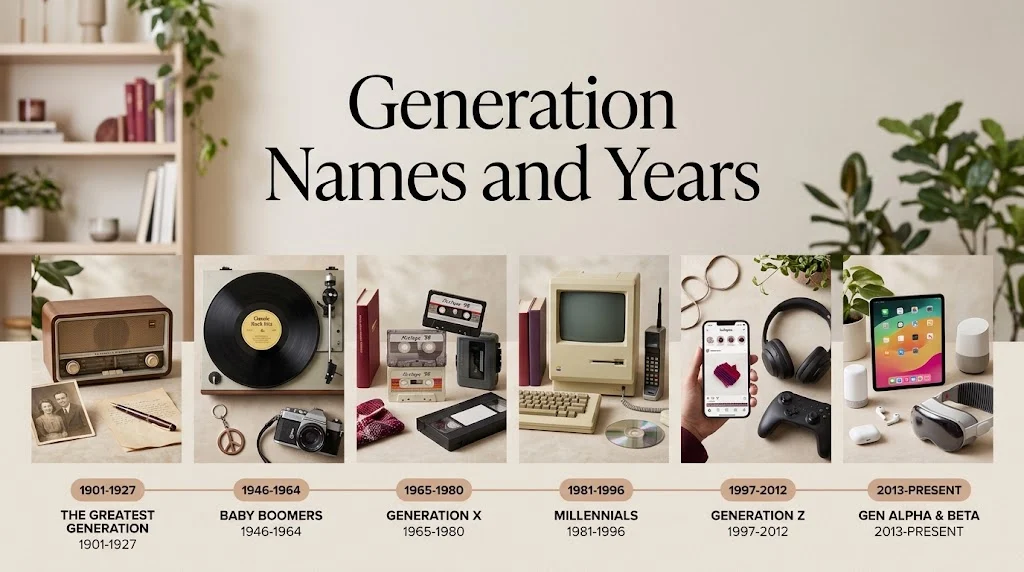
The commonly used generation groups include the Greatest Generation (1901–1927), Silent Generation (1928–1945), Baby Boomers (1946–1964), Gen X (1965–1980), Millennials (1981–1996), Gen Z (1997–2012), Gen Alpha (2013–2024), and Gen Beta (2025–2039). Exact boundaries vary by source.
Have you ever wondered why some people are called Baby Boomers, while others belong to Generation X, Millennials, or Gen Z? Every generation has a name, a birth-year range, and a collection of historical experiences that help explain its identity.
Understanding generation names and years makes it easier to see how people born in different periods grew up in different worlds. Older generations experienced major historical changes, the arrival of television, and the development of modern technology. Younger generations grew up with smartphones, social media, artificial intelligence, and instant access to information.
From the Greatest Generation to the newest Generation Beta, each group has its own story. Some names come from historical events, while others reflect cultural changes or simply follow an alphabetical pattern.
In this guide, you will discover all the major generations in order, their birth years, naming origins, characteristics, and defining influences. You will also learn how to identify your generation based on your birth year.
Important note: Generational dates are not universal scientific boundaries. Different researchers and organizations sometimes use slightly different ranges. This article uses a commonly referenced framework based on Pew Research Center’s historical ranges and McCrindle Research’s proposed ranges for Generation Alpha and Beta. Pew Research Center+1
Generation Names and Years Chart
Here is a quick overview of the commonly used generation ranges.
| Generation | Birth Years | Common Identity |
|---|---|---|
| Greatest Generation | 1901–1927 | Resilience and historical change |
| Silent Generation | 1928–1945 | Duty and stability |
| Baby Boomers | 1946–1964 | Postwar population boom |
| Generation X | 1965–1980 | Independence and adaptability |
| Millennials (Gen Y) | 1981–1996 | Digital transition |
| Generation Z | 1997–2012 | Digital connectivity |
| Generation Alpha | 2013–2024 | Technology-rich childhood |
| Generation Beta | 2025–2039 | Emerging generation |
These ranges are a practical reference, not universally agreed cutoffs. Some sources place Generation Alpha’s starting year at 2010 instead of 2013.
Greatest Generation (1901–1927)
whodoyouthinkyouaremagazine.com
The Greatest Generation refers to people born approximately between 1901 and 1927. The name became widely recognized through journalist and author Tom Brokaw’s 1998 book, The Greatest Generation. It celebrates people who experienced the Great Depression and World War II and contributed to rebuilding society.
Meaning of the Name: The name reflects courage, sacrifice, determination, and resilience.
Historical Background: Many members of this generation experienced economic hardship during the Great Depression. Those who were old enough also served during World War II or supported their communities during the conflict.
Commonly Associated Characteristics:
- Strong sense of responsibility
- Appreciation for hard work
- Community involvement
- Financial caution
- Respect for family traditions
Technology and Lifestyle: Many grew up before television, modern household appliances, and widespread personal communication technology became common. Their lives changed dramatically as transportation, medicine, and communication developed.
Why It Matters Today: The Greatest Generation helped shape many institutions and communities that influenced later generations. Its history offers an important perspective on resilience during difficult times.
Alternative Name: G.I. Generation.
Silent Generation (1928–1945)
Highland | City Club — Reimagining Family
The Silent Generation includes people born between 1928 and 1945. Its name became associated with a 1951 Time magazine article describing the younger generation of that period.
The word “Silent” refers to the generation’s public image as cautious, conformist, and less publicly outspoken than some later youth movements. It does not mean every person in this generation was quiet.
Meaning of the Name: A label connected with conformity, caution, and a reserved public image.
Historical Background: Members grew up during the Great Depression’s aftermath and World War II. Many experienced the postwar economic expansion as adults.
Commonly Associated Characteristics:
- Patience and discipline
- Respect for established institutions
- Appreciation for stability
- Strong work ethic
- Value placed on personal responsibility
Technology and Lifestyle: Radio, traditional newspapers, landline telephones, and television played important roles during their lives. Many also witnessed the development of commercial aviation and the space age.
Why It Matters Today: This generation helped shape postwar workplaces, families, communities, and institutions.
Alternative Name: Traditionalists.Pew Research Center+1
Baby Boomers (1946–1964)
20 Vintage Baby Names from the 1960s
Baby Boomers are people born between 1946 and 1964. Their name comes from the significant increase in births that occurred in the years following World War II.
After the war, many countries experienced rising birth rates. This period became known as the baby boom, which gave the generation its familiar name.
Meaning of the Name: Babies born during the postwar population boom.
Historical Background: Baby Boomers grew up during major economic, social, and cultural changes. Their childhood and adult years included the expansion of television, the space race, changing music styles, and important social movements.
Commonly Associated Characteristics:
- Ambition and career development
- Interest in social change
- Appreciation for personal achievement
- Strong connections to popular culture
- Experience with changing technology
Technology and Lifestyle: Many grew up with radio and television before experiencing personal computers, mobile phones, and the internet later in life.
Why It Matters Today: Baby Boomers have played important roles in business, education, entertainment, politics, and family life. Their generation also influenced music, fashion, and popular culture.
Alternative Names: Boomers or the Boomer Generation.Pew Research Center+1
Generation X (1965–1980)
X marks the spot: The forgotten generation remembers | RNZ
Generation X refers to people born between 1965 and 1980 in the commonly used Pew Research framework. It comes after the Baby Boomers and before Millennials.
The letter X helped give the generation a distinct identity. The name became widely popular through Douglas Coupland’s 1991 novel Generation X: Tales for an Accelerated Culture.
Meaning of the Name: The letter X represents an identity that was initially difficult to define or fit into traditional labels.
Historical Background: Gen X grew up during changing family structures, economic shifts, the rise of personal computers, and the expansion of popular entertainment.
Commonly Associated Characteristics:
- Independence
- Practical thinking
- Adaptability
- Resourcefulness
- Appreciation for personal freedom
Technology and Lifestyle: Many Gen X members experienced childhood before the internet became widespread. They later adapted to computers, mobile phones, email, and digital communication.
Why It Matters Today: Generation X connects the pre-digital and digital worlds. Many experienced traditional communication systems before becoming regular users of modern technology.
Alternative Names: Gen X or the MTV Generation.legacy.pewresearch.org+1
Millennials or Generation Y (1981–1996)
YR Media – MacArthur Foundation
Millennials, also known as Generation Y, were born between 1981 and 1996 under the commonly used Pew Research definition.
The name Millennials comes from the fact that this generation came of age around the beginning of the new millennium. It is one of the most widely recognized generational labels.
Meaning of the Name: People whose transition into adulthood coincided with the new millennium.
Historical Background: Millennials experienced the expansion of the internet, personal computers, mobile phones, and social media. Many also experienced major economic and social changes during their education and working lives.
Commonly Associated Characteristics:
- Comfort with digital technology
- Interest in education and career growth
- Appreciation for flexibility
- Online communication habits
- Interest in personal development
Technology and Lifestyle: Many Millennials remember childhood before smartphones and constant internet access. They experienced the shift from traditional media to online platforms.
Why It Matters Today: Millennials helped shape online communication, digital shopping, modern workplaces, and social media culture.
Alternative Names: Gen Y, Generation Y, and Echo Boomers.Pew Research Center+1
Generation Z (1997–2012)
Tren Anak Muda Jaman Now – RRI.co.id
Generation Z, commonly called Gen Z or Zoomers, includes people born between 1997 and 2012 in the widely used Pew Research framework.
This generation followed Millennials and grew up during a period when digital technology became an ordinary part of everyday life.
Meaning of the Name: The letter Z follows Generation X and Generation Y.
Historical Background: Gen Z experienced the growth of smartphones, social media, online video, streaming platforms, and digital communication. The 2008 financial crisis and the COVID-19 pandemic also influenced many members’ childhood, education, or early working years.
Commonly Associated Characteristics:
- Familiarity with digital platforms
- Comfort with online communication
- Interest in creative expression
- Awareness of global events
- Exposure to rapidly changing technology
Technology and Lifestyle: Many Gen Z members grew up using smartphones, search engines, social networks, and online learning platforms.
Why It Matters Today: Gen Z is influencing education, entertainment, communication, workplace culture, and online trends.
Alternative Names: Gen Z and Zoomers.Pew Research Center+1
Generation Alpha (2013–2024)
Top Fun Educational Apps for Kids UK Edition
Generation Alpha is a term used for children born during the 2010s and early 2020s. In the McCrindle framework, it covers 2010 to 2024. Other commonly used charts begin it in 2013, following the 1997–2012 Gen Z range.
The name Alpha marks a change from the Latin alphabet to the Greek alphabet. It was selected to represent a new beginning after Generation Z.
Meaning of the Name: Alpha is the first letter of the Greek alphabet and symbolizes a new beginning.
Historical Background: Generation Alpha is growing up in a world shaped by smartphones, tablets, online education, artificial intelligence, and connected devices.
Commonly Associated Characteristics:
- Early exposure to digital tools
- Interactive learning experiences
- Familiarity with online media
- Growing exposure to artificial intelligence
- Increasingly connected lifestyles
Technology and Lifestyle: Many children in this generation have encountered digital devices from an early age. However, their experiences differ depending on family, country, education, and access to technology.
Why It Matters Today: Generation Alpha is still young, so it is too early to make firm conclusions about its long-term personality or social behavior. Its members will experience major developments in education, communication, and technology as they grow.
Alternative Name: Gen Alpha.McCrindle+1
Generation Beta (2025–2039)
Generation Beta is the proposed name for children born between 2025 and 2039 in the McCrindle generational framework.
It follows Generation Alpha and continues the use of Greek letters for newer generations. The name Beta represents the next stage after Alpha.
Meaning of the Name: Beta is the second letter of the Greek alphabet.
Historical Background: Generation Beta has only recently begun. Its members are expected to grow up during continued developments in artificial intelligence, automation, connected technology, and environmental innovation.
Possible Influences:
- More advanced artificial intelligence
- New forms of digital education
- Changing communication systems
- Technological developments
- Greater focus on sustainability
Technology and Lifestyle: It is too early to describe the actual habits or personalities of this generation. Its members will grow up in circumstances that are still developing.
Why It Matters Today: Generation Beta is a useful label for discussing the next birth cohort, but predictions about its future should not be treated as established facts.
Alternative Name: Gen Beta.McCrindle+1
Quick Comparison of All Generations
| Generation | Birth Years | Historical Influence | Common Style |
|---|---|---|---|
| Greatest | 1901–1927 | Great Depression, WWII | Traditional |
| Silent | 1928–1945 | Postwar society | Reserved |
| Boomers | 1946–1964 | Postwar growth | Established |
| Gen X | 1965–1980 | Personal computers | Independent |
| Millennials | 1981–1996 | Internet expansion | Digital transition |
| Gen Z | 1997–2012 | Social media | Connected |
| Gen Alpha | 2013–2024 | Smart technology | Tech-exposed |
| Gen Beta | 2025–2039 | Emerging technologies | Future-oriented |
How to Find Your Generation by Birth Year
Finding your generation is simple. You only need to know your birth year.
Follow these steps:
- Find your year of birth.
- Compare it with the generation chart.
- Identify the generation whose birth-year range includes your year.
- Remember that some researchers use different starting and ending years.
For example:
- Born in 1955? You are a Baby Boomer.
- Born in 1975? You are Generation X.
- Born in 1988? You are a Millennial.
- Born in 2005? You are Generation Z.
- Born in 2015? You are Generation Alpha.
- Born in 2026? You are Generation Beta under the McCrindle framework.
A person’s exact age in 2026 depends on whether their birthday has already occurred.
What Generation Am I? Birth Year Reference
Here are some additional examples to help identify your generation.
| Birth Year | Generation |
|---|---|
| 1920 | Greatest Generation |
| 1935 | Silent Generation |
| 1948 | Baby Boomers |
| 1960 | Baby Boomers |
| 1968 | Generation X |
| 1978 | Generation X |
| 1985 | Millennials |
| 1990 | Millennials |
| 1999 | Generation Z |
| 2008 | Generation Z |
| 2018 | Generation Alpha |
| 2023 | Generation Alpha |
| 2025 | Generation Beta |
| 2026 | Generation Beta |
Most Popular Generation Names Today
Some generational labels are especially common in everyday conversations, online discussions, education, and media.
Here are the names you are most likely to encounter:
- Baby Boomers: People born during the post-World War II baby boom.
- Generation X: The generation between Baby Boomers and Millennials.
- Millennials: Also known as Generation Y.
- Generation Z: Commonly called Zoomers.
- Generation Alpha: The generation following Gen Z.
- Generation Beta: The proposed generation following Gen Alpha.
These names help people discuss broad social and historical patterns. However, they should not be used to assume that every person in a generation behaves in the same way.
Older Generation Names You Should Know
Before the most familiar modern labels became popular, several other terms were used to describe birth cohorts.
Lost Generation: A term associated with people who came of age around World War I. It is often linked to writers and artists who explored the social and emotional changes of that period.
Interbellum Generation: A historical label sometimes used for people born between World War I and World War II. Its exact boundaries vary.
G.I. Generation: Another name associated with the Greatest Generation, particularly people who served during World War II.
Traditionalists: A commonly used alternative label for the Silent Generation.
These names are useful when researching family history, historical writing, and older generational classifications.
Modern Generation Naming Trends
Generational names have changed over time. Earlier labels often reflected major historical experiences, while newer labels sometimes follow naming patterns created by researchers.
The Baby Boomers received their name from a measurable increase in births after World War II. Generation X followed with an alphabetical label. Millennials were named for their connection to the new millennium.
Generation Z continued the alphabetical sequence. After Z, researchers began using the Greek alphabet, introducing Generation Alpha and Generation Beta.
This naming approach provides a simple way to identify newer birth cohorts. It also gives researchers and writers a shared vocabulary when discussing population trends.
However, generational labels are not official personality categories. People born in the same year can have very different experiences depending on their country, family, education, economic circumstances, and culture.
Why Do Generations Have Different Names?
Generations receive names for several reasons:
- Historical events: Major events can shape how a birth cohort is remembered.
- Population changes: The Baby Boomer name reflects a rise in births.
- Cultural identity: Some names describe how a generation is viewed by society.
- Alphabetical patterns: Generation X, Y, and Z follow a familiar sequence.
- Research terminology: Researchers introduce labels to make population groups easier to discuss.
The names are useful descriptions, but they do not establish strict differences between individuals.
Are Generation Years the Same in Every Country?
No. Generational ranges are not identical everywhere.
Many popular generation charts use American historical events and demographic patterns. Other countries experienced different wars, economic changes, political events, and technological developments.
For example, the postwar birth-rate increase associated with Baby Boomers did not happen at precisely the same time or in the same way in every country.
This means a person born in a particular year may have a different cultural experience from someone of the same age living elsewhere.
When researching generations, always check which country and research framework a source uses.
Important Differences Between Generation Year Charts
One of the most common sources of confusion is the starting year for Generation Alpha.
Some researchers, including McCrindle Research, use these ranges:
- Generation Z: 1995–2009
- Generation Alpha: 2010–2024
- Generation Beta: 2025–2039.
The commonly used Pew-based framework instead places Generation Z at 1997–2012. Combining that range with a 2013 start for Alpha creates a different chart. McCrindle+2
Neither framework should be presented as a universal rule. If you are writing an academic report, demographic study, or educational resource, identify the source behind your chosen dates.
FAQs
1. What are all the generation names in order?
The commonly recognized generations, from oldest to newest, are the Greatest Generation, Silent Generation, Baby Boomers, Generation X, Millennials, Generation Z, Generation Alpha, and Generation Beta.
2. What years are Millennials born?
Millennials, also called Generation Y, are commonly defined as people born between 1981 and 1996. They experienced the transition from traditional communication to widespread internet access, smartphones, and social media.
3. What years are Generation Z?
Generation Z is commonly defined as people born between 1997 and 2012. They are often called Zoomers and are associated with growing up during the expansion of smartphones, social media, and digital communication.
4. What generation comes after Gen Z?
Generation Alpha comes after Generation Z. McCrindle Research uses 2010–2024 for Gen Alpha, while other charts use 2013–2024. Generation Beta follows, with 2025–2039 proposed by McCrindle.
5. What generation is someone born in 2000?
Someone born in 2000 belongs to Generation Z under the commonly used 1997–2012 birth-year framework. Gen Z is often associated with digital communication, social media, and growing up in an increasingly connected world.
Conclusion
Understanding generation names and years helps explain how people from different birth periods experienced changing societies, cultures, and technology. From the Greatest Generation and Silent Generation to Baby Boomers, Gen X, Millennials, and Gen Z, every group has a different historical background.
Generation Alpha represents a newer generation growing up with connected technology, while Generation Beta is the proposed name for children born from 2025 onward.
Remember that generational dates can vary depending on the research source and country. These labels are useful for understanding broad population trends, not for defining someone’s personality.
Save this generation chart for future reference, share it with friends and family, and leave a comment telling us which generation you belong to!
Discover More Related Articles:
- Chinese Girl Names | Beautiful Names With Meanings In 2026
- Baby Names 2025 | Popular, Unique & Beautiful Ideas In 2026











2 thoughts on “Generation Names and Years | From the Greatest Generation to Gen Alpha In 2026”