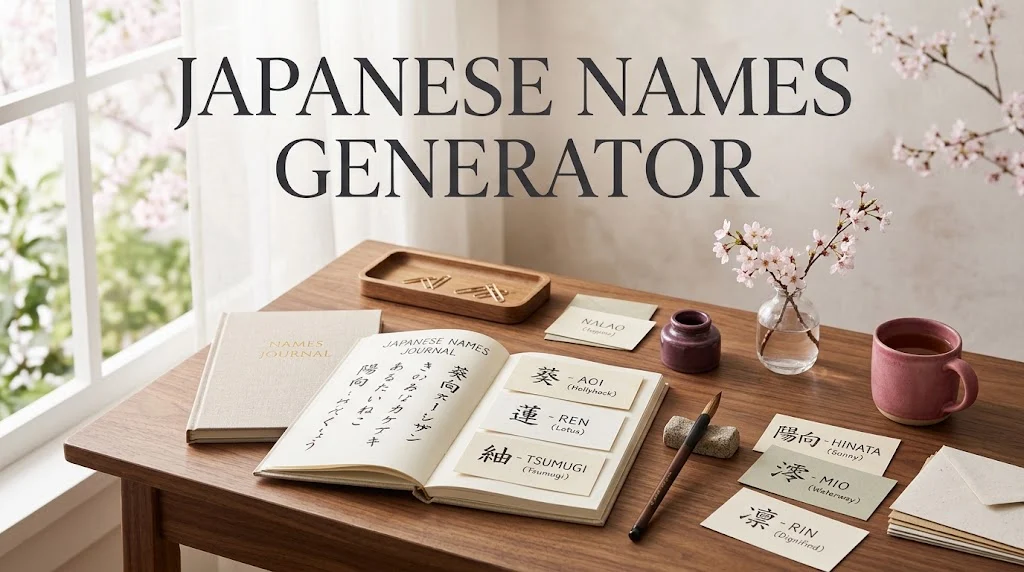
A Japanese names generator helps you discover Japanese names based on style, pronunciation, gender usage, and meaning. For accurate results, check the chosen name’s kanji, reading, and cultural context because the same pronunciation can have different written meanings.
Finding the right name can be an exciting part of creating a character, welcoming a baby, or building a new online identity. A Japanese names generator makes the process easier by offering ideas inspired by Japanese language, nature, traditional naming styles, and meaningful characters.
Japanese names have a special feature: their written form can be just as important as their sound. Many names use kanji, characters that can carry meanings connected to light, flowers, the sea, wisdom, or other ideas. However, the same pronunciation may have several possible kanji spellings, so a name’s meaning depends on how it is written.
Whether you want a gentle name such as Sakura, a strong-sounding choice such as Takeshi, or a versatile name such as Akira, exploring different options can help you find the right fit. You can also use Japanese-inspired names for stories, games, pets, and social media profiles.
This guide explores ten name ideas, explains how a generator works, and shares practical tips for choosing a name respectfully. It also covers Japanese writing systems, popular styles, and common questions so you can make a more informed choice.
How Does a Japanese Names Generator Work?
A Japanese names generator helps you explore names according to your preferred style, sound, meaning, or purpose. Depending on the tool, you may be able to select feminine, masculine, or gender-neutral names, explore nature-inspired choices, or combine a given name with a family name.
A useful generator should distinguish between an established Japanese name and a creative name invented for entertainment. It should also display the original Japanese writing when available, along with a pronunciation guide and a carefully explained meaning.
For example, you might explore names associated with flowers, sunlight, the ocean, or bravery. You can then compare the available spellings and decide which option best fits your needs.
Remember that a generator provides ideas, not guaranteed cultural or linguistic accuracy. Before using a name for a baby, a published character, or a formal purpose, verify its spelling, pronunciation, and suitability through reliable Japanese-language references.
Sakura
Meaning: Cherry blossom when written as 桜.
Origin: Japanese.
Personality: Sakura often evokes gentleness, beauty, renewal, and appreciation for nature.
Style: Floral, graceful, classic, and recognizable.
Best For: Baby girls, fictional characters, creative usernames, and spring-inspired projects.
Popularity: Sakura is a familiar Japanese given name and has also become recognizable internationally.
Emotional Appeal: Cherry blossoms are strongly associated with spring in Japan. Their short flowering season can also inspire reflections on life’s changing moments and the beauty of the present.
Pop Culture Reference: Sakura is used by characters in Japanese anime, manga, and other entertainment, making the name familiar to many fans.
Similar Names: Hana, Ayame, Sumire, Kaede.
Why It Still Works Today: Sakura combines a clear natural association with a soft, memorable sound. It suits people who want a name that feels elegant without being difficult to recognize.
Akira
Meaning: The meaning depends on the kanji used; some spellings are associated with brightness or clarity.
Origin: Japanese.
Personality: Akira can suggest intelligence, confidence, creativity, and a clear sense of purpose.
Style: Modern, versatile, strong, and simple.
Best For: Characters, baby names, gaming identities, and people looking for a name that can be used across genders.
Popularity: Akira is an established Japanese given name. Its gender usage and exact meaning depend on the individual name and spelling.
Emotional Appeal: Its short form is easy to remember, while its possible kanji spellings offer room for personal meaning.
Pop Culture Reference: Akira is the title of the influential Japanese animated film and manga created by Katsuhiro Otomo.
Similar Names: Aoi, Haru, Ren, Hikaru.
Why It Still Works Today: Akira has a distinctive sound and broad creative appeal. If you choose it, confirm the intended kanji rather than assuming that every spelling carries the same meaning.
Haruka
Meaning: Depends on the written form; some spellings can express ideas associated with distance or spring.
Origin: Japanese.
Personality: Haruka often feels calm, thoughtful, gentle, and imaginative.
Style: Elegant, soft, contemporary, and versatile.
Best For: Baby names, story characters, creative profiles, and names with a graceful sound.
Popularity: Haruka is an established Japanese given name, and its exact interpretation depends on its spelling.
Emotional Appeal: The flowing sound makes Haruka feel gentle without being overly delicate. Different kanji choices can also give the name a personal connection.
Pop Culture Reference: Haruka appears as a given name across Japanese entertainment, including anime and video games.
Similar Names: Haruna, Hikari, Hinata, Ayaka.
Why It Still Works Today: Haruka works well for readers who prefer names that sound natural, expressive, and adaptable to different kinds of characters.
Ren
Meaning: Depends on the kanji. 蓮 means lotus, a recognizable nature-related choice.
Origin: Japanese.
Personality: Ren can feel calm, thoughtful, confident, and understated.
Style: Short, modern, minimalist, and nature-inspired.
Best For: Baby names, fictional characters, usernames, and gender-flexible creative naming.
Popularity: Ren is an established Japanese given name. Gender associations and meanings can vary by spelling and individual usage.
Emotional Appeal: Its brevity makes it easy to remember, while the lotus association offers a strong natural image when the relevant kanji is used.
Pop Culture Reference: Ren is used by characters in Japanese games, manga, and anime, although the name is not tied to only one character.
Similar Names: Rei, Riku, Haru, Akira.
Why It Still Works Today: Ren is a practical option for anyone who prefers short names with a clean sound. Just remember that the meaning “lotus” applies to the relevant written form, not automatically to every Ren.
Yuki
Meaning: Can mean snow when written as 雪, but other kanji spellings carry different meanings.
Origin: Japanese.
Personality: Yuki often feels peaceful, gentle, fresh, and quietly confident.
Style: Soft, simple, nature-inspired, and versatile.
Best For: Baby names, fictional characters, pets, and social media identities.
Popularity: Yuki is a familiar Japanese given name and can be used by people of different genders depending on the spelling and naming context.
Emotional Appeal: The snow association creates a clean, wintery image. Other spellings can express different ideas, which makes checking the kanji especially important.
Pop Culture Reference: Yuki is a recurring given name in Japanese anime, manga, and video games.
Similar Names: Hikari, Haru, Sora, Aoi.
Why It Still Works Today: Yuki is short and easy to remember. It works particularly well for people who love nature-inspired names, provided they select the written form that matches their intended meaning.
Aoi
Meaning: Depends on the kanji; 葵 refers to hollyhock, while other spellings can carry other meanings.
Origin: Japanese.
Personality: Aoi can feel fresh, creative, calm, and connected to nature.
Style: Modern, simple, botanical, and gender-flexible.
Best For: Babies, fictional characters, usernames, and contemporary naming ideas.
Popularity: Aoi is an established Japanese given name used across different naming contexts.
Emotional Appeal: Its short sound and botanical associations make it appealing to readers who like names linked to plants and the natural world.
Pop Culture Reference: Aoi is found among characters in Japanese anime, manga, and games.
Similar Names: Ao, Akira, Ren, Hinata.
Why It Still Works Today: Aoi is distinctive without being long or complicated. It also demonstrates why kanji matters: the meaning should be linked to the actual written form, not inferred from pronunciation alone.
Hikari
Meaning: Light when written as 光.
Origin: Japanese.
Personality: Hikari suggests brightness, hope, warmth, and optimism.
Style: Bright, lyrical, elegant, and meaningful.
Best For: Baby names, fictional heroes, usernames, and characters associated with hope or discovery.
Popularity: Hikari is an established Japanese given name with a clear meaning when written with 光.
Emotional Appeal: Light is a widely understood symbol of knowledge, comfort, and new beginnings. This gives Hikari a positive meaning without requiring an elaborate explanation.
Pop Culture Reference: Hikari is used as a character name in Japanese entertainment, including anime and games.
Similar Names: Akari, Hikaru, Haruka, Nozomi.
Why It Still Works Today: Hikari has a graceful sound and a meaningful written form. It is a strong option for anyone who wants a name connected with hope and brightness.
Haruto
Meaning: Depends on the kanji chosen; some spellings combine characters associated with sunlight, openness, or flight.
Origin: Japanese.
Personality: Haruto often feels energetic, friendly, confident, and forward-looking.
Style: Contemporary, lively, masculine-leaning, and approachable.
Best For: Baby boys, protagonists, game characters, and modern Japanese naming inspiration.
Popularity: Haruto has been a prominent choice in contemporary Japanese baby-name rankings. Exact popularity varies by year and by whether rankings count kanji spellings or pronunciations.
Emotional Appeal: Haruto has a bright, upbeat sound. Depending on the chosen characters, parents may use it to express hopes for a child’s future.
Pop Culture Reference: The name appears in Japanese entertainment and fiction, though its appeal does not depend on any one character.
Similar Names: Haruki, Hiroto, Minato, Sota.
Why It Still Works Today: Haruto feels modern while fitting established Japanese naming patterns. Check the specific kanji before assigning it a precise English meaning.
Sora
Meaning: Sky when written as 空.
Origin: Japanese.
Personality: Sora often suggests freedom, curiosity, openness, and imagination.
Style: Airy, modern, simple, and nature-inspired.
Best For: Baby names, fictional adventurers, creative usernames, and names with a gentle sound.
Popularity: Sora is an established Japanese given name and is also familiar to many international audiences.
Emotional Appeal: The sky can symbolize possibility and freedom. That association makes Sora appealing for a character who explores, dreams, or grows beyond familiar boundaries.
Pop Culture Reference: Sora is the main character’s name in the Kingdom Hearts video game series.
Similar Names: Aoi, Haru, Yuki, Ren.
Why It Still Works Today: Sora is short, memorable, and connected to a clear image when written as 空. Its simplicity makes it useful for both real-name inspiration and fictional naming.
Takeshi
Meaning: Depends on the kanji; 武 is associated with martial or military qualities.
Origin: Japanese.
Personality: Takeshi can evoke courage, determination, resilience, and confidence when the chosen spelling supports that association.
Style: Strong, traditional, classic, and masculine-leaning.
Best For: Baby boys, historical fiction, action-adventure characters, and traditional naming inspiration.
Popularity: Takeshi is a well-established Japanese masculine given name, though its popularity can differ between generations.
Emotional Appeal: Its sound feels sturdy and direct. The relevant kanji can add a sense of purpose or strength to the name.
Pop Culture Reference: Takeshi is a familiar given name in Japanese film, television, games, and other media.
Similar Names: Kenji, Hiroshi, Daichi, Haruto.
Why It Still Works Today: Takeshi has a traditional character and a strong sound. It is useful for readers seeking a name with a classic Japanese feel rather than a highly modern style.
Quick Comparison Table
| Name | Meaning or Association | Style | Best For |
|---|---|---|---|
| Sakura | Cherry blossom (桜) | Floral, graceful | Girls, characters |
| Akira | Brightness in some kanji forms | Strong, versatile | All genders, characters |
| Haruka | Varies by kanji | Elegant, soft | Babies, stories |
| Ren | Lotus with 蓮 | Minimalist, modern | Babies, usernames |
| Yuki | Snow with 雪 | Gentle, natural | Babies, pets |
| Aoi | Hollyhock with 葵 | Botanical, modern | Babies, characters |
| Hikari | Light (光) | Hopeful, lyrical | Babies, protagonists |
| Haruto | Depends on kanji | Contemporary | Boys, characters |
| Sora | Sky (空) | Airy, creative | All genders, stories |
| Takeshi | Martial qualities with some kanji | Strong, classic | Boys, fiction |
How to Choose the Perfect Japanese Name
Choosing a name is easier when you consider its sound, writing, meaning, and intended use together.
- Decide on your purpose. A name for a baby may require more careful cultural and legal research than a temporary gaming username or fictional character.
- Choose the feeling you want. Explore themes such as flowers, light, the ocean, courage, wisdom, or the seasons.
- Check the kanji. Do not assume that a name has one fixed meaning simply because it has a familiar pronunciation.
- Learn the pronunciation. Use a reliable Japanese-language source or pronunciation recording when available.
- Consider the full name. Japanese names commonly put the family name before the given name in Japanese contexts. For example, the order may be surname first and given name second.
- Respect cultural context. If your character is Japanese, consider the character’s age, setting, family background, and the time period.
- Avoid invented certainty. A creative combination of kanji may look attractive but might not be a conventional name or have the intended reading.
- Verify important choices. For a real baby name, consult knowledgeable Japanese speakers and relevant official guidance where necessary.
Most Popular Japanese Name Styles Today
Japanese names come in many styles, from classic choices to short contemporary names. The best fit depends on personal taste, the intended kanji, and the period or context in which the name is used.
Nature-inspired names: Sakura, Sora, Aoi, and Yuki offer associations with flowers, the sky, plants, and snow when written with the corresponding kanji.
Light-inspired names: Hikari and some spellings of Akira connect with light or brightness.
Short, modern names: Ren, Rei, and Aoi appeal to readers who like concise names.
Traditional masculine names: Takeshi, Hiroshi, and Kenji have a more classic feel, although exact impressions can vary across generations.
Versatile names: Akira, Ren, and Aoi can be used in different gender contexts depending on the spelling and individual usage.
Popularity should be checked against dated Japanese baby-name surveys. An international list or anime fan poll does not necessarily reflect what Japanese families are choosing today.
Vintage Japanese Names Making a Comeback
Traditional names can feel fresh when rediscovered by a new generation. Classic choices such as Yoshiko, Kazuko, Fumiko, Hiroshi, and Takeshi can provide inspiration for historical fiction, family research, or a character from an earlier era.
However, a name’s popularity depends on generation and context. A name associated with older generations is not necessarily trending again among newborns.
If you want a vintage feel, consider the character’s birth year, family background, and setting. A historically appropriate name will usually feel more convincing than a name chosen only because it sounds old-fashioned.
For baby naming, consult recent Japanese sources rather than relying on assumptions about which traditional names are returning.
Modern Japanese Name Trends
Contemporary Japanese naming includes a wide range of readings and written forms. Parents may consider sound, the meaning of individual kanji, visual appearance, family preferences, and how a name feels when spoken.
Nature-related characters, bright imagery, and concise names can be appealing, but there is no single style that represents every Japanese family. Preferences change over time and differ between individuals.
Another important point is that a name’s pronunciation does not always tell you how it is written. Two people with the same spoken name may use different kanji and therefore have different written meanings.
For a generator, the most helpful approach is to offer documented name-and-kanji combinations instead of automatically pairing attractive characters and inventing a meaning.
Japanese Names and Their Cultural Background
Japanese personal names may be written with kanji, hiragana, katakana, or combinations of these scripts. Kanji can convey meaning, while hiragana and katakana represent sounds in different writing contexts. Many established Japanese given names use kanji, but the written form and pronunciation must be considered together.
Japanese full names commonly place the family name before the given name in Japanese-language settings. English-language publications sometimes reverse this order, so it helps to check the context when reading a name.
Family names and given names also follow different patterns. A surname that is common as a family name should not automatically be treated as a natural given name.
What Is the Difference Between Kanji, Hiragana, Katakana, and Romaji?
Kanji: Characters used to write words and name elements that can carry meaning.
Hiragana: A Japanese syllabic script often used for grammatical elements and some names.
Katakana: A syllabic script commonly used for foreign names and loanwords.
Romaji: Japanese words represented with the Latin alphabet, such as Sakura or Haruto.
These forms serve different purposes. A generator should identify which form it is displaying and avoid presenting romaji alone as proof of a name’s meaning.
Can a Japanese Names Generator Create Full Names?
Some generators combine a given name with a Japanese family name to suggest a complete name. This can be helpful for stories, games, and character profiles.
However, a random combination does not guarantee that the result is common, historically suitable, or used by a real person. Check the surname and given name separately, then review the complete combination.
If you are writing a character, also consider whether the family name fits the story’s time period and background. If you are choosing a real name, seek reliable guidance rather than relying only on random generation.
Can I Use a Japanese Names Generator for Anime Characters?
Yes. A Japanese names generator can help writers and fans brainstorm names for original anime-inspired characters, manga projects, role-playing games, and stories.
Choose a name that fits the character’s age, personality, setting, and background. A quiet character might suit a softer-sounding name, while an energetic character might suit a name with a lively rhythm. These are creative choices, not fixed rules about Japanese names or Japanese people.
If the character is intended to be Japanese, research the name’s actual usage and spelling. Avoid selecting kanji only because they look attractive if their meaning or reading does not fit.
Can a Japanese Name Have More Than One Meaning?
Yes. Japanese names can share the same pronunciation but use different kanji. Since individual kanji can have multiple readings and meanings, the written form is essential for understanding a particular name.
For example, Yuki may be written as 雪, meaning snow, but other written forms are possible. It is therefore more accurate to say that a specific spelling has a particular meaning than to claim every person named Yuki has that meaning.
Is a Japanese Names Generator Accurate?
Accuracy depends on the tool’s source data and how carefully it handles kanji and readings. A strong generator uses documented names, identifies the written form, and explains where interpretations are uncertain.
A weak generator may combine characters without checking whether the reading is plausible or the result is an established personal name. Treat automatically generated meanings as suggestions until they have been verified.
For serious naming decisions, consult reputable dictionaries, Japanese-language references, or knowledgeable speakers.
FAQs
What is the best Japanese names generator?
The best tool is one that provides documented Japanese names, their written forms, pronunciation, and reliable explanations of their meanings.
Can I generate a Japanese name for free?
Many online name generators offer free name ideas. Before using one, check whether it provides authentic names and useful explanations or simply combines sounds and characters randomly.
How do I generate a Japanese name with meaning?
Start with a theme, such as light, flowers, the sea, or strength. Find established Japanese names associated with that theme, then verify the exact kanji and reading.
What are some cute Japanese names?
Sakura, Hana, Yuki, and Aoi are examples often chosen for their soft sounds or natural associations.
What Japanese names are good for fictional characters?
Akira, Ren, Sora, Haruka, and Takeshi can be useful starting points. Select a name that fits your character’s background and setting, and check the spelling and cultural context before publishing your story.
Conclusion
A Japanese names generator can make it easier to explore beautiful names for babies, stories, games, usernames, and creative projects. From Sakura and its cherry-blossom association to Sora’s connection with the sky, Japanese names offer many ways to express nature, light, strength, and individuality.
The most important step is to look beyond the sound. Japanese names can be written with different kanji, and each written form may carry a different meaning. Check the spelling, pronunciation, cultural background, and intended use before settling on a favorite.
Whether you prefer a short modern name like Ren, a bright choice like Hikari, or a classic option like Takeshi, take time to find one that fits your purpose. Share this guide with someone searching for name inspiration, and leave a comment with your favorite Japanese name.
Discover More Related Articles:
- Mayan Girl Names | Beautiful, Unique & Meaningful Ideas In 2026
- Rap Playlist Names | Cool, Unique & Hard-Hitting Ideas In 2026