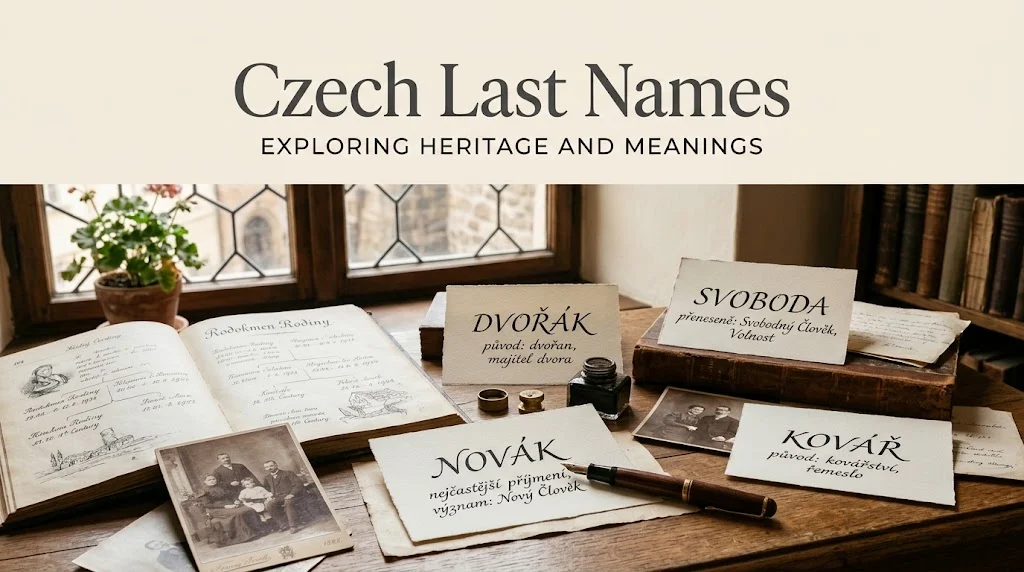
Czech last names are family names rooted in Czech and wider Central European history. They often come from occupations, personal names, physical traits, places, or nicknames. Examples include Novák, meaning newcomer, and Kovář, meaning blacksmith.
A last name can tell a fascinating story about the people who carried it generations ago. It may point to an ancestor’s occupation, describe a personal trait, reveal a connection to a place, or preserve a family tradition. Czech last names are especially interesting because they reflect centuries of Czech language, Slavic culture, and Central European history.
Some Czech surnames have straightforward meanings. Novák is associated with a newcomer, while Kovář refers to a blacksmith. Others developed from first names, nicknames, animals, plants, or regional identities. These names offer clues about everyday life in the Czech lands long before modern family records became widely accessible.
Czech surnames also have distinctive linguistic features. Many women’s surnames traditionally use the ending -ová, while surnames such as Černý and Veselý change their endings according to grammatical gender.
Whether you are exploring your family tree, choosing a surname for a fictional character, or simply curious about Czech heritage, this guide introduces ten surnames, their commonly understood meanings, and the traditions behind them.
Novák
Meaning: Newcomer or new arrival.
Origin: Czech and other Slavic naming traditions.
Personality and Style: Novák has a classic, straightforward, distinctly Central European feel. As a surname, it is associated with the idea of someone new to a community rather than a particular personality trait.
Historical Background: Novák is widely recognized as one of the most common Czech surnames. Historically, communities needed ways to distinguish people who shared the same first name. Calling someone a newcomer was one practical solution. The surname developed from the Czech word nový, meaning new.
Best For: Family history research, historical fiction, Czech characters, and readers interested in common surnames.
Popularity: Established and highly recognizable in Czech naming traditions.
Cultural Appeal: Novák provides a simple example of how an everyday description could become a hereditary family name.
Related Surnames: Novotný, Nový, Nováček, Neumann.
Why It Still Works Today: Its familiar spelling and long history make Novák an excellent starting point for anyone exploring Czech surnames. The feminine form is traditionally Nováková.
Svoboda
Meaning: Freedom or liberty; the surname’s historical development can also reflect social status.
Origin: Czech.
Personality and Style: Svoboda has a strong, memorable sound and a meaningful association with independence. These are impressions readers may attach to the name, not proven personality traits of people who carry it.
Historical Background: The Czech word svoboda means freedom. The surname is commonly explained through historical social conditions and the status of people who were free from certain obligations. However, the precise origin of an individual family’s surname cannot always be established from its modern meaning alone.
Best For: Genealogy, historical writing, fictional characters, and people interested in surnames with meaningful word roots.
Popularity: A well-established Czech surname.
Cultural Appeal: Its direct connection to freedom makes Svoboda particularly memorable to readers interested in names with symbolic meanings.
Related Surnames: Svobodník, Volný, Dvořák, Veselý.
Why It Still Works Today: Svoboda combines a recognizable Czech form with a word that has meaning beyond a family name. The traditional feminine form is Svobodová.
Novotný
Meaning: New or newcomer-related; historically associated with someone new to a place or community.
Origin: Czech.
Personality and Style: Novotný feels traditional, polished, and distinctly Czech. Its spelling includes the accented letter ý, which is an important part of standard Czech orthography.
Historical Background: Novotný belongs to the same broad family of surnames connected with the Czech word nový, meaning new. Such surnames could distinguish newcomers or people who were relatively new residents of a village. Although Novotný and Novák have related meanings, they are separate surnames with their own histories.
Best For: Czech ancestry research, historical novels, contemporary Czech characters, and surname lists.
Popularity: A long-established and recognizable surname in the Czech Republic.
Cultural Appeal: Novotný offers a good example of how similar word roots can produce several different surnames.
Related Surnames: Novák, Nový, Nováček, Neumann.
Why It Still Works Today: It retains a traditional Czech identity while remaining recognizable in modern settings. Its feminine form is Novotná, following the adjective-like surname pattern.
Dvořák
Meaning: Historically associated with a dvůr, or courtyard, farmyard, or estate; the exact surname history may depend on context.
Origin: Czech.
Personality and Style: Dvořák has a strong, distinctive sound. Its diacritic, the acute accent over á, helps preserve the correct Czech spelling and pronunciation.
Historical Background: Czech surname references often connect Dvořák with the word dvůr. Historical interpretations include associations with a farmstead or a person connected with a manor or estate. The exact social meaning should not be reduced to a single universal definition for every family.
Best For: Czech genealogy, heritage projects, historical fiction, and people exploring traditional Central European names.
Popularity: One of the best-known Czech surnames.
Cultural Appeal: The name is also widely associated with composer Antonín Dvořák, whose international reputation has made the surname familiar to music lovers.
Related Surnames: Dvorský, Dvořáček, Dvořáková, Sedlák.
Why It Still Works Today: Dvořák carries a strong connection to Czech cultural history. The traditional feminine form is Dvořáková.
Černý
Meaning: Black or dark.
Origin: Czech, from the adjective černý.
Personality and Style: Černý is short, bold, and visually distinctive. The meaning may suggest darkness or a dark color in a fictional naming context, but it should not be used to assume anything about a real person’s appearance or character.
Historical Background: Descriptive surnames developed in many European communities. A name based on a color could originally have been a nickname or another way to distinguish one person from others with the same first name. The original reason for a particular family’s surname may no longer be known.
Best For: Czech heritage research, fictional characters, historical stories, and lists of descriptive surnames.
Popularity: An established Czech surname with a clear dictionary meaning.
Cultural Appeal: Černý demonstrates how an ordinary descriptive word can become a lasting family name.
Related Surnames: Černík, Černoch, Bílý, Šedivý.
Why It Still Works Today: Its concise form and direct meaning make it easy to remember. The traditional feminine form is Černá, rather than Černýová, because the original surname is adjective-based.
Procházka
Meaning: Associated with walking, a stroll, or wandering.
Origin: Czech.
Personality and Style: Procházka feels traditional and lively. Its connection to walking can make it an interesting choice for a fictional traveler or an outdoors-loving character, although a surname does not establish a person’s actual interests.
Historical Background: The surname is commonly linked to the Czech verb procházet se, meaning to walk or stroll. Like many surnames originating from activities or nicknames, it may have developed as a way to distinguish someone in a local community.
Best For: Family history research, Czech character names, historical fiction, and surname meaning collections.
Popularity: A recognizable Czech surname with a long-standing place in Czech naming traditions.
Cultural Appeal: Procházka illustrates how an everyday action could become part of a family’s inherited identity.
Related Surnames: Chodec, Pospíšil, Krok, Tůma.
Why It Still Works Today: It has a distinctive Czech spelling and a meaning that is relatively easy to explain. Its traditional feminine form is Procházková.
Kučera
Meaning: Commonly linked to curly hair or a curly-haired person.
Origin: Czech and related Central European naming traditions.
Personality and Style: Kučera feels approachable, traditional, and memorable. Its historical association with a physical feature places it within a broad group of descriptive surnames found throughout Europe.
Historical Background: The surname is generally connected with words for curls or curly hair. Such descriptive names could begin as informal labels used to distinguish people in a community. Over time, these labels could become hereditary surnames.
Best For: Czech genealogy, historical characters, cultural research, and readers interested in surnames based on appearance.
Popularity: A familiar Czech surname.
Cultural Appeal: Kučera is an example of how surnames often preserve traces of the everyday language used by earlier generations.
Related Surnames: Kudrna, Kadeřábek, Černý, Veselý.
Why It Still Works Today: Kučera has a recognizable Czech character and an understandable linguistic association. The traditional feminine form is Kučerová.
Kovář
Meaning: Blacksmith.
Origin: Czech, from the word kovář.
Personality and Style: Kovář has a strong occupational identity. For readers creating a historical character, the meaning can evoke traditional metalworking, skilled craftsmanship, and village trades.
Historical Background: Occupational surnames are among the most widely recognized surname types in Europe. A blacksmith worked with metal to create or repair tools, horseshoes, and other useful objects. The Czech surname Kovář belongs to this occupational group.
Best For: Genealogy, historical fiction, heritage research, and people looking for surnames with clear meanings.
Popularity: A traditional and recognizable Czech surname.
Cultural Appeal: Kovář connects a family name to an important historical trade. Similar occupational surnames developed in neighboring countries, although their spellings and language roots differ.
Related Surnames: Kovářík, Kovářová, Švec, Krejčí.
Why It Still Works Today: Its occupational origin makes the meaning relatively easy to understand. The traditional feminine form is Kovářová.
Veselý
Meaning: Cheerful, merry, or happy.
Origin: Czech, from the adjective veselý.
Personality and Style: Veselý has a bright, friendly sound. Its meaning makes it attractive to writers looking for a surname with a positive association, but it does not tell us whether someone who carries it is actually cheerful.
Historical Background: Descriptive surnames based on personal characteristics developed in many parts of Europe. Veselý is commonly associated with a cheerful or merry person. The original nickname behind a particular family name may not be documented.
Best For: Czech ancestry research, fictional characters, traditional surname collections, and readers who enjoy names with positive meanings.
Popularity: An established Czech surname.
Cultural Appeal: Veselý offers a simple example of a personal description becoming a family name that can last for generations.
Related Surnames: Veselka, Radostný, Šťastný, Černý.
Why It Still Works Today: Its meaning is easy to remember, and its spelling reflects Czech language patterns. The traditional feminine form is Veselá.
Hájek
Meaning: Commonly interpreted as a small grove or copse.
Origin: Czech.
Personality and Style: Hájek feels gentle, traditional, and connected with nature. The meaning can appeal to readers interested in woodland imagery, rural history, and surnames linked to landscapes.
Historical Background: The surname is generally associated with háj, a Czech word for a grove. Place-based and landscape-related surnames could identify someone through the area where they lived or through a nearby natural feature. The exact origin of an individual family’s name may differ.
Best For: Genealogy, nature-inspired fictional characters, Czech heritage projects, and surname research.
Popularity: A recognized Czech surname with a nature-related meaning.
Cultural Appeal: Hájek shows that surnames did not always come from jobs or personal traits. The surrounding landscape could also influence how families were identified.
Related Surnames: Hájková, Háj, Lesák, Lesný.
Why It Still Works Today: Its connection to a grove gives it a natural, memorable meaning while keeping a traditional Czech form. The traditional feminine form is Hájková.
Quick Comparison Table
| Surname | Commonly Explained Meaning | Origin or Type | Style |
|---|---|---|---|
| Novák | Newcomer | Czech, descriptive | Classic |
| Svoboda | Freedom; historically linked to social status | Czech, descriptive | Meaningful |
| Novotný | New or newcomer-related | Czech, descriptive | Traditional |
| Dvořák | Associated with a courtyard or estate | Czech, place or status-related | Historic |
| Černý | Black or dark | Czech, descriptive | Bold |
| Procházka | Walking or strolling | Czech, nickname-related | Distinctive |
| Kučera | Curly-haired person | Czech, descriptive | Traditional |
| Kovář | Blacksmith | Czech, occupational | Strong |
| Veselý | Cheerful or merry | Czech, descriptive | Positive |
| Hájek | Small grove | Czech, nature-related | Gentle |
How to Choose the Right Czech Last Name
Choosing a Czech surname for genealogy, a character, or a creative project takes more than selecting a name with an appealing meaning.
Start with the purpose. If you are researching your family, prioritize documented family records. If you are naming a fictional character, consider the person’s background, age, setting, and family history.
Understand the meaning. Some Czech surnames have clear word roots, while others developed from older personal names, regional expressions, or historical nicknames. Treat simple translations as starting points rather than proof of a family’s ancestry.
Pay attention to spelling. Czech uses diacritics, including č, ř, š, and á. These marks are part of the spelling, not decoration. When possible, preserve them in names such as Černý, Dvořák, and Kovář.
Consider feminine forms. Many traditional Czech feminine surnames end in -ová. For adjective-based surnames, the ending may change in another way: Černý becomes Černá, and Veselý becomes Veselá. Contemporary naming practices also allow exceptions.
Check pronunciation. If you are using a Czech surname in a story, take time to learn how it is pronounced. Correct pronunciation adds authenticity and helps prevent avoidable mistakes.
Research the family connection. A surname can have more than one possible historical explanation. Genealogical records, regional history, and family documents are often more useful than a surname’s modern dictionary translation.
Most Popular Czech Last Names
The following are well-known Czech surnames. Exact rankings depend on the source, date, and whether masculine and feminine forms are counted separately.
- Novák
- Svoboda
- Novotný
- Dvořák
- Černý
- Procházka
- Kučera
- Veselý
- Horák
- Němec
- Marek
- Pokorný
- Pospíšil
- Hájek
- Král
Many of these surnames developed from common words, occupations, personal names, or descriptions. For example, Horák is associated with hilly or mountainous areas, while Král means king. These meanings can be helpful clues, but they do not prove a particular family’s social status or geographic origin.
Traditional Czech Last Names Making a Comeback
Traditional surnames remain part of everyday life in the Czech Republic, so they are not necessarily vintage names waiting to return. However, readers researching historical families or building period settings may be especially interested in surnames that reflect older trades, landscapes, and community roles.
Examples include:
- Kovář — blacksmith
- Krejčí — tailor
- Švec — shoemaker
- Mlynář — miller
- Sedlák — farmer or peasant
- Kolář — wheelwright
- Bednář — cooper or barrel maker
- Hájek — small grove
- Dvořák — associated with a courtyard or estate
- Vacek — a surname derived from a personal-name tradition
These names can help illustrate the occupations and social structures that shaped Czech communities. Their age and exact history, however, should be established through individual records rather than assumed from the surname alone.
Modern Czech Surname Trends
Czech surnames preserve traditional language patterns while adapting to modern life. One of the most noticeable features is the feminine form of many surnames.
For example, the traditional masculine form Novák corresponds to Nováková, while Kovář corresponds to Kovářová. Adjective-based names follow different patterns: Černý commonly corresponds to Černá, and Veselý to Veselá.
The suffix -ová has a long history in Czech naming practice. However, Czech law now allows women greater choice in registering surnames without the traditional feminine suffix under the applicable rules. Therefore, not every Czech woman will use an -ová form.
International families may also encounter Czech surnames without diacritics in passports, databases, or English-language records. These simplified spellings can make online searching easier, but they may obscure distinctions between Czech letters.
For genealogy, check both the original spelling and possible variations. This is especially useful when searching digitized records or historical documents that used different spelling conventions.
What Do Czech Last Names Reveal About Family History?
Czech surnames can offer clues about the lives of earlier generations. Researchers commonly group them by their possible origins.
Occupational surnames: Kovář means blacksmith, while Krejčí means tailor. These names can point toward trades that were important in historical communities.
Descriptive surnames: Černý means black or dark, and Veselý means cheerful or merry. Such surnames may have begun as nicknames.
Nature-related surnames: Hájek is associated with a small grove. Other Czech surnames refer to plants, animals, or features of the landscape.
Personal-name surnames: Some family names developed from given names and their historical variants. Their origins may be harder to recognize because older forms changed over time.
Place- or status-related surnames: Certain surnames are linked to settlements, landscapes, estates, or historical social roles. These connections require careful interpretation.
A surname is a useful research clue, but it cannot independently confirm ethnicity, nationality, occupation, or a specific family line. Parish registers, civil records, census material, and local archives can help connect a surname to an actual family history.
Czech Last Names and Their Feminine Forms
One distinctive feature of Czech surnames is the way many forms change according to grammatical gender.
| Masculine Form | Traditional Feminine Form |
|---|---|
| Novák | Nováková |
| Svoboda | Svobodová |
| Dvořák | Dvořáková |
| Černý | Černá |
| Veselý | Veselá |
| Kovář | Kovářová |
| Kučera | Kučerová |
| Procházka | Procházková |
| Hájek | Hájková |
| Novotný | Novotná |
These are standard traditional examples, but individual cases can vary because of legal choices, family preferences, foreign surnames, and naming history. When researching a real person, use the form they actually use rather than assuming the form from a grammar rule.
FAQs
What is the most common Czech last name?
Novák is widely reported as the most common Czech surname, although rankings can vary by date and by how masculine and feminine forms are counted.
What are some common Czech last names?
Recognizable Czech surnames include Novák, Svoboda, Novotný, Dvořák, Černý, Procházka, Kučera, Veselý, and Hájek.
Why do many Czech women’s last names end in -ová?
The ending -ová is a traditional way of forming many feminine Czech surnames. For example, Novák becomes Nováková.
What does Novák mean in Czech?
Novák is associated with the Czech word nový, meaning new. Historically, the surname could distinguish a newcomer or someone newly settled in a community.
What does Dvořák mean?
Dvořák is commonly connected with the Czech word dvůr, meaning a courtyard, farmyard, or estate.
Conclusion
Czech last names preserve fascinating clues about language, work, geography, and everyday life in Central Europe. Names such as Novák and Novotný are connected with the idea of being new to a community, Kovář points to the traditional craft of blacksmithing, and Hájek carries an association with a small grove.
These meanings make Czech surnames useful for family-history research, historical writing, and anyone curious about Czech heritage. Still, a surname’s modern translation is only one part of its story. The history of a particular family may be more complex, shaped by migration, spelling changes, and regional traditions.
As you explore Czech last names, choose a favorite, investigate its roots, and compare what you discover with trustworthy linguistic and historical sources. Share this guide with other surname enthusiasts, and leave a comment with the Czech surname whose meaning interests you most.
Discover More Related Articles:








3 thoughts on “Czech Last Names | Beautiful Surnames & Meanings In 2026”