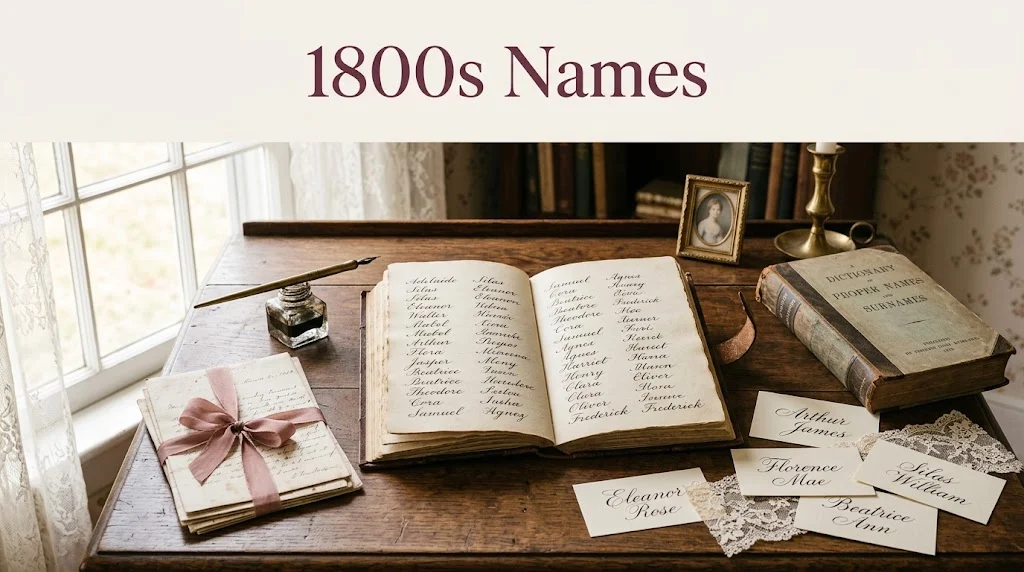
1800s names are first names used during the 19th century, including classics such as Clara, Florence, Eleanor, Henry, Arthur, and Theodore. Many remain appealing today because of their historical roots, elegant sounds, and timeless character.
Some names never lose their charm. They remind us of handwritten letters, beautiful old books, family portraits, and a time when names often carried a strong sense of tradition. 1800s names offer that special combination of history, elegance, and personality that many modern parents and writers love.
The 19th century, spanning 1800 to 1899, included the Victorian era, major social changes, and different naming traditions across Europe, North America, and other parts of the world. Names varied by country, religion, language, and social background. Some were inspired by the Bible or classical history, while others became fashionable through royalty, literature, and well-known public figures.
Today, vintage names appeal to parents looking for something meaningful and familiar without feeling ordinary. They are also useful for writers creating historical characters, readers exploring genealogy, and anyone who enjoys old-fashioned names with lovely nickname options.
In this guide, we explore ten memorable names associated with historical naming traditions, including their meanings, origins, styles, and possible nicknames. Whether you love delicate feminine names or strong classic names for boys, these choices offer plenty of inspiration.
Clara
Meaning: Bright, clear, or famous.
Origin: Latin, through the name Clarus.
Personality: Clara feels graceful, intelligent, gentle, and quietly confident. It has a simple elegance that works well for a thoughtful character or a child with a classic name.
Style: Vintage, elegant, feminine, timeless.
Best For: Baby girl, daughter, historical character, novel protagonist, or affectionate nickname.
Popularity: Clara was established long before the 1800s and was used during the 19th century. It has also remained familiar in later generations.
Emotional Appeal: Clara sounds delicate without being overly elaborate. Its clear pronunciation and positive meaning make it appealing to families who prefer names with understated beauty.
Pop Culture Reference: Clara appears in The Nutcracker, the famous ballet and story associated with the Christmas season.
Similar Nicknames: Clare, Claire, Clarabel, Clary, Cee.
Why It Still Works Today: Clara fits comfortably into both historical and modern settings. It is short, easy to spell, and elegant without sounding overly formal. Parents who love vintage girl names may appreciate how naturally Clara works for a child and an adult.
Florence
Meaning: Flourishing or prosperous, traditionally associated with the Latin word florens.
Origin: Latin.
Personality: Florence feels creative, capable, thoughtful, and sophisticated. It has an old-fashioned charm that can also suggest independence and determination.
Style: Victorian, literary, elegant, vintage.
Best For: Baby girl, daughter, writer, historical character, or classic nickname inspiration.
Popularity: Florence was a familiar name in English-speaking countries during the 19th and early 20th centuries. It is often associated with the vintage-name revival.
Emotional Appeal: The name has a graceful rhythm and a positive association with flourishing. It can feel both gentle and strong, making it suitable for different personalities.
Pop Culture Reference: Florence Nightingale, the pioneering British nurse born in 1820, is one of the best-known historical bearers of the name.
Similar Nicknames: Flo, Florrie, Flora, Flossie, Ren.
Why It Still Works Today: Florence offers several nickname options, from the cheerful Flo to the sweet Florrie. Its long history gives it substance, while its floral associations make it feel fresh and welcoming.
Eleanor
Meaning: Uncertain; its exact etymology is debated.
Origin: Medieval European usage, with a long history in English and other European naming traditions.
Personality: Eleanor feels intelligent, composed, independent, and dignified. It suits someone who prefers a name with presence rather than a highly decorative sound.
Style: Classic, vintage, refined, literary.
Best For: Baby girl, daughter, historical character, writer, or formal name with playful nicknames.
Popularity: Eleanor was used in the 1800s and has remained a familiar classic. Its continued use across generations gives it a lasting appeal.
Emotional Appeal: Eleanor feels substantial and graceful at the same time. It has a formal quality for official settings but can become warm and personal through a nickname.
Pop Culture Reference: Eleanor is associated with Eleanor of Aquitaine, the influential medieval queen, and many later historical and literary figures.
Similar Nicknames: Ellie, Nora, Nell, Nellie, Ella.
Why It Still Works Today: Eleanor adapts easily to different preferences. Someone who likes formal names may use the full version, while Ellie or Nora provides a more relaxed everyday alternative.
Adelaide
Meaning: Noble nature or noble kind.
Origin: Germanic, through forms related to the name Adalheidis.
Personality: Adelaide feels refined, confident, thoughtful, and romantic. It has a stately sound that makes it especially attractive to people who love antique names.
Style: Victorian, aristocratic, elegant, vintage.
Best For: Baby girl, daughter, historical fiction character, or a family seeking an uncommon classic.
Popularity: Adelaide has a long European history and was used during the 19th century. Its antique quality has made it appealing to modern vintage-name enthusiasts.
Emotional Appeal: Adelaide feels special without requiring an unusual spelling. The name’s connection with nobility gives it a dignified character.
Pop Culture Reference: Queen Adelaide, the wife of King William IV, was a notable historical figure of the 19th century. The Australian city of Adelaide also bears her name.
Similar Nicknames: Addie, Ada, Adele, Della, Lady.
Why It Still Works Today: Adelaide combines a distinctive full name with short, friendly nicknames. Addie feels casual, Ada feels classic, and the complete name works beautifully in formal settings.
Josephine
Meaning: Commonly interpreted as “God will add,” through the Hebrew name Joseph.
Origin: French feminine form of Joseph, ultimately from Hebrew.
Personality: Josephine feels warm, intelligent, artistic, and self-assured. It has a romantic sound without feeling overly delicate.
Style: Vintage, classic, elegant, literary.
Best For: Baby girl, daughter, sister, historical character, or someone who likes multiple nickname choices.
Popularity: Josephine was used throughout the 19th century and has a long history across Europe and North America.
Emotional Appeal: The name has a welcoming quality and offers several different styles within one name. It can feel formal, sweet, playful, or sophisticated depending on the nickname.
Pop Culture Reference: Empress Joséphine, the first wife of Napoleon Bonaparte, was a prominent historical figure, although her life began before the 1800s.
Similar Nicknames: Josie, Jo, Joey, Posy, Fina.
Why It Still Works Today: Josephine gives families flexibility. Josie is friendly and playful, Jo is short and practical, and the full name carries a timeless elegance that suits every age.
Henry
Meaning: Home ruler or ruler of the household.
Origin: Germanic, through the name Heinrich.
Personality: Henry feels dependable, intelligent, friendly, and quietly strong. It has a traditional sound that can suit a serious historical character or a cheerful modern child.
Style: Classic, masculine, vintage, timeless.
Best For: Baby boy, son, brother, historical character, or traditional family name.
Popularity: Henry was widely used in the 1800s, particularly in English-speaking communities. Its long history has helped it remain a recognizable classic.
Emotional Appeal: Henry has a familiar, reassuring sound. It is traditional without feeling difficult or overly formal, and it pairs well with a wide range of middle and surnames.
Pop Culture Reference: Henry David Thoreau, the American writer and philosopher, was born in 1817. Many kings and historical figures have also carried the name Henry.
Similar Nicknames: Hank, Harry, Hal, Hen, Henny.
Why It Still Works Today: Henry is easy to spell, easy to pronounce, and suitable for many stages of life. Parents can keep the full name or choose a more casual nickname such as Hank or Harry.
Arthur
Meaning: Uncertain; often associated with the legendary King Arthur, though the name’s deeper etymology is debated.
Origin: Medieval British and Celtic-associated naming traditions.
Personality: Arthur feels courageous, thoughtful, loyal, and dignified. It has a literary quality that can suggest adventure and leadership without sounding overly modern.
Style: Vintage, literary, classic, strong.
Best For: Baby boy, son, historical character, fantasy protagonist, or traditional family name.
Popularity: Arthur was well established during the 19th century and remained a recognizable classic in later generations.
Emotional Appeal: Arthur has a strong cultural history, especially through the legends of King Arthur and the Knights of the Round Table. It can evoke courage, loyalty, and imagination.
Pop Culture Reference: King Arthur is a legendary figure in British literature and folklore, inspiring countless stories, plays, and films.
Similar Nicknames: Art, Artie, Archie, Ari, Artur.
Why It Still Works Today: Arthur offers the balance of strength and warmth that many families seek. It suits historical and fantasy characters particularly well, yet it remains practical for everyday use.
Theodore
Meaning: Gift of God.
Origin: Greek, from Theodoros.
Personality: Theodore feels thoughtful, curious, warm, and intellectual. It has a scholarly quality while remaining friendly enough for everyday life.
Style: Vintage, classic, refined, literary.
Best For: Baby boy, son, historical character, writer, or anyone who wants a full name with several nickname options.
Popularity: Theodore was used during the 19th century and has a long history in English-speaking countries and beyond.
Emotional Appeal: Its positive meaning gives the name a sense of gratitude and affection. The longer form feels dignified, while its shorter forms are easygoing and approachable.
Pop Culture Reference: Theodore Roosevelt, the 26th president of the United States, was born in 1858.
Similar Nicknames: Theo, Teddy, Ted, Teo, Thee.
Why It Still Works Today: Theodore works across generations and offers several distinct nickname styles. Theo feels modern and concise, Teddy sounds affectionate, and Ted has a classic, understated appeal.
Walter
Meaning: Ruler of the army or powerful warrior.
Origin: Germanic, through the name Walter and related forms.
Personality: Walter feels dependable, practical, thoughtful, and strong. It has a sturdy traditional sound that suits a person who values reliability and honesty.
Style: Old-fashioned, classic, masculine, understated.
Best For: Baby boy, son, grandfather-inspired name, historical character, or family name.
Popularity: Walter was well established in the 19th century and became especially familiar in English-speaking countries.
Emotional Appeal: Walter has a straightforward charm. It does not depend on elaborate sounds or trendy spelling, making it appealing to families who value familiar names with history.
Pop Culture Reference: Walter Whitman, better known as Walt Whitman, was an influential American poet born in 1819.
Similar Nicknames: Walt, Wally, Wat, Wallie, Wal.
Why It Still Works Today: Walter has a strong vintage personality and practical nickname options. Walt feels concise and confident, while Wally gives the name a warmer, more playful tone.
Samuel
Meaning: Commonly interpreted as “God has heard,” although the precise derivation is discussed in biblical scholarship.
Origin: Hebrew, from the biblical name Shemu’el.
Personality: Samuel feels thoughtful, kind, reliable, and grounded. It has a gentle strength that works well for a name rooted in a long religious and cultural history.
Style: Traditional, biblical, classic, timeless.
Best For: Baby boy, son, brother, historical character, or a family looking for a familiar vintage name.
Popularity: Samuel was used for centuries before the 1800s and remained a familiar name during the 19th century.
Emotional Appeal: The name’s biblical connection and traditional interpretation give it a hopeful, spiritual quality. It also sounds approachable rather than overly formal.
Pop Culture Reference: Samuel Clemens, better known by his pen name Mark Twain, was born in 1835 and became one of America’s best-known writers.
Similar Nicknames: Sam, Sammy, Sami,uel, Samwise.
Why It Still Works Today: Samuel is easy to recognize and adapts to many settings. Sam feels simple and friendly, while Sammy has a more affectionate tone. The full name remains appropriate throughout adulthood.
Quick Comparison Table
| Name | Meaning | Style | Best For |
|---|---|---|---|
| Clara | Bright or clear | Elegant vintage | Baby girl |
| Florence | Flourishing | Victorian classic | Baby girl |
| Eleanor | Debated etymology | Refined | Baby girl |
| Adelaide | Noble nature | Antique elegance | Baby girl |
| Josephine | God will add | Romantic classic | Baby girl |
| Henry | Home ruler | Timeless classic | Baby boy |
| Arthur | Uncertain; legendary associations | Literary vintage | Baby boy |
| Theodore | Gift of God | Refined classic | Baby boy |
| Walter | Ruler of the army | Traditional | Baby boy |
| Samuel | Commonly, God has heard | Biblical classic | Baby boy |
How to Choose the Perfect 1800s Name
Choosing a historical name can be exciting, especially when you want a name that feels distinctive but still works in modern life.
Decide which historical period you like. The 1800s covered a full century, so a name used in 1805 may have a different feel from one popular in the late Victorian period. If historical accuracy matters, narrow your research to a particular decade.
Consider the country and language. Naming traditions varied across England, Ireland, Scotland, France, Germany, the United States, and other regions. Choose names that fit the cultural background you want to represent.
Look at the meaning. Some names express ideas such as strength, kindness, faith, or prosperity. Others have uncertain origins. Check reliable sources instead of relying on every claim found in baby-name lists.
Try the nickname. A formal name can offer several casual alternatives. Josephine becomes Josie, Theodore becomes Theo, and Henry can become Hank or Harry. Choose a full name you enjoy saying and a short form that feels natural.
Say the full name aloud. Test the first name with the middle name and surname. Consider pronunciation, spelling, rhythm, and whether the complete combination feels comfortable.
Think about the person’s future. A name should work for a baby, a schoolchild, a teenager, and an adult. A good vintage name can feel playful in childhood while remaining professional later in life.
Separate historical accuracy from vintage style. If you are naming a fictional character, you may want a name documented in a particular place and year. If you are choosing a baby name, you may simply want the charm of an older name.
Most Popular 1800s Names
Popularity depended on the country, decade, and community. The following names have strong historical associations and long records of use, but this is an inspiration list rather than a ranked list of the most popular names across the entire 19th century.
Vintage names for girls:
- Mary
- Elizabeth
- Sarah
- Clara
- Florence
- Emma
- Alice
- Margaret
- Catherine
- Josephine
Vintage names for boys:
- William
- John
- James
- Henry
- George
- Charles
- Arthur
- Thomas
- Samuel
- Theodore
Many of these names existed well before the 1800s. Their inclusion reflects their historical use and lasting appeal, not a claim that every name reached peak popularity during the same decade.
Vintage Nicknames Making a Comeback
Old-fashioned nicknames can make a traditional name feel friendly and personal. They also help families create a softer everyday version of a more formal name.
Examples include:
- Florrie: A vintage nickname for Florence.
- Josie: A warm short form of Josephine.
- Nellie: Historically used as a nickname for names such as Eleanor or Helen.
- Addie: A friendly nickname for Adelaide.
- Artie: A playful short form of Arthur.
- Teddy: An affectionate nickname for Theodore.
- Hank: A traditional nickname for Henry.
- Wally: A casual short form of Walter.
- Sammy: A familiar nickname for Samuel.
- Harry: A traditional form associated with Henry.
Nickname traditions vary by family and region. Some short forms also developed independently as given names, so they do not always have a single fixed origin.
Modern Trends in 1800s Names
Vintage names appeal to modern families for several reasons. They often have familiar spellings, established histories, and nickname options that suit different personalities.
Shortened classics: Names such as Theo, Sam, and Artie offer a relaxed everyday style while preserving a connection to a longer historical name.
Elegant feminine names: Clara, Adelaide, Florence, and Josephine appeal to people who enjoy names with a romantic or literary quality.
Literary inspiration: Readers may choose names associated with writers, poets, historical novels, and classic stories. This can make a name feel connected to a favorite book or period.
Family-history names: Some people rediscover names through old family records, census documents, letters, and photographs. A name that belonged to a great-great-grandparent can create a meaningful connection across generations.
Vintage without being obscure: Many 19th-century names remain recognizable today. This makes them useful for parents who want a name with character without needing to explain its spelling every time.
A name’s current popularity can change, so anyone seeking precise rankings should consult official birth-registration data for the relevant country and year.
Why Were Names in the 1800s Different?
Names in the 1800s reflected a mixture of religion, family traditions, regional languages, literature, royalty, and social customs. In many communities, children were named after relatives or religious figures. Some families also reused names across generations to honor parents, grandparents, or other loved ones.
The Victorian period, which broadly covered the reign of Queen Victoria from 1837 to 1901, influenced naming fashion in Britain and beyond. However, the 19th century was not culturally uniform. A family in rural Ireland, a family in France, and a family in the United States could follow very different naming customs.
Migration and religious traditions also shaped names. Biblical names such as Samuel appeared in many communities, while local languages preserved distinctive regional naming patterns.
For this reason, the most accurate way to research a historical name is to consider the time, place, language, and family background rather than treating all 1800s names as one shared list.
FAQs
What were the most common names in the 1800s?
Common names varied by country and decade. In English-speaking communities, names such as Mary, Elizabeth, John, William, James, and George were familiar historical choices.
What are some beautiful 1800s girl names?
Beautiful vintage girl names include Clara, Florence, Eleanor, Adelaide, Josephine, Alice, Emma, Margaret, and Catherine.
What are some strong 1800s boy names?
Henry, Arthur, Theodore, Walter, Samuel, William, Charles, and George are strong historical choices.
Are 1800s names still popular today?
Many names used during the 19th century remain familiar today. Their current popularity depends on the country, age group, and naming trends.
What are rare Victorian names?
The answer depends on the region and period. Names that seem unusual today may have been more familiar in certain communities during the Victorian era.
Conclusion
The charm of 1800s names comes from their history, meaningful traditions, and timeless sounds. Names such as Clara, Florence, and Josephine offer elegance, while Henry, Arthur, and Theodore bring a classic character that suits many styles. Whether you are choosing a baby name, building a fictional character, or exploring your family tree, these vintage choices provide a wonderful starting point.
Before making your final choice, explore the name’s origin, meaning, pronunciation, and cultural background. Consider how its nickname sounds and whether the full name feels comfortable for every stage of life. You do not have to choose the rarest name to find something special; sometimes, an established classic is exactly right.
Discover More Related Articles:
- Russian Women Names | Beautiful Ideas & Meanings In 2026
- Firbolg Names | Magical Ideas, Meanings & Nicknames In 2026