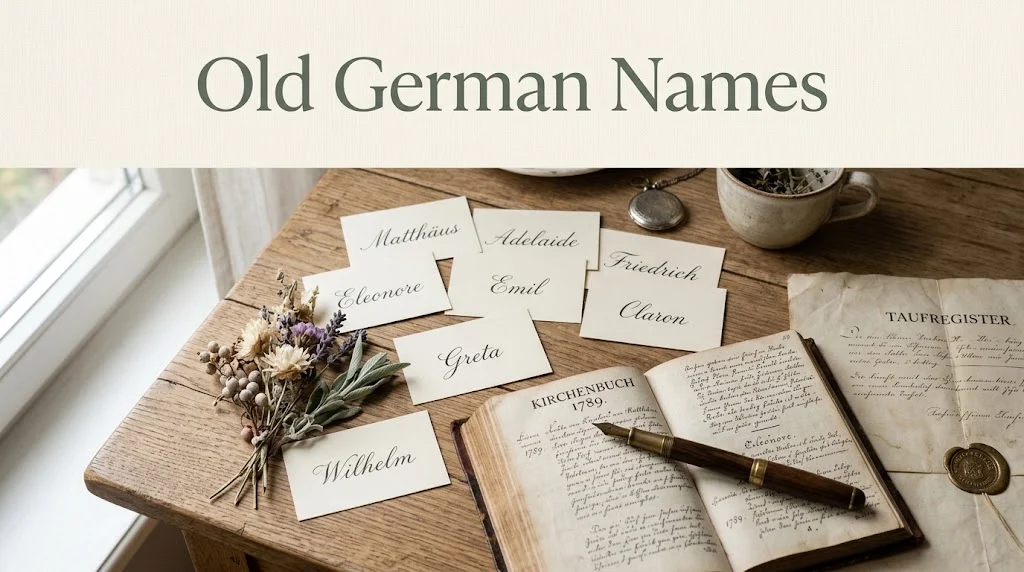
Old German names are traditional names rooted in German history and Germanic languages. Examples include Adelheid, Hildegard, Gertrud, Heinrich, Friedrich, and Konrad. Many combine ancient name elements associated with qualities such as strength, protection, leadership, and nobility.
Some names never lose their charm. They carry echoes of another time, connect generations, and offer something different from today’s most familiar choices. Old German names have this special appeal. From elegant vintage names once heard in European royal courts to strong Germanic names passed down through families, these choices offer history, character, and meaning.
Many traditional German names developed from Old High German or earlier Germanic languages. Their original elements often referred to ideas such as strength, protection, peace, honor, or leadership. Over time, these names evolved into the forms used in medieval records, family histories, and modern German-speaking communities.
Whether you are naming a baby, exploring your German ancestry, or simply drawn to vintage names, there are plenty of options worth discovering. Some feel formal and noble, while others have gentle, friendly nicknames that suit everyday life.
In this guide, we explore ten old German names, their meanings, origins, personalities, styles, and nickname possibilities. We also share practical naming tips to help you find a name that feels both historically meaningful and suitable for modern life.
Adelheid
Meaning: Often interpreted as “noble nature” or “of noble kind.”
Origin: Germanic, through Old High German name elements associated with nobility and kind or type.
Personality: Adelheid feels dignified, intelligent, graceful, and self-assured. Its long, elegant form gives it a strong historical character without making it feel harsh.
Style: Vintage, elegant, aristocratic, traditional, feminine.
Best For: Baby girl, daughter, family-history projects, historical characters, and anyone who loves classic European names.
Popularity: Adelheid is a traditional German name that is less familiar internationally than its related form Adelaide. Its vintage quality makes it appealing to parents seeking something distinctive.
Emotional Appeal: Adelheid combines a graceful sound with a meaning connected to nobility. It can feel like a meaningful link to German heritage.
Pop Culture Reference: The name is associated with historical European figures, including Saint Adelaide, whose Germanic name forms helped establish the Adelaide tradition.
Similar Nicknames: Heidi, Addie, Ada, Adele, Heidi.
Why It Still Works Today: Adelheid has several approachable short forms. Heidi and Ada feel friendly and modern, while the full name preserves its traditional character. It is a lovely option for parents who want a name that stands out without feeling invented.
Hildegard
Meaning: Commonly interpreted as “battle enclosure” or “protected in battle.”
Origin: Old High German, formed from elements associated with battle and protection or enclosure.
Personality: Hildegard feels wise, resilient, thoughtful, and strong. It carries the character of a name with a long history and a clear sense of purpose.
Style: Vintage, powerful, scholarly, traditional, distinctive.
Best For: Baby girl, daughter, historical fiction characters, and families who appreciate names with deep European roots.
Popularity: Hildegard is a traditional name that is now relatively uncommon in many places. Its rarity may appeal to parents who prefer names outside modern popular lists.
Emotional Appeal: Hildegard offers a feeling of strength and protection. Its historical associations also give it an intellectual and artistic quality.
Pop Culture Reference: One notable bearer was Hildegard of Bingen, a medieval German abbess, writer, composer, and visionary whose work remains historically important.
Similar Nicknames: Hilda, Hildy, Gardi, Heidi, Hilde.
Why It Still Works Today: Although the full name has a distinctly historical sound, shorter forms such as Hilda and Hilde are easier to use in everyday life. Hildegard is particularly appealing to parents who value individuality and a connection to medieval European history.
Gertrud
Meaning: Traditionally associated with strength and the spear.
Origin: German form of an old Germanic name built from elements commonly interpreted as “spear” and “strength.”
Personality: Gertrud feels practical, independent, dependable, and determined. It has a compact, sturdy sound that reflects its historical style.
Style: Vintage, strong, traditional, understated, classic.
Best For: Baby girl, daughter, family-history research, or a fictional character in a historical setting.
Popularity: Gertrud is an older German form of Gertrude. It is less familiar to many English speakers today, giving it a distinctive vintage feel.
Emotional Appeal: The name has an enduring, no-nonsense quality. It may appeal to families who want a traditional name with a strong meaning rather than a delicate or trendy sound.
Pop Culture Reference: Gertrude and related forms appear in European literature and historical records, although the exact German spelling has its own cultural character.
Similar Nicknames: Gerti, Trudi, Trude, Gertie, Gerda.
Why It Still Works Today: Gertrud offers a distinctive alternative to more common vintage names. Nicknames such as Trudi soften its formal sound, while the full form maintains a strong connection to German naming history.
Mathilde
Meaning: Commonly interpreted as “strength in battle” or “mighty in battle.”
Origin: Germanic, related to the Old High German elements maht (might or strength) and hiltja (battle).
Personality: Mathilde feels confident, thoughtful, graceful, and independent. It combines the strength of an old Germanic name with a refined, melodic ending.
Style: Elegant, vintage, literary, classic, feminine.
Best For: Baby girl, daughter, sister, historical characters, and families seeking an established European name.
Popularity: Mathilde remains familiar in parts of Europe, while its related forms, including Matilda, are widely recognized in English-speaking countries.
Emotional Appeal: Mathilde offers an appealing balance between strength and elegance. Its meaning suggests courage, while its sound feels graceful and timeless.
Pop Culture Reference: Matilda, a related form, appears in literature and popular culture, including Roald Dahl’s well-known children’s novel. This connection may make the broader name family familiar to readers.
Similar Nicknames: Mattie, Tilly, Tilda, Mati, Hilda.
Why It Still Works Today: Mathilde feels traditional without being difficult to adapt to modern life. Its shorter forms provide plenty of flexibility, making it suitable for families who like names that can feel both formal and affectionate.
Heinrich
Meaning: Commonly interpreted as “home ruler” or “ruler of the household.”
Origin: Old High German, from elements associated with home or household and ruler.
Personality: Heinrich feels confident, dependable, intelligent, and traditional. Its strong consonants give it a clear, formal sound.
Style: Classic, masculine, historic, dignified, traditional.
Best For: Baby boy, son, family-history research, and historical or literary characters.
Popularity: Heinrich has a long history in German-speaking countries. It may feel more formal than the English Henry, although both belong to the same broader name family.
Emotional Appeal: The name connects leadership with home and family. Parents who value historical names may appreciate its solid sound and longstanding place in European history.
Pop Culture Reference: Heinrich is associated with many historical German-speaking figures, including writers, rulers, scholars, and composers.
Similar Nicknames: Heini, Heinz, Hein, Rick, Henry.
Why It Still Works Today: Heinrich offers a more distinctive alternative to Henry while retaining a familiar underlying name tradition. Its shorter forms make it easier to use casually, while the full version carries a strong historical identity.
Friedrich
Meaning: “Peaceful ruler.”
Origin: Germanic, built from elements commonly associated with peace and ruler.
Personality: Friedrich feels thoughtful, composed, confident, and authoritative. Its meaning gives it a peaceful quality, while its traditional sound adds strength.
Style: Vintage, dignified, scholarly, classic, masculine.
Best For: Baby boy, son, family-history research, and anyone interested in historical German names.
Popularity: Friedrich is a long-established German form related to Frederick. It remains recognizable in historical and cultural contexts, although it may sound formal in everyday English conversation.
Emotional Appeal: The idea of peaceful leadership makes Friedrich attractive to families who want a strong name without an aggressive meaning.
Pop Culture Reference: Friedrich is associated with many prominent German-speaking figures, including philosopher Friedrich Nietzsche and composer Friedrich Kuhlau.
Similar Nicknames: Fritz, Fred, Freddie, Friedel, Rick.
Why It Still Works Today: Friedrich has history, meaning, and practical nickname options. Fritz gives it a lively, compact sound, while Freddie feels softer and more familiar to English speakers.
Konrad
Meaning: Commonly interpreted as “brave counsel” or “bold adviser.”
Origin: Old High German, from elements associated with boldness and counsel.
Personality: Konrad feels intelligent, reliable, thoughtful, and quietly confident. Its concise sound makes it strong without being overly elaborate.
Style: Traditional, understated, masculine, vintage, distinctive.
Best For: Baby boy, son, brother, historical character, or family name.
Popularity: Konrad is an established German form of Conrad. It is recognizable in German-speaking contexts and offers a less common alternative for families elsewhere.
Emotional Appeal: The meaning connects courage with wisdom. That combination makes Konrad appealing to parents who value thoughtful leadership rather than strength alone.
Pop Culture Reference: Konrad and Conrad appear in European literature and history. The exact spelling often reflects the language or cultural tradition in which the name is used.
Similar Nicknames: Koni, Kon, Koko, Conrad, Rad.
Why It Still Works Today: Konrad is short enough for modern use yet rich in history. It pairs well with both traditional and contemporary middle names and offers a distinctive German spelling without losing the familiarity of Conrad.
Otto
Meaning: “Wealth” or “fortune.”
Origin: Germanic, historically connected to name forms derived from an element meaning wealth or prosperity.
Personality: Otto feels cheerful, confident, friendly, and self-assured. Its short structure gives it a lively quality, while its history makes it feel established rather than newly invented.
Style: Vintage, short, classic, charming, masculine.
Best For: Baby boy, son, brother, pet name, or family nickname.
Popularity: Otto is an old Germanic name that has regained interest in some modern naming circles. Its compact form suits current preferences for short names with historical roots.
Emotional Appeal: The name is easy to say and remember. Its association with prosperity also gives it a positive meaning without making it sound overly formal.
Pop Culture Reference: Otto appears in European history and modern entertainment. Several historical German rulers and political figures bore the name.
Similar Nicknames: Otti, Ottie, Oto, O, Ott.
Why It Still Works Today: Otto is one of the easiest old German names to imagine on a modern child. It needs little shortening, works across age groups, and has a confident sound that does not depend on a passing trend.
Wilhelm
Meaning: Commonly interpreted as “resolute protector” or “determined guardian.”
Origin: Germanic, related to name elements associated with will or determination and protection or a helmet.
Personality: Wilhelm feels dependable, thoughtful, strong, and traditional. It carries a formal quality that suits families who enjoy historic names.
Style: Classic, vintage, formal, masculine, distinguished.
Best For: Baby boy, son, family-history research, historical fiction, and traditional naming styles.
Popularity: Wilhelm has a long history in German-speaking countries. Its English counterpart, William, is more familiar internationally, while Wilhelm retains a distinctly German character.
Emotional Appeal: The idea of determined protection makes Wilhelm a meaningful choice for families who value courage, loyalty, and responsibility.
Pop Culture Reference: Wilhelm is associated with historical German rulers, including Kaiser Wilhelm I and Kaiser Wilhelm II. These historical connections give the name a recognizable place in European history.
Similar Nicknames: Will, Willy, Wim, Helmi, Wil.
Why It Still Works Today: Wilhelm gives families a traditional full name with several accessible short forms. Will and Willy feel casual, while the complete name keeps its historical character.
Leopold
Meaning: Traditionally interpreted as “bold people” or “brave among the people.”
Origin: Germanic, through older name forms associated with boldness and the people. The historical development of its elements is more complex than the modern spelling suggests.
Personality: Leopold feels confident, cultured, thoughtful, and refined. It has a noble quality but also offers friendly nickname options.
Style: Vintage, aristocratic, elegant, traditional, distinctive.
Best For: Baby boy, son, historical character, or a family seeking an uncommon classic.
Popularity: Leopold has a long European history and remains recognizable in several countries. Its old-fashioned style may appeal to parents looking beyond common contemporary names.
Emotional Appeal: Leopold combines an elegant sound with associations of courage and community. It can feel distinguished without needing a complicated spelling.
Pop Culture Reference: Leopold appears in European royal history and literature. Several historical rulers and members of noble families used the name.
Similar Nicknames: Leo, Lenny, Poldi, Lee, Leon.
Why It Still Works Today: Leopold offers the best of both worlds: a formal vintage name and a very accessible short form. Leo, in particular, makes the name easy to use in contemporary settings while preserving its historic roots.
Quick Comparison Table
| Name | Meaning | Style | Best For |
|---|---|---|---|
| Adelheid | Noble nature | Elegant, vintage | Baby girl |
| Hildegard | Battle protection | Strong, historic | Baby girl |
| Gertrud | Strength and spear | Classic, sturdy | Baby girl |
| Mathilde | Strength in battle | Graceful, timeless | Baby girl |
| Heinrich | Ruler of the household | Traditional, dignified | Baby boy |
| Friedrich | Peaceful ruler | Classic, scholarly | Baby boy |
| Konrad | Brave counsel | Understated, strong | Baby boy |
| Otto | Wealth or fortune | Short, charming | Baby boy |
| Wilhelm | Resolute protector | Formal, historic | Baby boy |
| Leopold | Bold among the people | Noble, distinctive | Baby boy |
How to Choose the Perfect Old German Name
Choosing a historic name is easier when you consider its meaning, sound, and cultural background together.
Start with the meaning. Decide which ideas matter most to you. You might prefer strength, peace, wisdom, protection, prosperity, or nobility. Traditional Germanic names often combine two name elements, so their meanings can tell an interesting story.
Check the historical spelling. German names have changed over the centuries. A name may have an Old High German form, a medieval version, and a modern spelling. Decide whether you prefer a historically specific version or one that feels familiar today.
Think about pronunciation. Names such as Otto and Konrad are relatively straightforward for many English speakers. Names such as Adelheid and Hildegard may need more explanation. Say the full name aloud to see whether it feels comfortable.
Look at nickname options. A formal name can have a relaxed short form. Friedrich can become Fritz, Wilhelm can become Will, and Leopold can become Leo. Consider whether you like the full name and the everyday version.
Consider your family heritage. If you are researching German ancestry, look for names in family documents, church registers, and historical records. Spelling may vary across generations, regions, and languages.
Balance tradition and modern life. An old name does not have to sound outdated. A short form can make a historic name feel natural in a classroom, workplace, or social setting.
Verify the meaning. Online name lists sometimes oversimplify Germanic etymology. Look for trustworthy linguistic references and check whether a meaning is widely accepted or debated.
Most Popular Old German Names Today
Popularity varies by country, generation, and spelling. The following names are familiar examples of traditional German or Germanic names that may appeal to modern parents.
- Otto
- Friedrich
- Heinrich
- Wilhelm
- Konrad
- Leopold
- Adelheid
- Mathilde
- Hildegard
- Gertrud
These are examples of established names, not a verified current popularity ranking. For current birth statistics, consult official records from the relevant country or region.
Vintage German Names Making a Comeback
Vintage names often return when families begin looking for alternatives to recent naming trends. Their appeal comes from history, distinctive sounds, and connections to earlier generations.
Here are additional traditional names worth exploring:
- Anneliese: A German name formed from Anna and Liese, a form of Elisabeth.
- Greta: A traditional short form related to Margareta.
- Liesel: A German diminutive associated with Elisabeth.
- Frieda: A feminine name associated with peace.
- Hugo: A historic name connected with mind or spirit.
- Emil: A classic European name with Latin roots.
- Bruno: A traditional Germanic name with an old European history.
- Ernst: A German name associated with seriousness or earnestness.
- Clara: A classic name of Latin origin that has long been used in German-speaking countries.
- Ludwig: A traditional Germanic name associated with fame and battle.
Not every vintage name is originally Germanic. Some became traditional in Germany through Latin, Greek, Hebrew, or other European naming traditions.
Modern Old German Name Trends
Modern interest in old names often reflects a desire for individuality and a stronger connection to heritage. Parents may prefer a historic name because it feels substantial, meaningful, and less dependent on current fashion.
Short names such as Otto and Hugo are easy to spell and remember. Longer names such as Adelheid and Wilhelm offer a more formal, historical character, while nicknames make them practical for everyday life.
Another popular approach is to pair a traditional first name with a contemporary middle name. For example, Otto James or Mathilde Rose can combine old-world character with a familiar modern style.
Families researching German ancestry may also look for the exact spellings used by their ancestors. Names can differ across records because of regional dialects, changing spelling conventions, migration, and the languages used by record keepers.
The most important trend, however, is choosing a name that genuinely fits the family. A historic name can feel fresh when its meaning, sound, and personal connection matter more than its current ranking.
What Makes Old German Names Special?
Old German names are interesting because they preserve traces of earlier languages, values, and family traditions. Many traditional Germanic names were formed from meaningful elements. These could refer to peace, strength, protection, courage, fame, or leadership.
However, the term “old German names” can refer to several different things. It may describe names that originated in early Germanic languages, traditional names used in medieval German-speaking regions, or older names that became established in Germany even though their original roots were Latin, Hebrew, Greek, or elsewhere.
This distinction matters when researching a name’s meaning. For example, Friedrich has Germanic roots, while Clara comes from Latin but has a long history of use in German-speaking communities.
Old names can also reveal how languages change over time. Related names may appear in different forms across German, English, Dutch, Scandinavian, and other European traditions.
Understanding this background helps you choose a name for more than its sound. It gives you a clearer idea of where the name came from and how it developed.
Old German Names and Nicknames: A Quick Guide
What makes a name an old German name?
It may have originated in an early Germanic language, appeared in medieval German records, or been used in German-speaking communities for generations. The name’s exact history determines which category it belongs to.
Why are old German names popular with some parents?
They can offer meaningful histories, distinctive sounds, and links to family heritage. Some also have easy modern nicknames, making them practical for everyday use.
Are old German names suitable for modern babies?
Yes. Names such as Otto, Greta, Hugo, and Mathilde have traditional backgrounds but can work naturally in modern settings. The best choice depends on pronunciation, family preference, and cultural connection.
Do old German names always have Germanic origins?
No. German naming traditions also include names from Latin, Greek, Hebrew, and other languages. A name may be historically popular in Germany without originally coming from a Germanic language.
Can old German names be used as character names?
Yes. They can suit historical fiction, fantasy, family sagas, and contemporary stories. Research the relevant period and region if historical accuracy is important.
Are vintage German names different from ancient Germanic names?
Yes. Ancient Germanic names have roots in early Germanic languages and naming customs. Vintage German names may simply be older names that were used in Germany in more recent centuries.
FAQs
What are some old German names for girls?
Old German girl names include Adelheid, Hildegard, Gertrud, Mathilde, Anneliese, Frieda, Greta, and Liesel.
What are some old German names for boys?
Traditional choices include Heinrich, Friedrich, Konrad, Otto, Wilhelm, Leopold, Ludwig, Hugo, Bruno, and Ernst.
What does the name Friedrich mean?
Friedrich is a Germanic name commonly interpreted as “peaceful ruler.” It combines elements associated with peace and ruling.
What does the name Adelheid mean?
Adelheid is traditionally interpreted as “noble nature” or “of noble kind.” It developed from Old High German elements associated with nobility.
What are rare old German names?
Names such as Hildegard, Adelheid, Gertrud, and Leopold may feel uncommon in some modern communities.
Conclusion
Old German names offer a wonderful mix of history, character, and timeless appeal. Whether you prefer the graceful sound of Adelheid, the strength of Hildegard, the peaceful meaning of Friedrich, or the simple charm of Otto, each name has a story worth exploring.
When choosing a name, consider its original meaning, linguistic background, pronunciation, and possible nicknames. Remember that a name used in Germany for centuries may have roots in another language, so reliable research matters.
The best choice is one that feels meaningful to you and works comfortably in everyday life. Explore the names, say your favorites aloud, and imagine how they might suit a child throughout their life. If you enjoyed these ideas, share this guide with another name enthusiast and leave a comment with your favorite old German name.
Discover More Related Articles:
- Russian Women Names | Beautiful Ideas & Meanings In 2026
- Firbolg Names | Magical Ideas, Meanings & Nicknames In 2026