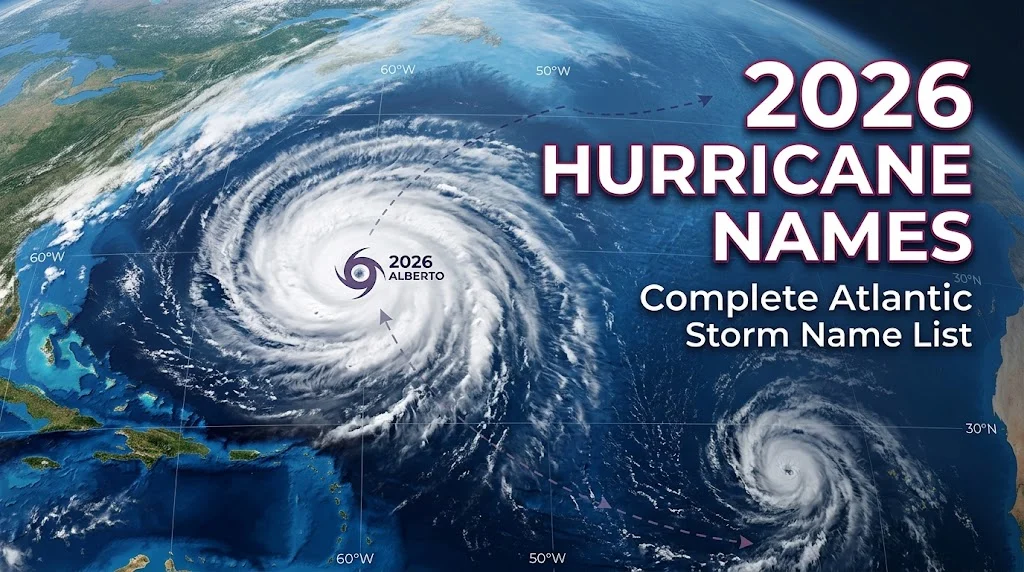
The official 2026 Atlantic hurricane names are Arthur, Bertha, Cristobal, Dolly, Edouard, Fay, Gonzalo, Hanna, Isaias, Josephine, Kyle, Leah, Marco, Nana, Omar, Paulette, Rene, Sally, Teddy, Vicky, and Wilfred.
Every hurricane season comes with a new list of names, and the 2026 hurricane names have already been selected for the Atlantic basin. These names help meteorologists, emergency officials, news organizations, and the public communicate about different tropical cyclones clearly.
The official 2026 Atlantic list contains 21 names, beginning with Arthur and ending with Wilfred. The list is maintained through an international process involving the World Meteorological Organization, while the U.S. National Hurricane Center publishes the official Atlantic list and pronunciation information.
Hurricane names are not chosen randomly during a storm. The names are arranged in advance, and tropical storms receive them in sequence as they reach the required naming threshold.
This guide explores ten names from the 2026 list in more detail, including their general meanings, origins, style, historical associations, and why each name stands out. You will also find the complete list, naming rules, FAQs, and useful information about the 2026 Atlantic hurricane season.
Arthur
Meaning: Bear or strong one, depending on the traditional etymological interpretation.
Origin: Traditionally associated with Celtic or Brittonic origins.
Style: Classic, masculine, traditional, familiar.
Best For: The first name on the 2026 Atlantic hurricane list.
Popularity: Arthur is a long-established personal name in English-speaking countries and many other regions.
Historical Appeal: Arthur has a strong historical association with the legendary King Arthur and the Arthurian tradition. That gives the name a familiar and memorable character.
Why It Stands Out: Arthur is the first name on the official 2026 Atlantic list. The National Hurricane Center lists its pronunciation as AR-thur.
Similar Names: Arthur, Art, Arturo, Artur.
Why It Still Works Today: Arthur has remained recognizable for generations. Its classic character makes it easy to remember when used as a storm name.
Bertha
Meaning: Bright or famous.
Origin: Germanic.
Style: Classic, vintage, feminine, traditional.
Best For: The second name on the 2026 Atlantic hurricane list.
Popularity: Bertha has a distinctly traditional feel and was especially common in earlier generations.
Historical Appeal: Bertha appears in European historical naming traditions and has been used across several Germanic-language cultures.
Why It Stands Out: Bertha follows Arthur in the official 2026 sequence and has a clear, easily recognized pronunciation.
Similar Names: Berta, Bertie, Alberta, Roberta.
Why It Still Works Today: Vintage names periodically return to public attention, and Bertha remains recognizable even though it is less common as a modern first name.
Cristobal
Meaning: Bearer of Christ.
Origin: Spanish form related to Christopher, ultimately from Greek roots.
Style: Traditional, international, Hispanic, historic.
Best For: The third name on the 2026 Atlantic list.
Popularity: Cristobal is an established personal name in Spanish-speaking communities.
Historical Appeal: The name belongs to a long European and Christian naming tradition. Its connection to Christopher gives it centuries of historical usage.
Why It Stands Out: Cristobal provides a distinctly Spanish-language name within the 2026 Atlantic sequence. The National Hurricane Center lists its pronunciation as krees-TOH-bahl.
Similar Names: Christopher, Cristóbal, Cristian, Christian.
Why It Still Works Today: Its recognizable linguistic roots make Cristobal memorable while reflecting the multicultural nature of the Atlantic region.
Dolly
Meaning: A traditional diminutive associated with Dorothy or Dolores.
Origin: English and Spanish naming traditions, depending on the full name from which it developed.
Style: Friendly, vintage, feminine, familiar.
Best For: The fourth name on the 2026 Atlantic list.
Popularity: Dolly has a long history as a nickname and standalone personal name.
Historical Appeal: The name is strongly associated with the traditional nickname style in English.
Why It Stands Out: Dolly is short and easy to recognize, making it practical for storm communication. It is the fourth name in the official 2026 Atlantic sequence.
Similar Names: Dorothy, Dolores, Dollie, Dolly.
Why It Still Works Today: Short names are easy to communicate and remember, which is especially useful for an organized storm-naming system.
Edouard
Meaning: Wealthy guardian or prosperous protector.
Origin: French form of Edward, with Germanic roots.
Style: French, classic, sophisticated, traditional.
Best For: The fifth name on the 2026 Atlantic list.
Popularity: Edouard is a traditional French personal name.
Historical Appeal: The name is related to Edward, a name with a long history among European royal and aristocratic families.
Why It Stands Out: Edouard brings a French-language form into the 2026 Atlantic naming sequence.
Similar Names: Edward, Eduardo, Édouard, Edouardo.
Why It Still Works Today: Its international familiarity makes Edouard recognizable while preserving a distinctly French form.
Fay
Meaning: Fairy or faith, depending on the proposed origin.
Origin: English and French naming traditions have both influenced interpretations of Fay.
Style: Short, vintage, feminine, delicate.
Best For: The sixth name on the 2026 Atlantic list.
Popularity: Fay has a vintage quality and has been used as both a given name and nickname.
Historical Appeal: The name became particularly familiar in English-language naming traditions during the early 20th century.
Why It Stands Out: Fay is brief and easy to pronounce, making it an efficient name for communication during the hurricane season.
Similar Names: Faye, Faith, Fayla, Faye.
Why It Still Works Today: Its short spelling and simple pronunciation make it easy to recognize in written and spoken storm reports.
Gonzalo
Meaning: Traditionally connected with ideas of battle or conflict, although the deeper etymology is debated.
Origin: Spanish, ultimately connected to an old Germanic personal-name tradition.
Style: Strong, traditional, Spanish, distinctive.
Best For: The seventh name on the 2026 Atlantic list.
Popularity: Gonzalo is an established Spanish personal name.
Historical Appeal: Gonzalo has a long history in Spain and Spanish-speaking communities.
Why It Stands Out: It is one of the more distinctly Spanish names in the 2026 Atlantic sequence.
Similar Names: Gonzales, González, Gonçalo, Gonzalo.
Why It Still Works Today: Gonzalo remains recognizable internationally and adds linguistic variety to the official list.
Hanna
Meaning: Grace or favor.
Origin: Related to Hebrew Hannah and used in multiple languages.
Style: Soft, classic, international, feminine.
Best For: The eighth name on the 2026 Atlantic list.
Popularity: Hanna is an established given name across Europe and other parts of the world.
Historical Appeal: Its relationship to Hannah gives it a long religious and historical naming tradition.
Why It Stands Out: Hanna is concise, familiar, and easy to pronounce. It follows Gonzalo in the official 2026 Atlantic sequence.
Similar Names: Hannah, Hana, Anna, Annah.
Why It Still Works Today: Its simplicity makes it memorable, while its international usage means many readers already recognize the name.
Isaias
Meaning: God is salvation.
Origin: Spanish form related to Isaiah, from Hebrew.
Style: Biblical, traditional, Spanish, historic.
Best For: The ninth name on the 2026 Atlantic list.
Popularity: Isaias is used particularly in Spanish-speaking communities.
Historical Appeal: The name is connected with the biblical prophet Isaiah and therefore has a long religious and literary history.
Why It Stands Out: Isaias introduces a distinctly Spanish form of a widely recognized biblical name.
Similar Names: Isaiah, Isaías, Isiah, Isaia.
Why It Still Works Today: Biblical names remain familiar across many cultures, making Isaias recognizable even outside Spanish-speaking communities.
Josephine
Meaning: God will add or God will increase.
Origin: French feminine form related to Joseph.
Style: Elegant, classic, feminine, vintage.
Best For: The tenth name on the 2026 Atlantic list.
Popularity: Josephine has experienced renewed interest as a classic-style personal name.
Historical Appeal: The name is strongly associated with European history, including Joséphine de Beauharnais, the first wife of Napoleon Bonaparte.
Why It Stands Out: Josephine is one of the longer names on the 2026 Atlantic list but remains easy to recognize.
Similar Names: Joseph, Josie, Josefina, Josephina.
Why It Still Works Today: Classic names such as Josephine continue to appeal because they combine history with a polished, familiar sound.
Quick Comparison Table
| Hurricane Name | General Meaning / Association | Style | Position |
|---|---|---|---|
| Arthur | Bear / traditional heroic name | Classic | 1 |
| Bertha | Bright / famous | Vintage | 2 |
| Cristobal | Bearer of Christ | Traditional | 3 |
| Dolly | Traditional diminutive | Friendly | 4 |
| Edouard | Wealthy guardian | French, classic | 5 |
| Fay | Fairy / faith associations | Vintage | 6 |
| Gonzalo | Traditional Spanish name | Strong | 7 |
| Hanna | Grace / favor | Classic | 8 |
| Isaias | God is salvation | Biblical | 9 |
| Josephine | God will add | Elegant | 10 |
Complete 2026 Atlantic Hurricane Names
The official 2026 Atlantic hurricane-name list contains 21 names in alphabetical order:
- Arthur
- Bertha
- Cristobal
- Dolly
- Edouard
- Fay
- Gonzalo
- Hanna
- Isaias
- Josephine
- Kyle
- Leah
- Marco
- Nana
- Omar
- Paulette
- Rene
- Sally
- Teddy
- Vicky
- Wilfred
These are the official Atlantic names published by the National Hurricane Center for 2026.
How Are 2026 Hurricane Names Chosen?
Hurricane names are prepared before the season begins. The Atlantic list contains alternating traditionally masculine and feminine names and is designed to make storm communication clearer.
The World Meteorological Organization maintains the international naming system, while the National Hurricane Center publishes the Atlantic list used for official storm identification. The lists are designed to be short, recognizable, and relatively easy to communicate.
The six Atlantic lists rotate on a six-year cycle. According to the National Hurricane Center, the 2026 list is scheduled to be used again in 2032, unless a name is retired.
When Does the 2026 Atlantic Hurricane Season Run?
The Atlantic hurricane season officially runs from June 1 through November 30. Tropical cyclones can occasionally form outside the official season, and the naming system has provisions for such situations.
The official list is therefore prepared before the season begins, allowing meteorologists and emergency agencies to identify storms quickly if they develop.
What Happens If All 21 Names Are Used?
If more than 21 named tropical cyclones occur in the Atlantic during a season, additional storms do not simply receive improvised names.
The National Hurricane Center states that additional storms use names from an alternate list approved by the World Meteorological Organization.
This system replaced the older practice of using the Greek alphabet after the primary list was exhausted.
What Happens If a Hurricane Name Is Retired?
A hurricane name can be retired when the World Meteorological Organization determines that using it again would be inappropriate because of the storm’s exceptional impact.
When a name is retired, a replacement is selected for the corresponding alphabetical position in a future list. The 2026 list is part of the six-year rotation, but individual names can therefore change before a future cycle if a name is retired.
Are 2026 Hurricane Names the Same Around the World?
No. Tropical cyclone names are basin-specific.
The Atlantic has its own list, while the eastern North Pacific has a different 2026 list. NOAA’s National Hurricane Center lists the 2026 eastern Pacific names beginning with Amanda, Boris, Cristina, Douglas, and Elida.
Other tropical cyclone regions around the world follow their own naming systems under the World Meteorological Organization framework.
2026 Eastern Pacific Hurricane Names
For readers searching broadly for 2026 hurricane names, it is useful to know that the eastern North Pacific has a separate list:
Amanda, Boris, Cristina, Douglas, Elida, Fausto, Genevieve, Hernan, Iselle, Julio, Karina, Lowell, Marie, Norbert, Odalys, Polo, Rachel, Simon, Trudy, Vance, Winnie, Xavier, Yolanda, and Zeke.
This list contains 24 names rather than the 21 names used in the Atlantic list.
How to Remember the 2026 Hurricane Names
A simple way to remember the Atlantic list is to divide it into groups of five:
Arthur – Bertha – Cristobal – Dolly – Edouard
Fay – Gonzalo – Hanna – Isaias – Josephine
Kyle – Leah – Marco – Nana – Omar
Paulette – Rene – Sally – Teddy – Vicky
Wilfred
This makes the long list easier to scan and remember.
Why Do Hurricanes Have Names?
Names make it easier to distinguish between multiple tropical systems and communicate about a specific storm.
A short, recognizable name is generally more practical in forecasts, emergency communications, news reports, and conversations than relying only on technical identification numbers or coordinates.
The modern system developed from earlier naming practices and is now maintained through an international process coordinated by the World Meteorological Organization.
Most Notable Features of the 2026 Name List
The 2026 Atlantic list contains a mixture of familiar English names, Spanish names, French forms, and names with older historical or religious roots.
Arthur and Josephine have strong traditional European associations. Cristobal and Isaias reflect Spanish-language forms, while Edouard is distinctly French in spelling.
This variety reflects the international character of the Atlantic basin and the need for names that can work across different languages and communities.
2026 Hurricane Name Trends
The 2026 Atlantic list has several names that sound familiar to English-speaking audiences, alongside names that reflect other linguistic traditions.
Classic names remain prominent. Arthur, Josephine, Sally, and Teddy are recognizable personal names with long histories.
Other names, such as Cristobal, Gonzalo, Isaias, and Edouard, have stronger associations with Spanish, Germanic, French, or broader European naming traditions.
The list is not designed as a popularity ranking. Its purpose is to provide a predetermined sequence for tropical cyclone communication.
FAQs
What are the 2026 hurricane names?
The 2026 Atlantic hurricane names begin with Arthur and continue through Bertha, Cristobal, Dolly, Edouard, Fay, Gonzalo, Hanna, Isaias, Josephine, Kyle, Leah, Marco, Nana, Omar, Paulette, Rene, Sally, Teddy, Vicky, and Wilfred.
How many hurricane names are on the 2026 Atlantic list?
There are 21 primary names on the official 2026 Atlantic list.
When does the 2026 Atlantic hurricane season start?
The official Atlantic hurricane season begins on June 1 and ends on November 30.
Who chooses the 2026 hurricane names?
The hurricane names are maintained through an international process involving the World Meteorological Organization.
Will the 2026 hurricane names be used again?
The 2026 Atlantic list is part of a six-year rotation and is scheduled to be used again in 2032.
Conclusion
The 2026 hurricane names provide a predetermined system for identifying tropical cyclones in the Atlantic basin. The official list begins with Arthur and ends with Wilfred, with 21 names arranged alphabetically and used in sequence as qualifying tropical systems develop.
Understanding the list is useful for anyone following weather reports, hurricane forecasts, or tropical cyclone news. It is also interesting to see the variety of linguistic backgrounds represented in the names, from Arthur and Josephine to Cristobal, Gonzalo, Isaias, and Edouard.
Remember that a storm’s name does not indicate its strength. A named tropical storm can become a hurricane, while other systems may never reach hurricane intensity. The name simply provides a clear way to identify the system.
Save this list for reference, share it with anyone following the 2026 Atlantic hurricane season, and check official weather authorities for current storm information.
Discover More Related Articles: