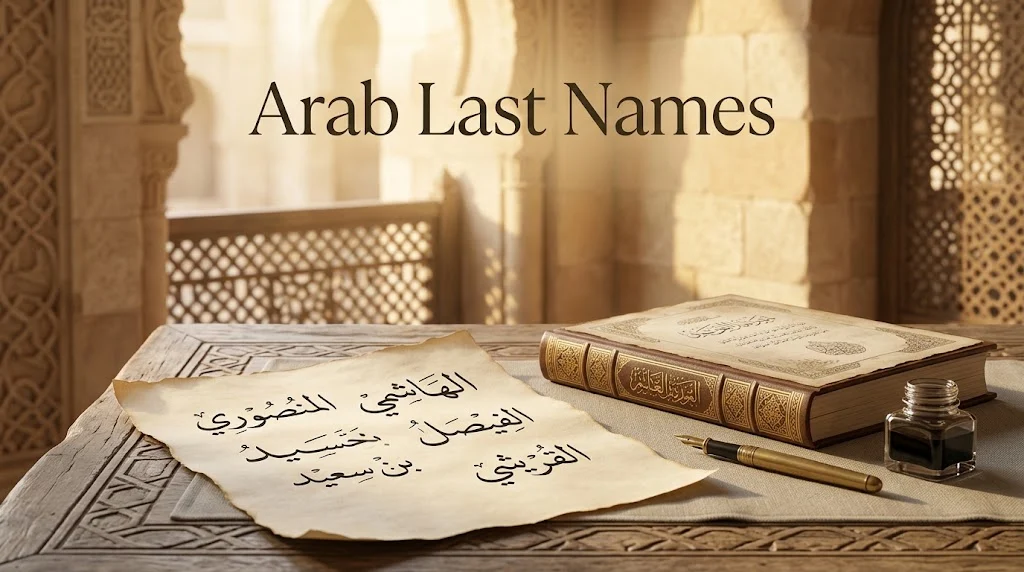
Arab last names are family names used across Arabic-speaking communities in the Middle East and North Africa. They may reflect ancestry, tribal affiliation, a person’s father, a place of origin, an occupation, or a family characteristic.
A family name can hold generations of history in just a few letters. It may point to an ancestral hometown, reflect a respected family tradition, or connect someone to a wider community. That is what makes Arab last names so fascinating.
Across the Arab world, surnames come from many sources. Some reflect geography, such as a town or region. Others connect families to ancestors, occupations, tribal affiliations, or personal characteristics. Names such as Al-Masri, Haddad, and Al-Baghdadi offer examples of how Arabic surnames can carry clues about identity and heritage.
However, not every Arabic surname has one simple meaning, and not everyone with an Arabic surname shares the same nationality, religion, or family history. Arabic is used across many communities, and naming traditions vary between countries and families.
In this guide, you will discover ten Arab last names, their commonly understood meanings, origins, styles, and cultural associations. You will also find helpful tips for researching surnames, choosing a name for a fictional character, or learning more about your family’s background.
Hassan
Meaning: Good, handsome, or excellent, depending on the context and Arabic usage.
Origin: Arabic.
Personality: Hassan is often associated with positive qualities because of its connection to goodness and beauty. As a surname, however, it identifies a family rather than necessarily describing an individual’s personality.
Style: Classic, traditional, familiar, and timeless.
Best For: Family-history research, character naming, and readers exploring Arabic surnames.
Popularity: Hassan is widely recognized across Arabic-speaking communities and beyond. It can appear as both a given name and a family name.
Emotional Appeal: Its positive linguistic associations make Hassan appealing to people who appreciate names with uplifting meanings.
Cultural Reference: Hassan is a historical personal name found across the Arab world and in many Muslim communities.
Similar Names: Hussein, Hasan, Hassani, Hassoun, Al-Hassan.
Why It Still Works Today: Hassan has a long-standing presence in Arabic naming traditions. Its familiar spelling and pronunciation make it recognizable internationally, while its exact family history depends on the particular lineage.
Haddad
Meaning: Blacksmith.
Origin: Arabic; the name is found in several Middle Eastern communities.
Personality: Haddad can suggest craftsmanship, skill, and a connection to traditional work. These are associations with the surname’s occupational meaning, not personality traits shared by everyone who carries it.
Style: Traditional, strong, historical, and distinctive.
Best For: Genealogy, historical fiction, contemporary character names, and surname research.
Popularity: Haddad is a recognizable surname in the Levant, including Lebanon, Syria, Jordan, and Palestine, although its distribution varies by family and region.
Emotional Appeal: Occupational surnames can offer a glimpse into the kinds of work that were important to earlier communities. Haddad preserves a linguistic connection to metalworking.
Cultural Reference: Arabic occupational surnames are part of a broader naming tradition in which family names developed from trades and professions.
Similar Names: Al-Haddad, Hadad, Najjar, Khayat, Attar.
Why It Still Works Today: Haddad is short, memorable, and rooted in a clear occupational meaning. Its historical associations make it useful for people exploring family names and their development over time.
Al-Masri
Meaning: The Egyptian or person associated with Egypt.
Origin: Arabic, from Misr, the Arabic name for Egypt.
Personality: Al-Masri carries a geographical association rather than a fixed personality meaning. It may indicate a family connection to Egypt, although a surname alone cannot prove someone’s birthplace or ancestry.
Style: Geographic, traditional, recognizable, and historical.
Best For: Family-history research, cultural studies, and fictional characters with an Egyptian family background.
Popularity: The surname and related forms are found among Arabic-speaking communities, especially in contexts connected with Egypt and its diaspora.
Emotional Appeal: Place-based surnames can help families maintain a symbolic connection to a homeland across generations.
Cultural Reference: Al-Masri is built around a common Arabic geographical designation associated with Egypt.
Similar Names: Masri, El-Masry, Al-Misri, Al-Shami, Al-Baghdadi.
Why It Still Works Today: Al-Masri provides a recognizable example of how a geographical association can become a family name. Spelling varies because Arabic names are transliterated into the Latin alphabet in different ways.
Al-Baghdadi
Meaning: The person associated with Baghdad.
Origin: Arabic, connected to Baghdad, the historic capital of Iraq.
Personality: The name evokes place, history, and cultural heritage. It does not establish that every family carrying it has the same background or relationship with Baghdad.
Style: Historical, geographical, distinguished, and traditional.
Best For: Genealogical research, historical writing, and character development.
Popularity: Al-Baghdadi is recognizable as a geographical surname, although its frequency differs across countries and communities.
Emotional Appeal: A surname connected to a historic city can create a strong sense of place. Baghdad has played an important role in the history of scholarship, trade, literature, and urban culture.
Cultural Reference: Baghdad was a major center of learning and cultural exchange during the Abbasid period.
Similar Names: Baghdadi, Al-Masri, Al-Dimashqi, Al-Halabi, Al-Shami.
Why It Still Works Today: Al-Baghdadi illustrates the relationship between Arabic surnames and cities. It is especially interesting to readers studying the historical movement of people between urban centers.
Al-Shami
Meaning: Associated with the Levant or Bilad al-Sham, a historical region that includes parts of the eastern Mediterranean.
Origin: Arabic.
Personality: Al-Shami suggests a regional connection rather than a specific personal quality. It can be associated with family histories linked to the Levant.
Style: Regional, traditional, historical, and distinctive.
Best For: Family-history research, historical fiction, and readers interested in Levantine heritage.
Popularity: The surname and related forms appear across different Arabic-speaking communities. The historical term al-Sham has had a broader meaning than the modern borders of any single country.
Emotional Appeal: Regional surnames can preserve a connection to a homeland, particularly when families move to other countries.
Cultural Reference: Bilad al-Sham has long been an important geographical and cultural term in Arabic history.
Similar Names: Al-Dimashqi, Al-Halabi, Al-Masri, Al-Baghdadi, Shami.
Why It Still Works Today: Al-Shami links a family name to a wider historical region. It is a useful example of why the meanings of older geographical surnames do not always match modern national boundaries.
Najjar
Meaning: Carpenter.
Origin: Arabic.
Personality: Najjar carries associations with woodworking, craftsmanship, and practical skill because of its occupational meaning.
Style: Traditional, concise, professional, and historical.
Best For: Surname research, historical novels, family trees, and character naming.
Popularity: Najjar is used as a surname in multiple Arabic-speaking communities, including parts of the Levant and other regions.
Emotional Appeal: Like other occupational surnames, Najjar connects language with everyday life in earlier communities. A trade could become a lasting part of a family’s identity.
Cultural Reference: Arabic surnames often developed from occupations such as carpentry, blacksmithing, tailoring, and other crafts.
Similar Names: Al-Najjar, Haddad, Khayat, Attar, Sabbagh.
Why It Still Works Today: Najjar is easy to recognize as a short family name and has a straightforward occupational meaning. It is a strong example of how work and social history can influence surnames.
Mansour
Meaning: Victorious, supported, or granted victory.
Origin: Arabic.
Personality: Mansour has associations with resilience, success, and overcoming challenges because of its linguistic meaning. A surname does not determine the personality or achievements of its bearer.
Style: Strong, classic, traditional, and widely recognizable.
Best For: Family-history projects, character names, and readers seeking surnames with positive meanings.
Popularity: Mansour and spelling variants are found throughout the Arab world and in communities with Arabic-speaking heritage.
Emotional Appeal: The idea of victory can make the name meaningful to people who value perseverance, hope, and achievement.
Cultural Reference: Mansour is also used as a given name, illustrating how a name can function differently across families and naming systems.
Similar Names: Al-Mansour, Nasr, Nasser, Fawzi, Zafar.
Why It Still Works Today: Mansour combines a strong sound with a positive meaning. Its use as both a given name and a surname makes it recognizable in different cultural settings.
Khalil
Meaning: Friend or close companion.
Origin: Arabic.
Personality: Khalil is associated with friendship and closeness. The meaning gives it a warm linguistic character, although it does not describe every person or family with this surname.
Style: Classic, warm, traditional, and literary.
Best For: Family trees, historical research, character creation, and readers interested in Arabic name meanings.
Popularity: Khalil is found as both a given name and a surname in Arabic-speaking communities and across the diaspora.
Emotional Appeal: Friendship is a universal idea, so the name can feel approachable and meaningful to people from different backgrounds.
Cultural Reference: Khalil is familiar in Arabic literary and cultural contexts. The writer Kahlil Gibran, born in what is now Lebanon, is a well-known example of a related transliterated name.
Similar Names: Al-Khalil, Khalili, Khaleel, Habib, Sadiq.
Why It Still Works Today: Khalil is concise and memorable, with a meaning that remains easy to appreciate. Its spelling can vary in English, so family-specific records are important when researching a particular lineage.
Farouk
Meaning: One who distinguishes between right and wrong, or one who makes a distinction.
Origin: Arabic, often transliterated as Faruq or Farouk.
Personality: Farouk is associated with discernment and judgment because of its traditional meaning. These associations should not be treated as factual descriptions of people who carry the name.
Style: Traditional, dignified, historical, and distinctive.
Best For: Historical writing, genealogy, character naming, and readers interested in Arabic-derived surnames and personal names.
Popularity: Farouk is more commonly encountered as a given name in some communities, but it can also appear as part of a family name.
Emotional Appeal: Its meaning connects with the idea of recognizing differences and making thoughtful judgments, which some families may find appealing.
Cultural Reference: Farouk is associated with Arabic naming traditions and has historical recognition in Egypt and beyond.
Similar Names: Faruq, Al-Faruq, Farouq, Hakim, Rashid.
Why It Still Works Today: Farouk has a recognizable Arabic sound and historical resonance. When used as a surname, its exact family origin should be confirmed rather than inferred from the spelling alone.
Darwish
Meaning: Commonly associated with dervish, a term for a member of certain Sufi traditions.
Origin: The Arabic form is related to a word that entered Arabic through Persian; usage and associations vary by context.
Personality: Darwish can evoke spirituality, devotion, and religious history because of its association with dervishes. It should not be assumed that every person with this surname belongs to a Sufi order.
Style: Historical, distinctive, spiritual, and literary.
Best For: Genealogy, cultural research, historical fiction, and readers interested in surnames with religious or linguistic backgrounds.
Popularity: Darwish and related spellings appear in several Arabic-speaking communities.
Emotional Appeal: Its history connects the surname with wider traditions of spiritual practice, travel, learning, and cultural exchange.
Cultural Reference: Dervish traditions are associated with several Sufi communities in different parts of the Muslim world.
Similar Names: Darwishi, Al-Darwish, Sufi, Zahid, Abid.
Why It Still Works Today: Darwish has a distinctive sound and a layered linguistic history. It also demonstrates how Arabic surnames can reflect cultural contact with neighboring languages.
Quick Comparison Table
| Last Name | Common Meaning or Association | Style | Best For |
|---|---|---|---|
| Hassan | Good or handsome | Classic | Family research |
| Haddad | Blacksmith | Occupational | Historical characters |
| Al-Masri | Associated with Egypt | Geographical | Egyptian heritage research |
| Al-Baghdadi | Associated with Baghdad | Historical | Genealogy |
| Al-Shami | Associated with the Levant | Regional | Levantine heritage |
| Najjar | Carpenter | Occupational | Family history |
| Mansour | Victorious or supported | Strong | Character naming |
| Khalil | Friend or companion | Warm | Cultural research |
| Farouk | One who distinguishes | Traditional | Historical writing |
| Darwish | Associated with dervish traditions | Spiritual | Linguistic research |
How to Choose the Perfect Arab Last Name
Choosing an Arabic surname for a family-history project, story, or character requires more than picking a name that sounds appealing.
Understand the meaning. Research the word’s original Arabic form and its likely meaning. Some surnames have several interpretations, and context matters.
Identify the regional background. Arabic surnames may be associated with Egypt, Iraq, the Levant, the Arabian Peninsula, North Africa, or communities beyond these regions. Do not assume a surname proves someone’s nationality.
Consider spelling variations. Arabic is written in a different script, and transliteration into English is not standardized. For example, Faruq and Farouk can represent the same or closely related name forms.
Learn how the family uses the name. A name may have a special spelling, pronunciation, or family history that differs from a general dictionary definition.
Distinguish Arabic from Arab identity. Arabic surnames are not exclusive to Arabs, and not every Arab person has an Arabic-origin surname. Naming practices reflect diverse languages, religions, histories, and family traditions.
Check historical accuracy. If you are writing a character, research the character’s country, time period, religion if relevant, and family background. A surname that is plausible in one setting may be less appropriate in another.
Use trustworthy references. Look for university publications, reputable dictionaries, academic studies, and reliable historical records rather than relying only on surname lists.
Most Recognizable Arab Last Names
The following surnames are widely recognizable in different Arabic-speaking communities, although their prevalence varies by country and family:
- Hassan
- Hussein
- Haddad
- Najjar
- Mansour
- Khalil
- Saleh
- Farouk
- Darwish
- Nasser
- Hamdan
- Habib
- Abbas
- Rahman
- Saad
Some of these names also appear as given names. Their use as family names, and their exact meanings, may differ between communities.
Traditional Arab Last Names With Historical Connections
Many Arabic surnames reflect older naming practices. Some come from professions, while others refer to a geographical place, an ancestor, or a wider social group.
Examples include:
- Haddad: Associated with blacksmithing.
- Najjar: Associated with carpentry.
- Al-Masri: Associated with Egypt.
- Al-Baghdadi: Associated with Baghdad.
- Al-Shami: Associated with the historical region of Bilad al-Sham.
- Mansour: Related to victory or support.
- Khalil: Associated with friendship or companionship.
These names can offer clues for research, but they are not definitive evidence of a particular ancestor’s occupation, hometown, or life story.
Modern Arab Surname Trends
Arabic surnames are used in many different legal and cultural naming systems. In some families, the surname is inherited consistently across generations. In others, a person’s full name may preserve a father’s name, grandfather’s name, tribal affiliation, or additional family identifiers.
The element Al- often functions as the Arabic definite article, broadly corresponding to “the.” It appears in many names, including Al-Masri and Al-Baghdadi. However, its presence alone does not identify a person’s nationality or family lineage.
Spelling also varies across countries and official records. The same Arabic name may appear differently in English because of different transliteration practices. A family might retain one spelling for generations, even when another spelling is more common elsewhere.
For this reason, modern Arabic surnames should be understood through their specific family and regional context, not just online popularity lists.
How Arab Last Names Are Formed
Arabic surnames can come from several sources.
Ancestry and parentage: Some naming systems include a father’s or ancestor’s name. The word ibn means “son of” in Arabic, while bint means “daughter of.” These elements can appear in longer personal names, although inherited surnames work differently across communities.
Geography: A surname may refer to a city, region, or country. Al-Masri and Al-Baghdadi are examples of names with geographical associations.
Occupations: Names such as Haddad and Najjar are linked to traditional trades.
Personal characteristics or descriptive terms: Some family names developed from words that describe a quality or characteristic.
Tribal and family affiliations: Some names preserve links to a tribe, clan, or extended family. The meaning and social significance of such names require careful regional context.
Not every surname fits neatly into one category, and a name’s original meaning may not tell the whole story of a modern family.
FAQs
What are common Arab last names?
Hassan, Hussein, Haddad, Najjar, Mansour, Khalil, Saleh, and Nasser are examples of recognizable surnames used in Arabic-speaking communities.
What is the difference between Arab and Arabic last names?
“Arab” generally refers to people and cultural identities associated with the Arab world, while “Arabic” refers to the language and things connected to it.
What do Arabic last names mean?
Arabic surnames can refer to occupations, ancestors, geographical locations, personal qualities, or tribal and family affiliations.
Do all Arab last names start with Al?
No. Many Arabic surnames do not include Al-. Examples include Hassan, Haddad, Najjar, Khalil, and Mansour.
Are Arab last names the same as Muslim last names?
No. Arab identity and Muslim religious identity are not the same thing. Many Arabs are Muslim, but Arab communities also include Christians and people of other faiths.
Conclusion
Arab last names offer a fascinating way to explore language, family history, geography, and cultural traditions. Names such as Haddad and Najjar preserve connections to traditional occupations, while Al-Masri and Al-Baghdadi reflect geographical associations. Others, including Mansour and Khalil, carry meanings linked to victory and friendship.
Remember that a surname’s meaning is only one part of its story. Regional traditions, family records, spelling variations, and historical changes can all affect how a name is understood today. If you are researching your ancestry or choosing a surname for a character, take time to verify its background through trustworthy sources.
We hope this guide helps you discover an Arab surname that interests you. Share this article with someone exploring Arabic names, and leave a comment with your favorite surname or the name you would like us to research next.
Discover More Related Articles:
- Black Women Names | Beautiful, Unique & Meaningful Ideas In 2026
- Drake London Fantasy Names | Funny & Creative Ideas In 2026