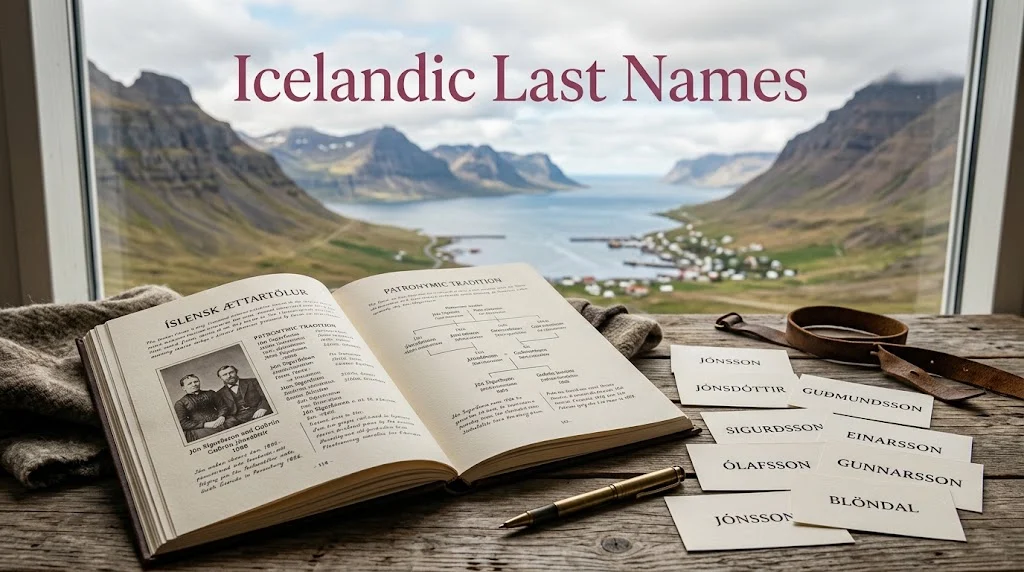
Icelandic last names commonly identify a person’s parent rather than an inherited family surname. Traditionally, names use -son for “son of” and -dóttir for “daughter of,” although hereditary family names also exist in Iceland.
At first glance, Icelandic last names may look similar to surnames from other Nordic countries. Look a little closer, though, and you discover a fascinating difference: many Icelanders do not share a hereditary family surname with their parents or siblings.
Instead, Icelandic naming traditions commonly connect a person’s last name to a parent’s first name. A boy might have a last name ending in -son, while a girl might have one ending in -dóttir. These endings essentially identify the person’s relationship to a parent. Iceland also permits certain other forms, including names based on the mother and some gender-neutral options.
That means two siblings can sometimes have different last names. It also means that a married couple does not necessarily share one family surname.
This naming system makes Icelandic names particularly interesting for anyone researching genealogy, writing historical or contemporary characters, studying Nordic culture, or looking for names with a strong connection to Iceland.
The examples below explain some well-known Icelandic surname forms and hereditary family names while showing how the system works.
Jónsson
Meaning: Son of Jón.
Origin: Icelandic patronymic tradition.
Name Structure: Jón + -sson.
Style: Traditional, Nordic, classic.
Best For: Historical research, Icelandic characters, genealogy, and examples of patronymic naming.
Popularity: Jónsson is a recognizable Icelandic patronymic form. It should not automatically be understood as one inherited family surname shared by everyone with the name.
Cultural Significance: The ending -son traditionally indicates that the person’s parent is named Jón. In Icelandic naming, the relationship is more important than the idea of belonging to a permanent surname family.
Emotional Appeal: The name has a simple family connection built directly into it. Rather than describing an occupation or place, it tells you something about the person’s parentage.
Similar Names: Jónsdóttir, Gunnarsson, Einarsson, Ólafsson.
Why It Still Works Today: Patronymic naming remains an important part of Icelandic naming culture. The Icelandic government explains that a child’s name can be formed from a parent’s name with -son or -dóttir.
Jónsdóttir
Meaning: Daughter of Jón.
Origin: Icelandic patronymic and matronymic naming tradition.
Name Structure: Jón + -sdóttir.
Style: Traditional, feminine, distinctly Icelandic.
Best For: Genealogy research, historical writing, character names, and examples of Icelandic naming.
Popularity: Jónsdóttir is a familiar form because -dóttir is traditionally used to indicate a daughter.
Cultural Significance: The ending -dóttir means “daughter of.” For example, an individual whose parent is named Jón can have Jónsdóttir as a traditional last-name form.
Emotional Appeal: This naming structure creates a direct link between a person and a parent. It makes family relationships visible within the name itself.
Similar Names: Jónsson, Guðmundsdóttir, Sigurðardóttir, Ólafsdóttir.
Why It Still Works Today: It represents one of the clearest features of Icelandic naming tradition and continues to be used in contemporary Iceland.
Guðmundsson
Meaning: Son of Guðmundur.
Origin: Icelandic patronymic tradition.
Name Structure: Guðmundur + -sson, with the grammatical form changing in the compound.
Style: Traditional, strong, Nordic.
Best For: Icelandic genealogy, historical characters, cultural research, and authentic Icelandic naming examples.
Popularity: Guðmundsson is an established patronymic form rather than a surname that necessarily represents one extended family.
Cultural Significance: The name identifies the bearer through a parent named Guðmundur. Icelandic naming can therefore change from one generation to the next.
Emotional Appeal: The name reflects family connection rather than a fixed surname identity.
Similar Names: Guðmundsdóttir, Guðrúnarson, Sigurðsson, Einarsson.
Why It Still Works Today: It demonstrates how Icelandic naming remains connected to traditional family relationships instead of relying exclusively on inherited surnames.
Sigurðsson
Meaning: Son of Sigurður.
Origin: Icelandic patronymic naming.
Name Structure: Sigurður + -sson.
Style: Traditional, masculine, Nordic.
Best For: Genealogy, character creation, historical fiction, and Icelandic cultural studies.
Popularity: Sigurðsson is an established Icelandic patronymic form.
Cultural Significance: The name tells the listener that the person’s relevant parent is named Sigurður. The name therefore identifies a relationship rather than necessarily identifying a permanent family line.
Emotional Appeal: It has the familiar sound of a traditional Nordic name while showing the distinctive Icelandic naming pattern.
Similar Names: Sigurðardóttir, Jónsson, Einarsson, Ólafsson.
Why It Still Works Today: Patronymic naming remains part of Iceland’s modern naming tradition, making names such as Sigurðsson culturally relevant today.
Sigurðardóttir
Meaning: Daughter of Sigurður.
Origin: Icelandic naming tradition.
Name Structure: Sigurður + -dóttir.
Style: Traditional, feminine, Nordic.
Best For: Character names, genealogy projects, historical research, and examples of Icelandic matronymic or patronymic-style naming.
Popularity: This is a recognizable traditional Icelandic name form.
Cultural Significance: The -dóttir ending identifies the person as the daughter of a parent named Sigurður.
Emotional Appeal: Like other Icelandic relational names, it places family connection directly into the name.
Similar Names: Sigurðsson, Jónsdóttir, Eiríksdóttir, Guðmundsdóttir.
Why It Still Works Today: It reflects an Icelandic naming structure that remains part of contemporary naming practice rather than simply being an old historical custom.
Einarsson
Meaning: Son of Einar.
Origin: Icelandic and wider Nordic naming traditions.
Name Structure: Einar + -sson.
Style: Classic, Nordic, traditional.
Best For: Icelandic characters, genealogy, historical settings, and surname research.
Popularity: Einarsson is an established name form and can be encountered in Icelandic contexts.
Cultural Significance: As a patronymic form, Einarsson traditionally points to a parent named Einar.
Emotional Appeal: The name sounds familiar to people interested in Scandinavian naming while still fitting the Icelandic patronymic system.
Similar Names: Einarsdóttir, Jónsson, Ólafsson, Gunnarsson.
Why It Still Works Today: It demonstrates how a traditional Icelandic last name can communicate family connection without functioning as a permanent hereditary surname.
Ólafsson
Meaning: Son of Ólafur.
Origin: Icelandic patronymic tradition.
Name Structure: Ólafur + -sson, with grammatical adaptation.
Style: Traditional, historic, Nordic.
Best For: Genealogy, historical characters, Icelandic naming examples, and Nordic-inspired fiction.
Popularity: Ólafsson is a recognizable Icelandic name form.
Cultural Significance: The name traditionally identifies someone through a parent named Ólafur. This illustrates why the same apparent surname can occur among people who are not members of one surname-based family.
Emotional Appeal: Ólafsson has an unmistakably Nordic character and connects modern naming with older Scandinavian traditions.
Similar Names: Ólafsdóttir, Jónsson, Einarsson, Gunnarsson.
Why It Still Works Today: The structure remains useful for understanding Icelandic names because patronymics continue to be part of the naming system.
Ólafsdóttir
Meaning: Daughter of Ólafur.
Origin: Icelandic naming tradition.
Name Structure: Ólafur + -dóttir.
Style: Traditional, feminine, Nordic.
Best For: Icelandic character names, genealogy, naming research, and historical fiction.
Popularity: It is a recognizable Icelandic relational name.
Cultural Significance: Ólafsdóttir traditionally identifies the bearer as the daughter of someone named Ólafur.
Emotional Appeal: The name carries a clear family connection and has a distinctive Icelandic appearance.
Similar Names: Ólafsson, Jónsdóttir, Einarsdóttir, Gunnarsdóttir.
Why It Still Works Today: It represents one of the most recognizable patterns in Icelandic naming and helps explain why Icelandic siblings may have different last names.
Gunnarsson
Meaning: Son of Gunnar.
Origin: Icelandic patronymic tradition.
Name Structure: Gunnar + -sson.
Style: Strong, traditional, Scandinavian.
Best For: Historical characters, Icelandic genealogy, Nordic-inspired writing, and cultural research.
Popularity: Gunnarsson is an established Icelandic patronymic form.
Cultural Significance: Traditionally, the name identifies a person through a parent named Gunnar rather than establishing a permanent surname shared by descendants.
Emotional Appeal: Gunnarsson has a strong Nordic sound and works naturally in historical and contemporary Icelandic contexts.
Similar Names: Gunnarsdóttir, Jónsson, Einarsson, Sigurðsson.
Why It Still Works Today: Its structure clearly demonstrates how Icelandic patronymics can connect generations while changing as family relationships change.
Blöndal
Meaning: A hereditary family surname rather than a standard patronymic form.
Origin: Icelandic family-name tradition.
Style: Historic, distinctive, established.
Best For: Genealogy, historical research, family-history projects, and authentic Icelandic surname examples.
Popularity: Blöndal is among the hereditary family names documented in Icelandic statistics. Statistics Iceland’s study of Icelandic naming identified Blöndal as one of the larger family-name groups in its 2017 data.
Cultural Significance: Unlike a typical -son or -dóttir name, Blöndal can function as a hereditary family name.
Emotional Appeal: For people researching Icelandic genealogy, hereditary names such as Blöndal are especially interesting because they differ from the country’s more common parent-based naming pattern.
Similar Names: Thorarensen, Thoroddsen, Waage, Kvaran.
Why It Still Works Today: Hereditary family names do exist in Iceland, although they are relatively uncommon compared with traditional parent-based names.
Thorarensen
Meaning: A hereditary family surname.
Origin: Icelandic family-name tradition, with Scandinavian naming influence.
Style: Historic, formal, distinctive.
Best For: Genealogy, historical research, fictional family names, and surname studies.
Popularity: Statistics Iceland listed Thorarensen among the larger hereditary family-name groups in its 2017 analysis.
Cultural Significance: Thorarensen differs from the ordinary parent-based -son and -dóttir pattern. It is useful as an example of Iceland’s smaller hereditary surname tradition.
Emotional Appeal: The name has an old Nordic and historical quality, making it appealing for family-history and historical storytelling.
Similar Names: Blöndal, Thoroddsen, Möller, Waage.
Why It Still Works Today: It demonstrates that Iceland’s naming system is not completely without hereditary surnames. Instead, hereditary family names coexist with a much more common parent-based tradition.
Quick Comparison Table
| Icelandic Last Name | Type | Meaning/Relationship | Style |
|---|---|---|---|
| Jónsson | Patronymic | Son of Jón | Traditional |
| Jónsdóttir | Patronymic | Daughter of Jón | Traditional |
| Guðmundsson | Patronymic | Son of Guðmundur | Classic |
| Sigurðsson | Patronymic | Son of Sigurður | Nordic |
| Sigurðardóttir | Patronymic | Daughter of Sigurður | Traditional |
| Einarsson | Patronymic | Son of Einar | Classic |
| Ólafsson | Patronymic | Son of Ólafur | Historic |
| Ólafsdóttir | Patronymic | Daughter of Ólafur | Feminine |
| Gunnarsson | Patronymic | Son of Gunnar | Strong |
| Blöndal | Family surname | Hereditary surname | Historic |
| Thorarensen | Family surname | Hereditary surname | Formal |
How Icelandic Last Names Work
The first thing to understand is that Icelandic last names do not usually work like English, American, or many European surnames.
In Iceland, a child will generally receive a last-name form based on a parent. The name can refer to either the father or mother, depending on the family’s choice.
For a boy, the traditional ending is -son, meaning “son.” For a girl, the traditional ending is -dóttir, meaning “daughter.” Iceland also permits other naming forms, including -bur for people with a neutral gender registration, as well as a parent’s name in the genitive without an ending in certain circumstances.
For example, the Icelandic government gives examples in which Gunnar Jónsson and Anna Pétursdóttir could have children named Sigurður Gunnarsson and Elísabet Gunnarsdóttir, or names based on their mother instead.
This explains why Icelandic siblings can have different last names.
Patronymic Icelandic Last Names
A patronymic name identifies a person through their father or, in broader use, through a male parent.
The traditional Icelandic pattern is:
Parent’s first name + -son
For example:
Jón → Jónsson
This can be understood as “son of Jón.”
The spelling can change slightly because Icelandic is an inflected language. Therefore, it is better to think of the structure as a grammatical naming system rather than simply adding the English word “son” to a name.
Patronymics are one of the defining characteristics of traditional Icelandic naming.
Matronymic Icelandic Last Names
A matronymic name identifies a person through their mother.
The traditional feminine and masculine endings can therefore be based on the mother’s given name as well.
For example, Iceland’s official guidance gives forms such as Önnuson and Önnudóttir when the mother’s name is Anna/Önnu in the relevant grammatical form.
This makes Icelandic naming especially interesting because the naming system does not have to follow only the father’s name.
Why Icelandic Siblings Can Have Different Last Names
In many countries, siblings normally inherit exactly the same family surname.
That is not necessarily the case in Iceland.
Because children can be named from either parent, one child may use a father’s name while another may use a mother’s name. Iceland’s official example specifically notes that siblings can have different last names.
This is one of the most important differences between Icelandic names and conventional hereditary surnames.
Do Icelanders Have Family Surnames?
Yes, but hereditary family surnames are relatively uncommon.
Iceland’s official naming information states that family names are rare and permitted under specific exceptions.
Statistics Iceland has also studied the distinction between traditional parent-based names and hereditary family names. Its analysis found that most names ending in forms such as -son were traditional parent-based names rather than hereditary family surnames, although a smaller number were actual family names.
So when researching Icelandic last names, it is important to distinguish between a surname-looking name and an actual inherited surname.
Common Icelandic Last Name Endings
The most recognizable traditional endings are:
-son — traditionally indicates “son of.”
-dóttir — traditionally indicates “daughter of.”
-bur — an additional option permitted for people with a neutral gender registration.
Iceland’s official guidance explains that -bur comes from Old Norse and refers to offspring.
The ending therefore provides useful information about how the name was formed.
Famous Icelandic Family Names
Although most Icelandic naming follows parent-based traditions, some hereditary family names are well established.
Statistics Iceland’s analysis of Icelandic naming practices documented family-name groups including Blöndal, Thorarensen, Hansen, Olsen, Andersen, Thoroddsen, Möller, Nielsen, Waage, Bergmann, Briem, Thorlacius, Jensen, Hjaltalín, Scheving, Petersen, Kvaran, Fjeldsted, Norðdahl, and Berndsen in its 2017 data.
These examples should not be confused with the much more common Icelandic parent-based naming system.
Traditional Icelandic Last Names
Traditional Icelandic names are closely connected with family relationships.
Names ending in -son and -dóttir are especially important examples. They preserve a connection between a person’s name and a parent rather than creating a permanent surname passed unchanged through every generation.
This makes traditional Icelandic naming particularly valuable for genealogy. A researcher should not assume that everyone with the same ending belongs to one extended surname family.
Modern Icelandic Naming Rules
Icelandic naming is governed by specific rules.
According to Ísland.is, children must receive a name before reaching six months of age. Iceland maintains an official Personal Names Register containing approved Icelandic names. If a proposed name is not already included, an application may need to be submitted to the Personal Names Committee.
The official rules also state that a person cannot have more than three given names. Names must fit Icelandic language structure and spelling conventions or have established usage in the language.
These rules show that Icelandic naming is not simply a matter of choosing any word as a personal name.
Are Icelandic Last Names Passed Down?
Usually, traditional Icelandic parent-based names are not passed down unchanged from generation to generation.
If a father named Jón has a son, the son’s last-name form may be Jónsson. But that son’s own child will normally receive a last-name form based on the relevant parent’s name rather than automatically inheriting Jónsson.
This is why Icelandic naming can look like a family surname system while functioning very differently from one.
How to Choose an Icelandic Last Name for a Character
If you are writing a story with an Icelandic character, first decide whether the character should have a traditional patronymic, matronymic, or hereditary family surname.
For a contemporary character, a parent-based name will generally reflect Iceland’s naming traditions more accurately.
Next, choose an appropriate parent’s given name and form the relational name correctly. Pay attention to Icelandic spelling and grammatical forms.
If the story takes place in an earlier historical period, research the naming practices of that particular period rather than assuming modern rules always applied.
For fantasy characters, you can take inspiration from Icelandic naming patterns, but it is better to avoid presenting an invented name as a historically authentic Icelandic surname.
FAQs
Are Icelandic Last Names Unique?
Yes, Icelandic names can feel very distinctive to people unfamiliar with the naming system. Their uniqueness comes less from unusual inherited surnames and more from the way names connect a person to a parent.
Are Icelandic Last Names Good for Baby Names?
If you are choosing an Icelandic name for a real child, it is important to understand the country’s naming rules and cultural context rather than treating a traditional last-name form as an ordinary surname.
What Does -son Mean in Icelandic Names?
The ending -son traditionally means “son of.” It is attached to a parent’s name to create a patronymic name. For example, Jónsson traditionally indicates “son of Jón.”
What Does -dóttir Mean in Icelandic Names?
The ending -dóttir traditionally means “daughter of.” It identifies the bearer through a parent and is one of the most recognizable features of Icelandic naming.
Can Icelandic Children Have Their Mother’s Name?
Yes. Iceland’s official naming guidance allows a child’s name to be based on either the father or mother, depending on the family’s naming choice.
Conclusion
Icelandic last names offer a fascinating example of how a naming system can preserve family connections without relying on conventional inherited surnames. Names ending in -son and -dóttir traditionally identify a person through a parent, while matronymic choices and some hereditary family names add further variety.
This system also explains why Icelandic siblings can have different last names and why married couples may not share one surname. Rather than thinking of every Icelandic last name as a permanent family label, it is more useful to understand the relationship and naming tradition behind it.
You are researching Icelandic genealogy, creating a character, studying Nordic culture, or simply exploring distinctive surname traditions, Icelandic names offer plenty to discover. Save your favorite examples, share this guide with another name enthusiast, and explore the deeper story behind each name.
Discover More Related Articles:
- Funny Sourdough Starter Names | Clever & Cute Ideas In 2026
- Girls Middle Names | Beautiful Ideas for Every Style In 2026