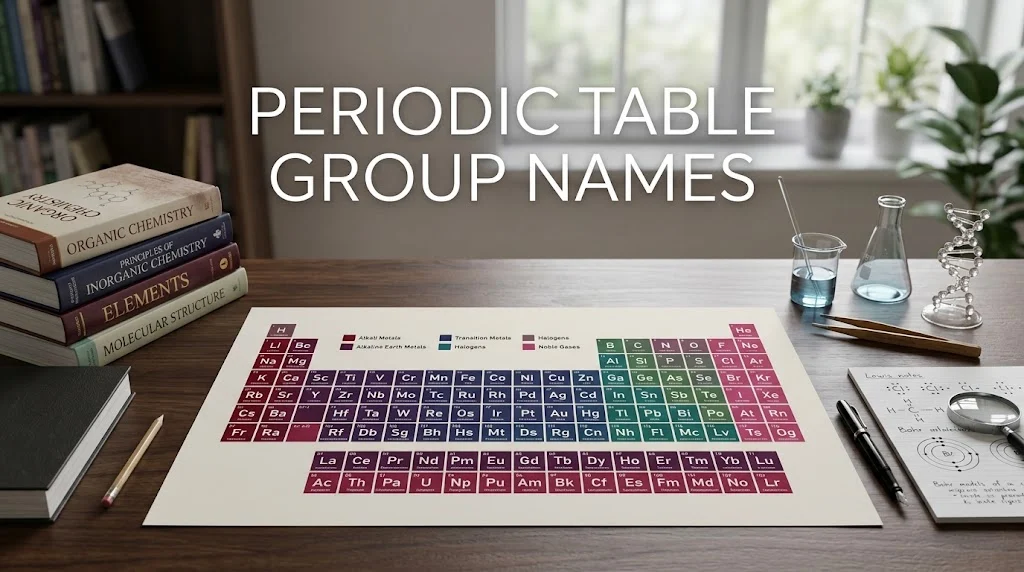
The periodic table has 18 numbered groups. Important group names include alkali metals, alkaline earth metals, transition metals, the boron group, carbon group, nitrogen group, chalcogens, halogens, and noble gases.
The periodic table can look complicated at first, but its layout follows a clear pattern. One of the easiest ways to understand it is to learn the periodic table group names.
A group is a vertical column on the periodic table. Elements in the same group often have similar chemical properties because they have related patterns in their outer electrons. These similarities make the groups useful for learning, comparing, and predicting how elements behave.
There are 18 numbered groups in the modern periodic table. Some have familiar family names, such as the alkali metals, alkaline earth metals, halogens, and noble gases. Other groups are commonly identified by the element at the top, such as the boron group or carbon group.
This guide explains all 18 groups in a simple way. You will learn their names, representative elements, general characteristics, and why each group matters in chemistry.
Group 1 | Alkali Metals
Meaning: Highly reactive metals found in Group 1.
Origin: The name “alkali” refers to the alkaline substances formed when these metals react with water.
Elements: Lithium, sodium, potassium, rubidium, cesium, and francium.
Personality: If we gave chemical elements personalities, alkali metals would be energetic and highly reactive. They readily lose one outer electron during chemical reactions.
Style: Reactive, metallic, soft, electropositive.
Best For: Learning chemical reactivity, ionic compounds, and periodic trends.
Popularity: Group 1 is one of the best-known periodic table families because its elements show a clear pattern down the group.
Key Feature: Alkali metals generally have one valence electron and commonly form +1 ions.
Why It Still Matters Today: Members of this group are important in batteries, chemical manufacturing, medicine, glass production, and other technologies. Sodium and potassium are also biologically important elements.
Group 2 | Alkaline Earth Metals
Meaning: Reactive metals that form alkaline compounds.
Origin: The term “alkaline earth” comes from the historical description of their oxides and related compounds.
Elements: Beryllium, magnesium, calcium, strontium, barium, and radium.
Personality: These metals are reactive but generally less reactive than Group 1 metals. They typically lose two outer electrons.
Style: Metallic, reactive, stable compared with alkali metals.
Best For: Studying ionic bonding, minerals, biological elements, and periodic trends.
Popularity: Group 2 is especially familiar because magnesium and calcium are important in everyday life and biology.
Key Feature: Group 2 elements generally form +2 ions.
Why It Still Matters Today: Calcium is important in bones and teeth, magnesium plays roles in biological systems, and several Group 2 elements have industrial applications.
Group 3 | Scandium Group
Meaning: The first group commonly associated with the transition metals.
Origin: The group is commonly identified by scandium, the element at the top.
Elements: Scandium, yttrium, and elements placed in the lower position of the group depending on the periodic-table convention.
Personality: These elements are metallic and often form compounds with useful oxidation states.
Style: Metallic, strong, conductive, transition-metal related.
Best For: Understanding transition-metal chemistry and periodic structure.
Popularity: Group 3 is less familiar by name than the halogens or noble gases, partly because the exact membership of the lower part of the group is treated differently in some periodic-table presentations.
Key Feature: Scandium and yttrium are transition metals with useful industrial properties.
Why It Still Matters Today: Scandium compounds and alloys have applications in specialized materials and technologies.
Group 4 | Titanium Group
Meaning: The group containing titanium at the top.
Origin: It is commonly called the titanium group.
Elements: Titanium, zirconium, hafnium, and rutherfordium.
Personality: These elements are strong, metallic, and useful for materials science.
Style: Strong, durable, metallic, industrial.
Best For: Learning about transition metals, alloys, and materials.
Popularity: Titanium is the most widely recognized member of the group.
Key Feature: Titanium and zirconium are valued for strength and resistance to corrosion.
Why It Still Matters Today: Titanium is used in aerospace, medical devices, sports equipment, and other applications where strength and relatively low density are useful.
Group 5 | Vanadium Group
Meaning: The group named after vanadium.
Origin: The name comes from vanadium, the first element in the group.
Elements: Vanadium, niobium, tantalum, and dubnium.
Personality: These are transition metals known for metallic properties and multiple oxidation states.
Style: Strong, metallic, durable, versatile.
Best For: Understanding transition-metal chemistry and advanced materials.
Popularity: Vanadium and tantalum are particularly important in industrial chemistry and materials science.
Key Feature: Several members form compounds in multiple oxidation states.
Why It Still Matters Today: Vanadium is used in specialized alloys and energy-storage technologies, while tantalum is important in electronic components.
Group 6 | Chromium Group
Meaning: The transition-metal group headed by chromium.
Origin: It is commonly known as the chromium group.
Elements: Chromium, molybdenum, tungsten, and seaborgium.
Personality: These elements are strong, heat-resistant, and chemically versatile.
Style: Metallic, durable, heat-resistant, industrial.
Best For: Studying alloys, catalysts, and transition-metal chemistry.
Popularity: Chromium, molybdenum, and tungsten are widely recognized because of their industrial applications.
Key Feature: Tungsten has an exceptionally high melting point, while chromium is important in corrosion-resistant alloys.
Why It Still Matters Today: Members of this group contribute to stainless steels, high-temperature materials, catalysts, tools, and other advanced applications.
Group 7 | Manganese Group
Meaning: The transition-metal group headed by manganese.
Origin: Named after manganese.
Elements: Manganese, technetium, rhenium, and bohrium.
Personality: These elements are chemically versatile and can show several oxidation states.
Style: Metallic, reactive, versatile, industrial.
Best For: Learning oxidation states and transition-metal chemistry.
Popularity: Manganese and rhenium are particularly relevant in industrial and chemical applications.
Key Feature: Manganese is known for forming compounds with several oxidation states.
Why It Still Matters Today: Manganese is important in steel production and biological systems, while rhenium is used in specialized high-temperature applications.
Group 8 | Iron Group
Meaning: A transition-metal group associated with iron.
Origin: The name comes from iron, one of its most familiar members.
Elements: Iron, ruthenium, osmium, and hassium.
Personality: These metals are strong, dense, and chemically versatile.
Style: Metallic, strong, industrial, durable.
Best For: Learning about transition metals, alloys, catalysts, and magnetism.
Popularity: Iron is one of the most important and widely used chemical elements in human civilization.
Key Feature: Iron commonly forms +2 and +3 ions and is central to many important chemical and biological processes.
Why It Still Matters Today: Iron is fundamental to steel production and biological systems, while ruthenium and osmium have specialized chemical and materials applications.
Group 9 | Cobalt Group
Meaning: A transition-metal group headed by cobalt.
Origin: Named after cobalt.
Elements: Cobalt, rhodium, iridium, and meitnerium.
Personality: These elements are metallic and can participate in a range of chemical reactions.
Style: Metallic, strong, catalytic, specialized.
Best For: Studying catalysts, alloys, and transition-metal chemistry.
Popularity: Cobalt, rhodium, and iridium are well known for specialized industrial uses.
Key Feature: Several members are useful as catalysts or in high-performance materials.
Why It Still Matters Today: Cobalt is used in some battery technologies and alloys, while rhodium and iridium have important specialized applications.
Group 10 | Nickel Group
Meaning: A transition-metal group headed by nickel.
Origin: Named after nickel.
Elements: Nickel, palladium, platinum, and darmstadtium.
Personality: These metals are durable, conductive, and chemically useful.
Style: Metallic, valuable, durable, catalytic.
Best For: Learning about catalysts, corrosion resistance, alloys, and noble-metal chemistry.
Popularity: Nickel, palladium, and platinum are familiar because of their industrial and technological importance.
Key Feature: Platinum-group members are particularly important catalysts.
Why It Still Matters Today: Nickel is widely used in alloys and batteries, while palladium and platinum are important in catalysts and other specialized technologies.
Group 11 | Coinage Metals
Meaning: Metals historically used to make coins.
Origin: The group is called the coinage metals because copper, silver, and gold have long been used in coinage.
Elements: Copper, silver, gold, and roentgenium.
Personality: These metals are conductive, workable, and relatively unreactive compared with many other metals.
Style: Valuable, conductive, attractive, metallic.
Best For: Learning about conductivity, metals, alloys, and historical materials.
Popularity: Copper, silver, and gold are among the most recognizable elements.
Key Feature: Copper and silver are excellent electrical conductors, while gold is highly resistant to corrosion.
Why It Still Matters Today: Copper is essential for electrical wiring, silver has specialized industrial uses, and gold is important in jewelry, electronics, and other applications.
Group 12 | Zinc Group
Meaning: The group headed by zinc.
Origin: Commonly called the zinc group.
Elements: Zinc, cadmium, mercury, and copernicium.
Personality: These metals have distinctive chemical and physical properties.
Style: Metallic, specialized, industrial.
Best For: Studying metals, alloys, electrochemistry, and periodic trends.
Popularity: Zinc and mercury are the most familiar members for many students.
Key Feature: Zinc commonly forms a +2 ion, while mercury is notable for being liquid at room temperature under standard conditions.
Why It Still Matters Today: Zinc is used in corrosion protection and alloys, while the other members have more specialized uses and important safety considerations.
Group 13 | Boron Group
Meaning: The group containing boron at the top.
Origin: Named after boron.
Elements: Boron, aluminium, gallium, indium, thallium, and nihonium.
Personality: This group is chemically diverse. It begins with the metalloid boron and continues through metallic elements.
Style: Diverse, metallic-to-metalloid, versatile.
Best For: Understanding how metallic character changes across the periodic table.
Popularity: Aluminium is the best-known member because of its widespread everyday use.
Key Feature: Group 13 elements generally have three valence electrons.
Why It Still Matters Today: Aluminium is important in transportation, construction, packaging, and electrical applications. Boron compounds also have important industrial uses.
Group 14 | Carbon Group
Meaning: The group headed by carbon.
Origin: Named after carbon.
Elements: Carbon, silicon, germanium, tin, lead, and flerovium.
Personality: This is one of the most chemically important groups because its members show a wide range of properties.
Style: Versatile, diverse, essential, technological.
Best For: Learning about organic chemistry, semiconductors, materials, and bonding.
Popularity: Carbon and silicon are especially well known.
Key Feature: Group 14 elements have four valence electrons.
Why It Still Matters Today: Carbon is the foundation of known biological chemistry, while silicon is central to modern electronics and semiconductor technology.
Group 15 | Nitrogen Group
Meaning: The group headed by nitrogen.
Origin: Named after nitrogen.
Elements: Nitrogen, phosphorus, arsenic, antimony, bismuth, and moscovium.
Personality: Chemically diverse, with members ranging from nonmetals to metals.
Style: Versatile, biological, industrial, diverse.
Best For: Studying biological chemistry, fertilizers, acids, and periodic trends.
Popularity: Nitrogen and phosphorus are especially important in biology and agriculture.
Key Feature: Group 15 elements generally have five valence electrons.
Why It Still Matters Today: Nitrogen is abundant in Earth’s atmosphere and essential to living systems, while phosphorus is important in biological molecules and agriculture.
Group 16 | Chalcogens
Meaning: Often called the oxygen group or chalcogens.
Origin: “Chalcogen” is derived from Greek roots associated with ore-forming elements.
Elements: Oxygen, sulfur, selenium, tellurium, polonium, and livermorium.
Personality: These elements are chemically varied and include essential nonmetals as well as heavier elements.
Style: Reactive, diverse, biological, industrial.
Best For: Learning oxidation, acids, oxides, biological chemistry, and periodic trends.
Popularity: Oxygen and sulfur are the most familiar members.
Key Feature: Group 16 elements generally have six valence electrons.
Why It Still Matters Today: Oxygen is essential for most aerobic life, while sulfur and selenium have important industrial and biological roles.
Group 17 | Halogens
Meaning: Highly reactive nonmetal elements that readily form salts with metals.
Origin: The word “halogen” comes from Greek roots meaning salt-forming.
Elements: Fluorine, chlorine, bromine, iodine, astatine, and tennessine.
Personality: Reactive and chemically active. Halogens commonly gain one electron to form −1 ions.
Style: Reactive, nonmetallic, distinctive, salt-forming.
Best For: Learning chemical reactions, ionic compounds, acids, and periodic trends.
Popularity: Fluorine, chlorine, and iodine are particularly familiar.
Key Feature: Halogens have seven valence electrons.
Why It Still Matters Today: Halogen chemistry has applications in water treatment, materials, medicine, manufacturing, and many other fields. Some individual halogens and compounds require careful handling because of their reactivity.
Group 18 | Noble Gases
Meaning: Very unreactive gases under ordinary conditions.
Origin: The term “noble” reflects their relatively low chemical reactivity.
Elements: Helium, neon, argon, krypton, xenon, radon, and oganesson.
Personality: Calm and chemically reserved compared with many other groups.
Style: Inert, gaseous, stable, distinctive.
Best For: Learning electron configurations, chemical stability, gases, and periodic trends.
Popularity: Helium, neon, and argon are especially familiar.
Key Feature: Most Group 18 elements have full outer electron shells, which contributes to their low reactivity.
Why It Still Matters Today: Noble gases are used in lighting, specialized industrial processes, scientific equipment, and other technologies. Their low reactivity makes them useful in situations where chemical stability is valuable.
Quick Comparison Table
| Group | Group Name | Representative Elements | Key Feature |
|---|---|---|---|
| 1 | Alkali Metals | Li, Na, K | Highly reactive metals |
| 2 | Alkaline Earth Metals | Be, Mg, Ca | Usually form +2 ions |
| 3 | Scandium Group | Sc, Y | Transition metals |
| 4 | Titanium Group | Ti, Zr, Hf | Strong transition metals |
| 5 | Vanadium Group | V, Nb, Ta | Multiple oxidation states |
| 6 | Chromium Group | Cr, Mo, W | Durable transition metals |
| 7 | Manganese Group | Mn, Tc, Re | Variable oxidation states |
| 8 | Iron Group | Fe, Ru, Os | Important transition metals |
| 9 | Cobalt Group | Co, Rh, Ir | Catalytic and metallic |
| 10 | Nickel Group | Ni, Pd, Pt | Durable and catalytic |
| 11 | Coinage Metals | Cu, Ag, Au | Excellent conductivity |
| 12 | Zinc Group | Zn, Cd, Hg | Metallic properties |
| 13 | Boron Group | B, Al, Ga | Three valence electrons |
| 14 | Carbon Group | C, Si, Ge | Four valence electrons |
| 15 | Nitrogen Group | N, P, As | Five valence electrons |
| 16 | Chalcogens | O, S, Se | Six valence electrons |
| 17 | Halogens | F, Cl, Br | Salt-forming elements |
| 18 | Noble Gases | He, Ne, Ar | Very low reactivity |
How to Remember the Periodic Table Group Names
Learning 18 groups at once can feel overwhelming. A better approach is to divide them into familiar families.
Start with the groups that have widely recognized names:
Group 1: Alkali metals
Group 2: Alkaline earth metals
Groups 3–12: Transition metals
Group 13: Boron group
Group 14: Carbon group
Group 15: Nitrogen group
Group 16: Chalcogens
Group 17: Halogens
Group 18: Noble gases
Another useful strategy is to remember the outer-electron pattern for the main-group elements. Groups 1 and 2 have one and two valence electrons, while Groups 13–18 generally follow a pattern from three through eight.
This pattern helps explain why elements within a group often behave similarly.
Most Important Periodic Table Groups to Know
For beginners, some group names appear more often in introductory chemistry than others.
- Alkali metals
- Alkaline earth metals
- Transition metals
- Boron group
- Carbon group
- Nitrogen group
- Chalcogens
- Halogens
- Noble gases
The four groups students often recognize immediately are alkali metals, alkaline earth metals, halogens, and noble gases. They have distinctive chemical patterns that make them useful examples when learning periodic trends.
Periodic Table Groups vs. Periods
A common source of confusion is the difference between a group and a period.
A group is a vertical column. The modern periodic table has 18 numbered groups.
A period is a horizontal row. There are seven periods in the standard periodic table.
Elements in the same group often have related chemical properties. Elements in the same period have the same number of occupied principal electron shells, although their chemical properties change significantly across the row.
Remembering group = column and period = row makes the structure much easier to understand.
Why Periodic Table Group Names Matter
Group names are more than labels. They help chemists organize elements according to shared patterns.
For example, knowing that an element belongs to the halogen family immediately tells you that it has seven valence electrons and tends to be reactive. Recognizing a noble gas suggests a much lower tendency to react under ordinary conditions.
The groups also help students predict trends such as atomic size, ion formation, metallic character, and reactivity.
Instead of memorizing every element as an isolated fact, group names provide a framework. Once the framework makes sense, many individual facts become easier to remember.
FAQs
What are the 18 periodic table group names?
The periodic table contains 18 numbered groups. Groups 3 through 12 are collectively known as transition-metal groups.
Which periodic table group is the most reactive?
There is no single answer for all elements because reactivity depends on whether you are discussing metals or nonmetals and under what conditions.
What is Group 1 called?
Group 1 is called the alkali metals. It includes lithium, sodium, potassium, rubidium, cesium, and francium.
What is Group 17 called?
Group 17 is known as the halogens. It includes fluorine, chlorine, bromine, iodine, astatine, and tennessine.
What is Group 18 called?
Group 18 is called the noble gases. It includes helium, neon, argon, krypton, xenon, radon, and oganesson.
Conclusion
Learning the periodic table group names turns a large collection of elements into an organized system. Instead of trying to memorize every element separately, you can use groups to understand recurring patterns in chemistry.
Start with the most familiar families: alkali metals, alkaline earth metals, halogens, and noble gases. Then learn the carbon, nitrogen, oxygen, and other main-group families. Groups 3–12 can be understood together as the transition metals.
Once you know that groups are vertical columns and periods are horizontal rows, the structure becomes much easier to follow. Keep practicing the names, elements, and major properties, and the periodic table will gradually become much more familiar.
If this guide helped you, share it with a student or chemistry learner who is studying the periodic table.
Discover More Related Articles: