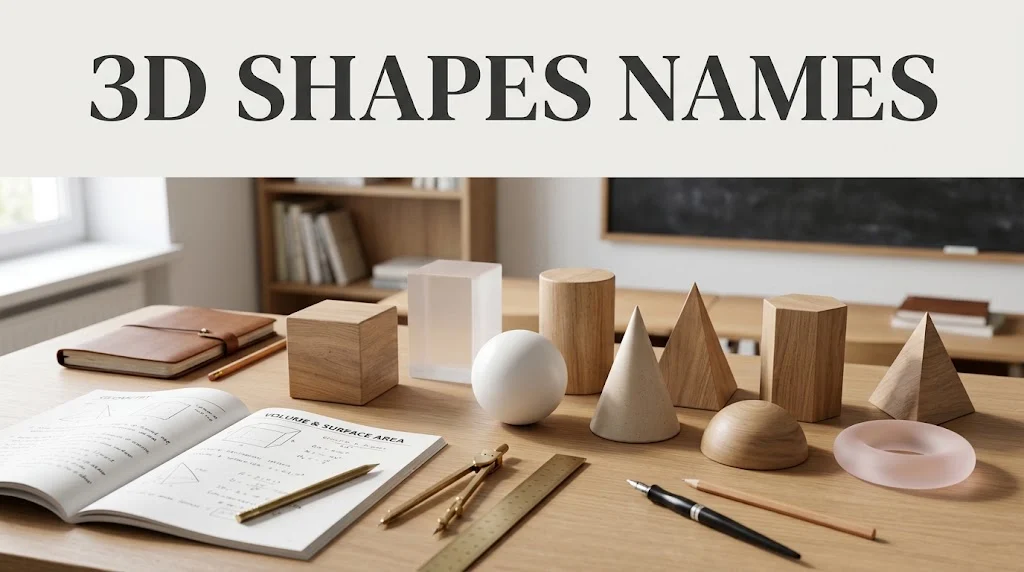
3D shapes are solid objects with three dimensions: length, width, and height. Common 3D shapes include cubes, cuboids, spheres, cylinders, cones, pyramids, prisms, tetrahedrons, hemispheres, and toruses.
Look around you and you will find three-dimensional shapes almost everywhere. A dice looks like a cube, a football resembles a sphere, a can has the shape of a cylinder, and an ice-cream cone gives us a familiar example of a cone.
Learning 3D shapes names helps students understand geometry and also makes it easier to describe objects in everyday life. Unlike flat, two-dimensional shapes such as circles, squares, and triangles, 3D shapes have depth. They occupy space and can have faces, edges, vertices, or curved surfaces.
Some 3D shapes are very familiar, while others are more specialized. A cube has six square faces, a sphere has one continuous curved surface, and a pyramid has triangular faces meeting at a point.
In this guide, we explore ten common three-dimensional shapes in simple language. You will learn what each shape is, its basic properties, where you may see it in real life, and why it is useful to know.
Cube
Meaning: A solid shape with six equal square faces.
Origin: The word “cube” comes from the Greek word kybos, meaning a die or cube.
Personality: A cube looks balanced, regular, and symmetrical. Every edge has the same length, giving the shape a very organized appearance.
Style: Geometric, symmetrical, regular, simple, classic.
Best For: Mathematics lessons, geometry activities, classroom models, puzzles, games, packaging, and architecture.
Popularity: The cube is one of the most familiar 3D shapes. It is commonly introduced early in geometry because its properties are easy to observe.
Key Properties: A cube has 6 square faces, 12 equal edges, and 8 vertices.
Real-Life Examples: Dice, sugar cubes, ice cubes, Rubik’s Cubes, and some boxes.
Why It Still Works Today: The cube is simple enough for young learners but important enough to appear in advanced mathematics, engineering, architecture, computer graphics, and design. Its symmetry also makes it a useful model for understanding volume and surface area.
Cuboid
Meaning: A solid shape with six rectangular faces.
Origin: The word comes from terms related to the Latin cubus and Greek -oeidēs, referring to something cube-like.
Personality: A cuboid feels practical, structured, and familiar. Unlike a cube, its length, width, and height do not necessarily have to be equal.
Style: Geometric, rectangular, practical, structured, modern.
Best For: Learning volume, surface area, packaging, architecture, engineering, and everyday object identification.
Popularity: Cuboids are among the most common solid shapes in daily life because many manufactured objects have rectangular forms.
Key Properties: A typical cuboid has 6 rectangular faces, 12 edges, and 8 vertices.
Real-Life Examples: Books, bricks, cereal boxes, shipping boxes, rooms, and many electronic devices.
Why It Still Works Today: The cuboid is especially useful because it connects classroom geometry with real objects. Students can easily identify its length, width, and height by looking at a box or book.
Sphere
Meaning: A perfectly round 3D shape in which every point on its surface is the same distance from its center.
Origin: The word “sphere” comes from the Greek word sphaira, meaning ball or globe.
Personality: A sphere feels smooth, balanced, and continuous. It has no corners or straight edges.
Style: Round, smooth, symmetrical, curved, classic.
Best For: Geometry lessons, sports examples, astronomy, design, and explaining curved surfaces.
Popularity: The sphere is one of the easiest 3D shapes to recognize because many familiar objects are approximately spherical.
Key Properties: A sphere has one continuous curved surface and no flat faces, straight edges, or vertices.
Real-Life Examples: Balls, marbles, some beads, spherical ornaments, and globes.
Why It Still Works Today: The sphere appears in mathematics, science, engineering, astronomy, architecture, and product design. Its symmetry makes it especially important when studying circles, radius, diameter, surface area, and volume.
Cylinder
Meaning: A 3D shape with two parallel circular bases joined by a curved surface.
Origin: The word “cylinder” comes through Latin from the Greek kylindros, meaning a roller.
Personality: A cylinder feels balanced and practical. Its straight sides and circular ends make it easy to recognize.
Style: Curved, symmetrical, practical, geometric, modern.
Best For: Geometry lessons, science, engineering, packaging, and identifying everyday objects.
Popularity: Cylinders are extremely common in manufactured products and natural structures.
Key Properties: A cylinder has 2 circular flat faces and 1 curved surface. In elementary geometry, it is commonly described as having 2 circular edges and no vertices.
Real-Life Examples: Cans, pipes, drinking glasses, batteries, candles, and some containers.
Why It Still Works Today: Cylindrical forms are useful because they combine strength, symmetry, and efficient use of space. Engineers and designers use cylindrical structures in everything from pipes to storage containers.
Cone
Meaning: A solid shape with a circular base that narrows to a single point called the apex.
Origin: The word “cone” comes from the Greek kōnos, referring to a cone or pine-cone shape.
Personality: A cone feels pointed, directional, and dynamic. Its shape naturally guides the eye toward its apex.
Style: Pointed, curved, geometric, distinctive, symmetrical.
Best For: Geometry lessons, classroom crafts, road-safety examples, design, and identifying everyday objects.
Popularity: The cone is one of the most recognizable 3D shapes and is commonly taught alongside cylinders and spheres.
Key Properties: A cone has 1 circular flat face, 1 curved surface, and 1 vertex.
Real-Life Examples: Ice-cream cones, party hats, traffic cones, funnels, and some lampshades.
Why It Still Works Today: The cone is useful for teaching circles, radius, height, slant height, volume, and surface area. Its recognizable form also makes it easy for children to connect geometry with real objects.
Pyramid
Meaning: A solid shape with a polygonal base and triangular faces that meet at one point.
Origin: The English word “pyramid” comes through Latin and Greek terms associated with pyramid-shaped structures.
Personality: A pyramid feels strong, stable, pointed, and architectural. Its triangular sides create a distinctive appearance.
Style: Geometric, architectural, traditional, symmetrical, pointed.
Best For: Geometry, architecture, history, classroom models, and studying faces and vertices.
Popularity: Pyramids are especially familiar because of their importance in ancient architecture, including the pyramids of Egypt.
Key Properties: The exact number of faces, edges, and vertices depends on the shape of the base. A square pyramid, for example, has 5 faces, 8 edges, and 5 vertices.
Real-Life Examples: Egyptian pyramids, pyramid-shaped roofs, decorative structures, and some packaging designs.
Why It Still Works Today: Pyramids connect mathematics with architecture and history. They are useful for teaching volume, surface area, symmetry, and the relationship between polygons and solid shapes.
Prism
Meaning: A 3D shape with two matching, parallel polygonal bases connected by rectangular or parallelogram-shaped faces.
Origin: The word “prism” comes from the Greek prisma, associated with something sawed or cut.
Personality: A prism feels structured, orderly, and versatile. Its exact appearance depends on the shape of its two bases.
Style: Geometric, structured, symmetrical, versatile, mathematical.
Best For: Geometry, architecture, science, optical studies, and classroom models.
Popularity: Prisms are important in geometry because they demonstrate how a two-dimensional polygon can extend through space.
Key Properties: The number of faces, edges, and vertices depends on the polygon forming the base. A triangular prism, for example, has 5 faces, 9 edges, and 6 vertices.
Real-Life Examples: Toblerone-style triangular packaging, some buildings, prisms used in optics, and many box-like structures.
Why It Still Works Today: Prisms help learners understand volume and the relationship between 2D and 3D geometry. They are also important in physics and optical applications.
Tetrahedron
Meaning: A 3D shape made from four triangular faces.
Origin: The word comes from Greek roots meaning “four” and “seat” or “base,” referring to a four-faced solid.
Personality: A tetrahedron feels sharp, compact, and symmetrical. Its triangular structure gives it a distinctive geometric appearance.
Style: Mathematical, triangular, symmetrical, compact, modern.
Best For: Advanced geometry, mathematics, science, modeling, and geometric design.
Popularity: The tetrahedron is one of the fundamental polyhedra and is often introduced when students move beyond basic solid shapes.
Key Properties: A tetrahedron has 4 triangular faces, 6 edges, and 4 vertices. A regular tetrahedron has four congruent equilateral triangles.
Real-Life Examples: Some molecular models, triangular structures, certain dice, and geometric sculptures.
Why It Still Works Today: The tetrahedron is important in geometry, chemistry, engineering, computer modeling, and structural design. Its simple triangular construction also makes it a useful building block for more complex forms.
Hemisphere
Meaning: Half of a sphere.
Origin: The word combines “hemi,” meaning half, with “sphere.”
Personality: A hemisphere feels smooth, rounded, and balanced. It combines the curved surface of a sphere with a flat circular base.
Style: Curved, symmetrical, rounded, simple, geometric.
Best For: Geometry lessons, architecture, science, design, and understanding relationships between spheres and their halves.
Popularity: Hemispheres are commonly taught as an extension of the sphere and are useful in practical examples.
Key Properties: A hemisphere has 1 curved surface and 1 circular flat face. It has a curved boundary where the curved surface meets the flat circular base.
Real-Life Examples: Dome-shaped structures, half-bowls, some architectural roofs, and certain scientific models.
Why It Still Works Today: The hemisphere helps students understand how a sphere can be divided into equal parts. It is also useful for studying volume and surface area.
Torus
Meaning: A ring-shaped 3D surface created by rotating a circle around an axis outside the circle.
Origin: The word “torus” comes from Latin and has been used in mathematics to describe ring-like forms.
Personality: A torus feels unusual, smooth, continuous, and distinctive. Unlike many basic 3D shapes, it has a central opening.
Style: Curved, advanced, symmetrical, ring-shaped, mathematical.
Best For: Advanced geometry, mathematics, computer graphics, engineering, and 3D modeling.
Popularity: The torus is less familiar to young students than cubes or spheres, but it is an important mathematical shape.
Key Properties: A torus has a continuous curved surface and a central hole. It does not have flat faces, straight edges, or vertices.
Real-Life Examples: Donuts, inflatable rings, some mechanical components, and ring-shaped objects.
Why It Still Works Today: The torus is especially useful in higher-level geometry and computer graphics. Its distinctive shape also appears in engineering, architecture, science, and digital modeling.
Quick Comparison Table
| 3D Shape | Main Features | Faces | Edges | Vertices |
|---|---|---|---|---|
| Cube | 6 equal square faces | 6 | 12 | 8 |
| Cuboid | 6 rectangular faces | 6 | 12 | 8 |
| Sphere | Fully curved surface | 0 flat faces | 0 | 0 |
| Cylinder | 2 circular bases + curved surface | 2 flat | 2 curved edges | 0 |
| Cone | Circular base + curved surface | 1 flat | 1 curved edge | 1 |
| Square Pyramid | Square base + triangular faces | 5 | 8 | 5 |
| Triangular Prism | 2 triangular bases | 5 | 9 | 6 |
| Tetrahedron | 4 triangular faces | 4 | 6 | 4 |
| Hemisphere | Half of a sphere | 1 flat | 1 circular boundary | 0 |
| Torus | Ring-shaped curved surface | 0 | 0 | 0 |
Note: The terms “faces” and “edges” can be defined slightly differently for curved solids in different school curricula. The table uses common elementary-geometry conventions.
How to Identify a 3D Shape
Identifying a 3D shape becomes easier when you look at a few basic properties.
Look at the faces.
Are they squares, rectangles, triangles, circles, or another shape? A cube has square faces, while a cuboid has rectangular faces.
Count the vertices.
A vertex is a corner where edges meet. A cube has eight vertices, while a sphere has none.
Look for edges.
Edges are boundaries where faces meet. Cubes have straight edges, while cones and cylinders can have curved boundaries.
Check for curved surfaces.
A sphere is completely curved. A cylinder has both flat and curved surfaces.
Look for symmetry.
Many 3D shapes have regular patterns. A cube, sphere, and regular tetrahedron are good examples of highly symmetrical solids.
Think about the base.
Pyramids and prisms can often be identified by their bases. A triangular prism has triangular bases, while a square pyramid has a square base.
Most Common 3D Shapes Today
Some 3D shapes appear much more often in everyday learning and objects than others.
- Cube
- Cuboid
- Sphere
- Cylinder
- Cone
- Pyramid
- Prism
- Tetrahedron
- Hemisphere
- Torus
The cube, cuboid, sphere, cylinder, and cone are particularly easy to find in everyday objects. More advanced shapes such as tetrahedrons and toruses are especially useful in higher-level mathematics, science, engineering, and computer modeling.
3D Shapes in Everyday Life
Geometry becomes easier to understand when students can connect shapes to familiar objects.
Cube: Dice, toy blocks, and ice cubes.
Cuboid: Books, boxes, bricks, and furniture.
Sphere: Balls, marbles, and some decorative objects.
Cylinder: Cans, pipes, candles, and glasses.
Cone: Traffic cones, funnels, party hats, and ice-cream cones.
Pyramid: Architectural structures and decorative models.
Prism: Certain packages, buildings, and optical prisms.
Tetrahedron: Geometric models and some structural designs.
Hemisphere: Domes and bowl-like objects.
Torus: Donuts, rings, and inflatable tubes.
These examples help learners see that 3D geometry is not limited to textbooks. It describes the physical world around us.
Why Are 3D Shapes Important?
Learning three-dimensional shapes develops more than simple geometry skills. It helps learners understand space, measurement, design, construction, and the way objects are organized.
Students use 3D shapes when learning about volume and surface area. Architects use geometric forms when planning buildings. Engineers consider shapes when designing structures and machines. Artists and 3D designers use solid forms to create realistic objects.
Understanding shapes also helps children develop spatial awareness. They learn to imagine how an object looks from different angles and how flat shapes can combine to create solid forms.
For this reason, 3D geometry appears in mathematics, science, engineering, architecture, art, technology, and many other fields.
FAQs
What are the most common 3D shapes names?
Some of the most common 3D shapes names are cube, cuboid, sphere, cylinder, cone, pyramid, and prism.
What is a 3D shape?
A 3D shape is an object with three dimensions: length, width, and height. Unlike a flat 2D shape, a three-dimensional object occupies space.
What are the 3 main dimensions of a 3D shape?
The three basic dimensions are length, width, and height. Depending on the object and context, these may also be described using terms such as depth, radius, diameter, or height.
Which 3D shape has 6 faces, 12 edges, and 8 vertices?
A cube has six square faces, twelve edges, and eight vertices. A cuboid also has six faces, twelve edges, and eight vertices, although its faces are generally rectangles rather than six equal squares.
What is the difference between a cube and a cuboid?
A cube has six equal square faces and all twelve edges have the same length. A cuboid has six rectangular faces, and its length, width, and height do not have to be equal.
Conclusion
Learning 3D shapes names is a simple way to build a strong foundation in geometry. From the familiar cube and sphere to the more advanced tetrahedron and torus, each solid has its own structure and useful properties.
The easiest way to remember these shapes is to connect them with real objects. Think of a dice when you see a cube, a ball when you see a sphere, a can when you see a cylinder, and an ice-cream cone when you see a cone. These everyday connections make geometry easier to understand and remember.
You are a student, teacher, parent, or simply curious about geometry, knowing the names and properties of common 3D shapes can make the world around you more interesting. Save this guide for learning, share it with other learners, and explore more geometry topics to strengthen your understanding.
Discover More Related Articles:
- O Names | Unique, Beautiful & Meaningful Ideas In 2026
- 3 Letter Names | Short, Cute & Unique Ideas In 2026