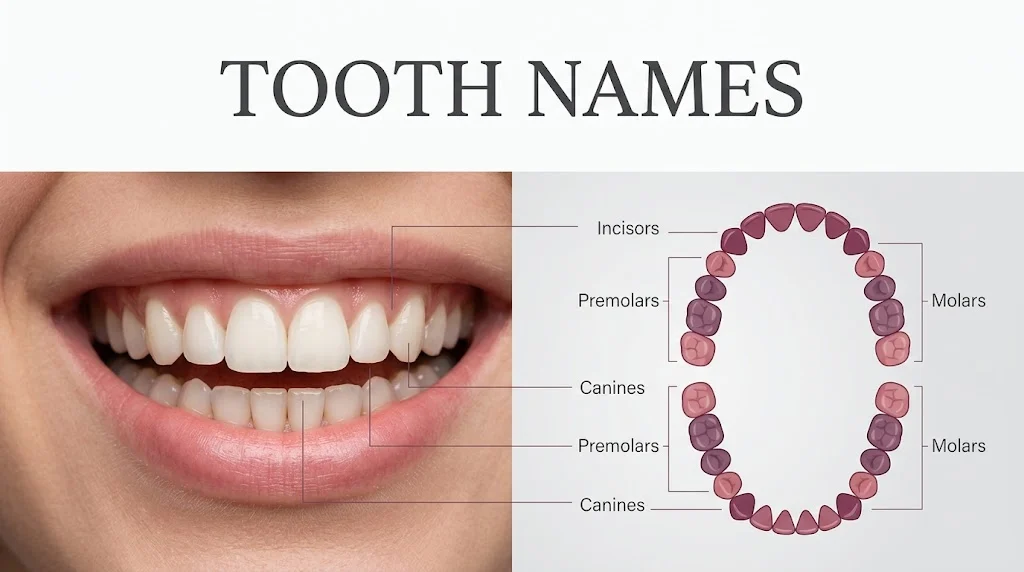
The four main types of human teeth are incisors, canines, premolars, and molars. Incisors cut food, canines tear it, premolars crush it, and molars grind it. Adults typically have 32 permanent teeth, including four wisdom teeth.
Your teeth may look similar at first glance, but each type has a different shape and job. Understanding tooth names makes it much easier to learn basic dental anatomy and understand what happens when a dentist talks about a particular tooth.
Human teeth are designed to work together. The sharp front teeth help bite into food, pointed canines help tear it, and the wider back teeth crush and grind it. Children have a smaller set of primary teeth, while adults develop a larger set of permanent teeth.
Knowing the names of teeth can also help you understand dental charts, school lessons, dental appointments, and basic oral-health information. You may have heard terms such as incisors, canines, premolars, or molars without knowing exactly where they are located.
This guide explains the main tooth types in simple language. We will look at their names, locations, functions, characteristics, and differences so you can easily understand how the human mouth is organized.
Incisors
Meaning: Front cutting teeth.
Origin: The word “incisor” comes from Latin roots associated with cutting.
Personality: If teeth had personalities, incisors would be the precise and practical ones. Their thin edges are designed for biting and cutting rather than heavy grinding.
Style: Thin, flat, sharp-edged, front-facing.
Best For: Biting and cutting food.
Popularity: Incisors are among the easiest teeth to identify because they sit at the very front of the mouth.
Emotional Appeal: These are often the teeth people think about when they picture a smile. The upper and lower front incisors play an important role in the visible appearance of the mouth.
Pop Culture Reference: Front teeth frequently appear in cartoons, illustrations, and children’s educational materials because they are easy to recognize.
Similar Tooth Types: Canines, premolars, molars.
Why It Still Works Today: Incisors are essential for the first step of eating. They help take bites before the food moves toward the other teeth for tearing and grinding.
Canines
Meaning: Pointed teeth used mainly for tearing.
Origin: The name “canine” comes from the association of these pointed teeth with dogs.
Personality: Canines have a sharper, stronger appearance than incisors. They are the pointed teeth positioned between the incisors and premolars.
Style: Pointed, strong, prominent.
Best For: Tearing and helping grip food.
Popularity: Canines are familiar to most people because of their distinctive pointed shape.
Emotional Appeal: Their pointed appearance gives them a recognizable character. They are also sometimes called “eye teeth” because of the position of the upper canines.
Pop Culture Reference: Canine teeth are often exaggerated in fictional vampires and fantasy characters, although real human canines are much less dramatic.
Similar Tooth Types: Incisors, premolars.
Why It Still Works Today: Canines provide an important transition between the cutting action of incisors and the crushing and grinding work of the back teeth.
Premolars
Meaning: Teeth positioned before the molars.
Origin: The name comes from their position immediately in front of the molars.
Personality: Premolars are the versatile middle workers of the mouth. They have surfaces designed to help crush and break food into smaller pieces.
Style: Broad, ridged, functional.
Best For: Crushing and breaking food.
Popularity: Premolars are less visible than incisors and canines but are essential to normal chewing.
Emotional Appeal: They may not be the most recognizable teeth, but they demonstrate how specialized the human mouth is. Different teeth cooperate to process food efficiently.
Pop Culture Reference: Premolars do not have a major pop-culture identity, which makes their anatomy more interesting than their entertainment associations.
Similar Tooth Types: Canines and molars.
Why It Still Works Today: Premolars bridge the gap between the sharper front teeth and the larger grinding teeth at the back.
Molars
Meaning: Large back teeth designed mainly for grinding.
Origin: The word is related to Latin terminology associated with grinding.
Personality: Molars are the heavy-duty workers of the dental team. Their broad chewing surfaces help break food down through repeated grinding.
Style: Large, broad, ridged, strong.
Best For: Grinding and crushing food.
Popularity: Molars are among the most important teeth for efficient chewing and are commonly discussed in dental care.
Emotional Appeal: Molars show how function shapes anatomy. Their broad surfaces are very different from the thin edges of the incisors because they perform a completely different task.
Pop Culture Reference: Molars are sometimes featured in educational diagrams and children’s dental materials rather than popular entertainment.
Similar Tooth Types: Premolars and wisdom teeth.
Why It Still Works Today: Molars provide much of the grinding action needed to prepare food for swallowing.
Wisdom Teeth
Meaning: The third molars at the very back of the mouth.
Origin: They are called wisdom teeth because they usually appear later than the other permanent teeth, traditionally associated with reaching greater maturity.
Personality: Wisdom teeth are the late arrivals of the dental family. They are the final permanent teeth to develop and emerge, although not everyone develops or retains all four.
Style: Large back molars, late-developing.
Best For: They are molars, so their basic function is associated with chewing and grinding.
Popularity: Wisdom teeth are widely known because their development can sometimes lead to dental discussions about space, positioning, or removal.
Emotional Appeal: Their name sounds symbolic because “wisdom” is associated with maturity and growing older.
Pop Culture Reference: Wisdom teeth frequently appear in jokes, school health materials, and stories about growing up.
Similar Tooth Types: First and second molars.
Why It Still Works Today: Wisdom teeth remain an interesting part of dental anatomy because they are the final teeth in the permanent set and can vary significantly from person to person.
Primary Teeth
Meaning: The first set of teeth, commonly called baby teeth.
Origin: “Primary” refers to the first or initial set.
Personality: Primary teeth are smaller and temporary compared with permanent adult teeth, but they have important developmental roles.
Style: Small, white, temporary.
Best For: Helping children bite and chew food, supporting speech development, and maintaining space while the permanent teeth develop.
Popularity: Baby teeth are familiar to families because they appear during early childhood and are eventually replaced.
Emotional Appeal: A child’s first teeth are often associated with early childhood milestones and memorable family moments.
Pop Culture Reference: Baby teeth are commonly featured in children’s stories involving the tooth fairy.
Similar Tooth Types: Permanent incisors, canines, and molars.
Why It Still Works Today: Primary teeth are an important part of childhood development. Even though they eventually fall out naturally, caring for them is still important.
Permanent Teeth
Meaning: The adult set of teeth that replaces the primary teeth.
Origin: “Permanent” refers to the teeth intended to remain throughout adulthood, although individual teeth can be lost or damaged.
Personality: Permanent teeth are the long-term members of the dental system.
Style: Larger, stronger, lasting.
Best For: Biting, tearing, crushing, and grinding throughout adulthood.
Popularity: Permanent teeth are the standard focus when discussing adult dental anatomy.
Emotional Appeal: They represent an important stage of growing from childhood into adulthood.
Pop Culture Reference: Permanent teeth often appear in educational materials about dental development and oral hygiene.
Similar Tooth Types: Incisors, canines, premolars, molars.
Why It Still Works Today: Understanding permanent teeth helps people recognize the basic structure of an adult mouth and understand dental charts.
Front Teeth
Meaning: Teeth located toward the front of the mouth.
Origin: A descriptive anatomical term.
Personality: Front teeth are highly visible and perform important biting functions.
Style: Visible, thin-edged, prominent.
Best For: Biting and cutting food.
Popularity: Front teeth are among the most recognizable teeth because they are visible when people smile or speak.
Emotional Appeal: They contribute significantly to a person’s smile and facial appearance.
Pop Culture Reference: Front teeth are frequently used in cartoon characters and children’s illustrations because their position makes them easy to show.
Similar Tooth Types: Incisors and canines.
Why It Still Works Today: Front teeth have both functional and visible roles. They begin the process of biting while also helping form certain speech sounds.
Back Teeth
Meaning: Teeth positioned farther toward the back of the mouth.
Origin: A simple descriptive term rather than a specific tooth classification.
Personality: Back teeth are the hardworking grinders. They are less visible but perform major chewing tasks.
Style: Broad, strong, ridged.
Best For: Crushing and grinding food.
Popularity: The term “back teeth” is commonly used in everyday conversation, although dentists may use specific names such as premolars and molars.
Emotional Appeal: Back teeth show that not every important part of a smile needs to be visible. Their main role is functional.
Pop Culture Reference: Back teeth are less common in popular culture but often appear in educational dental diagrams.
Similar Tooth Types: Premolars, molars, and wisdom teeth.
Why It Still Works Today: Understanding back teeth makes it easier to understand the difference between visible front teeth and the chewing teeth farther inside the mouth.
Quick Comparison Table
| Tooth Name | Main Function | Location | Typical Set |
|---|---|---|---|
| Incisors | Cutting and biting | Front | Primary & permanent |
| Canines | Tearing and gripping | Between incisors and premolars | Primary & permanent |
| Premolars | Crushing | Behind canines | Permanent |
| Molars | Grinding | Back of mouth | Primary & permanent |
| Wisdom Teeth | Grinding | Very back | Permanent |
| Primary Teeth | Early biting and chewing | Throughout childhood mouth | Children |
| Permanent Teeth | Long-term biting and chewing | Adult mouth | Adults |
| Front Teeth | Biting and cutting | Front of mouth | Children & adults |
| Back Teeth | Crushing and grinding | Back of mouth | Children & adults |
FAQs
How Many Teeth Do Humans Have?
Most adults have 32 permanent teeth when all four wisdom teeth are present. This includes eight incisors, four canines, eight premolars, and twelve molars.
What Are the Four Main Types of Teeth?
The four main types of permanent human teeth are incisors, canines, premolars, and molars.
How Are Baby Teeth Different From Adult Teeth?
Baby teeth, also called primary teeth, are generally smaller than permanent teeth. Children have 20 primary teeth, while adults typically have up to 32 permanent teeth.
What Are Front Teeth Called?
The front teeth are primarily called incisors. There are four upper and four lower incisors in a typical permanent set.
What Are Back Teeth Called?
The back teeth include premolars and molars. Premolars sit behind the canines and help crush food, while molars are farther back and are especially important for grinding.
Conclusion
Understanding tooth names makes the human mouth much easier to understand. Each type has a specific role, from the cutting action of incisors to the tearing work of canines and the crushing and grinding performed by premolars and molars.
The difference between primary and permanent teeth is also important. Children begin with 20 primary teeth, while adults typically have up to 32 permanent teeth, including wisdom teeth.
Whether you are studying anatomy, helping a child learn about dental health, or simply curious about the teeth in your own mouth, knowing these basic names gives you a useful foundation. Save this guide for future reference, share it with someone learning about dental anatomy, and explore more educational naming and anatomy guides on the site.
Discover More Related Articles:
- O Names | Unique, Beautiful & Meaningful Ideas In 2026
- 3 Letter Names | Short, Cute & Unique Ideas In 2026