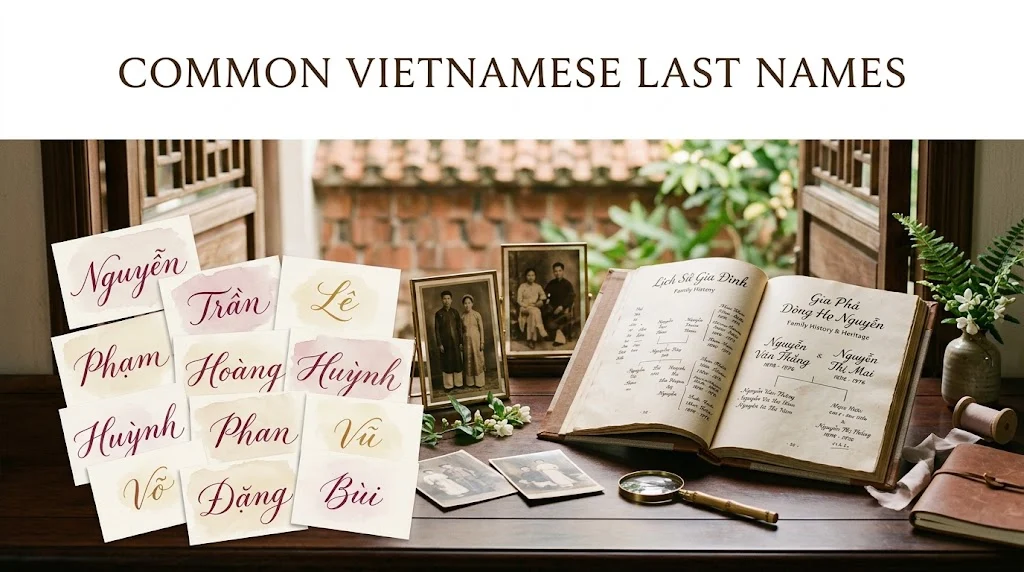
The most common Vietnamese last name is Nguyen, followed by surnames such as Tran, Le, Pham, Hoang, Huynh, Phan, Vu, Vo, Dang, and Bui. Vietnamese surnames reflect centuries of history, migration, and cultural influence.
A surname can be a small word with a very large story behind it. It can connect generations, preserve family identity, and offer clues about a person’s cultural background. Vietnamese family names are especially interesting because a relatively small group of surnames is shared by a large part of the population.
When people search for common Vietnamese last names, Nguyen is often the first surname they encounter. It is by far the best-known Vietnamese surname internationally, but it is only one part of a much broader naming tradition. Tran, Le, Pham, Hoang, Huynh, Phan, Vu, Vo, Dang, and Bui are also widely recognized Vietnamese family names.
Vietnamese naming conventions can differ from Western naming patterns. In a typical Vietnamese full name, the family name usually comes first, followed by a middle name and given name. This structure makes the surname especially important when understanding Vietnamese names and family relationships.
In this guide, we explore ten common Vietnamese last names, their linguistic and historical background, cultural associations, and why they remain important today.
Nguyen
Meaning: The exact origin and meaning of Nguyen as a surname are historically complex. The name is traditionally written Nguyễn in Vietnamese.
Origin: Vietnam, with historical connections to Vietnamese dynastic and aristocratic history.
History: Nguyen is overwhelmingly the most common Vietnamese surname. Several historical factors are associated with its widespread use, including the influence of the Nguyen dynasty and periods when people adopted or changed surnames for social, political, or administrative reasons.
Cultural Significance: Because so many Vietnamese people share the surname, Nguyen is one of the strongest examples of how a surname can become a broad marker of cultural identity rather than identifying one single family line.
Style: Traditional, historic, recognizable, widespread.
Best For: Genealogy research, Vietnamese characters, family-history projects, cultural studies, and naming references.
Popularity: Extremely common in Vietnam and among Vietnamese communities around the world.
Why It Still Works Today: Nguyen remains deeply connected to Vietnamese identity. Its international visibility has also made it one of the most recognizable Asian surnames in English-speaking countries.
Similar Vietnamese Surnames: Tran, Le, Pham, Hoang, Phan.
Tran
Meaning: Tran (Trần) is primarily a hereditary family name rather than a surname whose modern meaning is usually interpreted as a simple dictionary word.
Origin: Vietnamese; historically connected with the Trần dynasty.
History: The Trần dynasty ruled Vietnam during the medieval period and played an important role in Vietnamese history. The surname therefore has strong historical associations with one of Vietnam’s major ruling families.
Cultural Significance: Tran is one of the most recognizable Vietnamese surnames. It is also found throughout Vietnamese communities outside Vietnam.
Style: Historic, traditional, strong, familiar.
Best For: Family-history research, Vietnamese characters, genealogy, and cultural naming projects.
Popularity: One of the most common Vietnamese family names.
Why It Still Works Today: Tran is short, recognizable, and strongly associated with Vietnamese heritage. Its historical connection gives it an additional layer of cultural significance.
Similar Vietnamese Surnames: Nguyen, Le, Pham, Phan, Dang.
Le
Meaning: Le is written Lê in Vietnamese and is primarily a hereditary surname.
Origin: Vietnam; historically associated with the Lê dynasty.
History: The Lê dynasty was one of the major dynasties in Vietnamese history. The surname Lê therefore has a significant historical association with Vietnamese political and royal history.
Cultural Significance: Le is widely used among Vietnamese families and is also familiar internationally because of the Vietnamese diaspora.
Style: Short, classic, historic, elegant.
Best For: Vietnamese family names, historical characters, genealogy, and multicultural naming.
Popularity: A very common Vietnamese surname.
Why It Still Works Today: Its short spelling makes Le easy to recognize internationally, while its Vietnamese diacritic, Lê, preserves the original written form.
Similar Vietnamese Surnames: Ly, Tran, Nguyen, Pham, Ho.
Pham
Meaning: Phạm is a Vietnamese hereditary surname. Its modern surname use should not be reduced to one simple literal translation.
Origin: Vietnam.
History: Pham has been established as a Vietnamese family name for many generations and became widespread among Vietnamese communities.
Cultural Significance: Pham is particularly recognizable among Vietnamese people living in Vietnam and abroad. It is also frequently encountered in historical, academic, professional, and cultural contexts.
Style: Traditional, strong, familiar, concise.
Best For: Vietnamese family-history research, character naming, genealogy, and cultural studies.
Popularity: Pham is among the most common Vietnamese surnames.
Why It Still Works Today: Pham is easy to recognize and pronounce for many English speakers while retaining a strong Vietnamese identity.
Similar Vietnamese Surnames: Nguyen, Tran, Le, Phan, Dang.
Hoang
Meaning: Hoàng is a Vietnamese surname with historical and linguistic connections that differ from the surname’s modern family-name use.
Origin: Vietnam.
History: Hoang is an established Vietnamese surname and is also closely related in written form to the Chinese-Vietnamese linguistic tradition. In some contexts, the surname is written Huỳnh due to regional usage and historical spelling conventions.
Cultural Significance: Hoang is especially familiar in Vietnamese communities, while Huynh is also widely encountered among Vietnamese families.
Style: Traditional, distinctive, established.
Best For: Vietnamese characters, genealogy, family-history research, and cultural naming.
Popularity: One of the more common Vietnamese family names.
Why It Still Works Today: Hoang has a recognizable Vietnamese sound and remains an established surname across generations.
Similar Vietnamese Surnames: Huynh, Phan, Pham, Bui, Vu.
Huynh
Meaning: Huỳnh is a Vietnamese surname and is related historically to the same broader surname tradition as Hoàng in certain regional and historical contexts.
Origin: Vietnam, with particularly strong usage in southern Vietnamese communities.
History: Regional naming and pronunciation practices have influenced the forms Hoàng and Huỳnh. The distinction can be important when studying Vietnamese family history.
Cultural Significance: Huynh is especially recognizable among Vietnamese communities in southern Vietnam and in Vietnamese diaspora communities.
Style: Traditional, regional, distinctive, familiar.
Best For: Vietnamese family names, genealogy, cultural research, and fictional characters.
Popularity: A common Vietnamese surname, particularly in southern communities.
Why It Still Works Today: Huynh preserves a distinctly Vietnamese spelling and sound while remaining familiar to many Vietnamese families around the world.
Similar Vietnamese Surnames: Hoang, Pham, Bui, Vu, Phan.
Phan
Meaning: Phan is a Vietnamese hereditary surname, written Phan in modern Vietnamese without requiring a simple literal translation.
Origin: Vietnam, with historical roots connected to Vietnamese and Sino-Vietnamese naming traditions.
History: Phan has been used by Vietnamese families for generations and is found in different parts of the country and diaspora communities.
Cultural Significance: The surname is recognizable across Vietnam and among Vietnamese communities overseas.
Style: Classic, traditional, concise, versatile.
Best For: Family-history research, Vietnamese characters, genealogy, and cultural studies.
Popularity: A common Vietnamese surname, though less widespread than Nguyen, Tran, or Le.
Why It Still Works Today: Phan is short and memorable while retaining a clear Vietnamese identity. It works naturally in both traditional and modern contexts.
Similar Vietnamese Surnames: Pham, Tran, Le, Nguyen, Dang.
Vu
Meaning: Vũ is a Vietnamese surname with historical Sino-Vietnamese roots.
Origin: Vietnam.
History: Vũ has been used as a Vietnamese family name for generations. The surname is also connected to broader East Asian naming traditions through historical linguistic exchange.
Cultural Significance: Vu is a familiar Vietnamese surname, particularly when represented without Vietnamese diacritics in international documents.
Style: Short, classic, refined, distinctive.
Best For: Vietnamese characters, genealogy, international naming, and family-history projects.
Popularity: A well-established Vietnamese surname.
Why It Still Works Today: Vu is particularly adaptable internationally. The short form is easy to write in contexts where Vietnamese diacritics are omitted, while Vũ preserves the traditional Vietnamese spelling.
Similar Vietnamese Surnames: Vo, Vuong, Bui, Dang, Ho.
Vo
Meaning: Võ is a Vietnamese surname with historical Sino-Vietnamese linguistic roots.
Origin: Vietnam.
History: Võ has long been used as a Vietnamese family name. The surname is especially familiar in Vietnamese communities, including those outside Vietnam.
Cultural Significance: Võ is also visually associated with Vietnamese martial-arts terminology because of the broader Vietnamese word võ, although a surname should not automatically be interpreted as having that meaning.
Style: Short, strong, traditional, distinctive.
Best For: Vietnamese characters, genealogy, family-history research, and cultural projects.
Popularity: A recognized Vietnamese surname, especially common among Vietnamese communities in southern Vietnam and abroad.
Why It Still Works Today: Its concise spelling makes Võ easy to remember while the diacritic helps preserve its Vietnamese form.
Similar Vietnamese Surnames: Vu, Pham, Bui, Dang, Le.
Dang
Meaning: Đặng is a Vietnamese hereditary surname. Its historical linguistic background is connected to Sino-Vietnamese naming traditions.
Origin: Vietnam.
History: Đặng has been used by Vietnamese families for many generations. Historical figures bearing the surname appear in different periods of Vietnamese history.
Cultural Significance: Dang remains a recognizable surname in Vietnam and among Vietnamese communities around the world.
Style: Traditional, strong, historic, straightforward.
Best For: Vietnamese family names, historical research, genealogy, fictional characters, and cultural studies.
Popularity: A common Vietnamese surname, although less widespread than Nguyen.
Why It Still Works Today: Dang has a compact form that works easily in international contexts while the original Đặng spelling provides the Vietnamese form.
Similar Vietnamese Surnames: Dang, Bui, Phan, Pham, Vu.
Bui
Meaning: Bùi is a Vietnamese hereditary surname with historical Sino-Vietnamese roots.
Origin: Vietnam.
History: Bùi has been established as a Vietnamese family name for centuries. Families with this surname can be found throughout Vietnam and in overseas Vietnamese communities.
Cultural Significance: Bui is a recognizable Vietnamese surname and appears frequently in modern Vietnamese communities.
Style: Traditional, concise, familiar, classic.
Best For: Vietnamese characters, genealogy, family-history research, and cultural naming projects.
Popularity: Bui is among the commonly encountered Vietnamese surnames.
Why It Still Works Today: Bui is short and distinctive. The original Vietnamese spelling, Bùi, also demonstrates how diacritics can be important when preserving Vietnamese names accurately.
Similar Vietnamese Surnames: Dang, Vu, Vo, Pham, Hoang.
Quick Comparison Table
| Last Name | Vietnamese Form | Background | Style |
|---|---|---|---|
| Nguyen | Nguyễn | Historic Vietnamese surname | Traditional & widespread |
| Tran | Trần | Associated with Trần dynasty | Historic & classic |
| Le | Lê | Associated with Lê dynasty | Short & historic |
| Pham | Phạm | Established Vietnamese surname | Classic & strong |
| Hoang | Hoàng | Traditional Vietnamese surname | Distinctive |
| Huynh | Huỳnh | Regional Vietnamese usage | Traditional & regional |
| Phan | Phan | Vietnamese/Sino-Vietnamese tradition | Classic |
| Vu | Vũ | Sino-Vietnamese roots | Short & refined |
| Vo | Võ | Vietnamese/Sino-Vietnamese tradition | Strong & concise |
| Dang | Đặng | Established Vietnamese surname | Traditional & historic |
| Bui | Bùi | Vietnamese/Sino-Vietnamese tradition | Classic & familiar |
How Vietnamese Last Names Work
Vietnamese names usually follow a different order from the naming pattern common in English-speaking countries.
A traditional Vietnamese full name generally places the family name first, followed by a middle name and then the given name.
For example, in a name such as Nguyễn Văn An, Nguyễn is the family name, Văn is the middle name, and An is the given name.
This means that when reading a Vietnamese name, the first part is often the surname rather than the given name.
Vietnamese families may also use middle names for additional meaning, family connections, generational patterns, or distinctions between names. Naming practices can vary by family, generation, region, and historical period.
Why Are Some Vietnamese Last Names So Common?
Vietnam has a relatively concentrated surname distribution. A small number of family names are shared by a large portion of the population.
Historical changes help explain part of this pattern. Dynasties, political transitions, social circumstances, adoption of surnames, and changes in family identity all influenced Vietnamese surname distribution over time.
Nguyen is the clearest example. Its widespread use is associated with several historical factors rather than one simple explanation.
It is also important not to assume that every person with the same Vietnamese surname belongs to one immediate family. A surname can be shared by many unrelated families.
Vietnamese Last Names and Cultural Identity
A surname can be an important part of Vietnamese identity, but it does not tell the complete story of a person’s ancestry.
Vietnam includes many ethnic communities, languages, regional traditions, and historical influences. Vietnamese surnames have also been shaped by contact with Chinese civilization and the use of Sino-Vietnamese vocabulary over many centuries.
For this reason, surname research should be approached with care. A surname may have a documented historical connection, but that does not automatically reveal one person’s exact family origin.
Genealogy requires additional evidence such as family records, historical documents, oral histories, and regional information.
Vietnamese Last Names in the Diaspora
Vietnamese surnames are now found throughout the world because of Vietnamese migration and diaspora communities.
Countries such as the United States, Australia, Canada, France, and other destinations have significant Vietnamese communities. International records sometimes remove Vietnamese diacritics, so Nguyễn may appear as Nguyen, Trần as Tran, and Đặng as Dang.
This can make genealogy slightly more complicated. Searching both the accented and unaccented versions of a surname can help researchers locate historical records.
Most Common Vietnamese Last Names
A short list of widely recognized Vietnamese surnames includes:
- Nguyễn
- Trần
- Lê
- Phạm
- Hoàng
- Huỳnh
- Phan
- Vũ
- Võ
- Đặng
- Bùi
- Đỗ
- Hồ
- Ngô
- Dương
The exact ranking can vary depending on the dataset, region, spelling conventions, and whether closely related regional forms are counted separately.
Traditional Vietnamese Surnames
Traditional Vietnamese family names often have long histories and may be connected to historical dynasties, regional communities, or broader Sino-Vietnamese linguistic traditions.
Some examples include:
- Nguyễn
- Trần
- Lê
- Phạm
- Phan
- Đặng
- Bùi
- Đỗ
- Hồ
- Ngô
These names remain common because surnames are passed through generations and form an important part of family identity.
Vietnamese Surname Trends Today
Modern Vietnamese naming continues to preserve traditional family names while adapting to changing social environments.
One noticeable feature is the increasing international use of Vietnamese names. Vietnamese people living abroad may preserve diacritics in formal and personal contexts or omit them when using systems that do not support Vietnamese characters.
The pronunciation of names can also change slightly in international settings. However, many families continue to use the traditional Vietnamese form within their communities.
Another important point is that a surname’s popularity does not necessarily make it less meaningful. A common surname can represent generations of family history.
Are Vietnamese Last Names Related to Chinese Surnames?
There are historical linguistic connections between many Vietnamese surnames and Chinese-character traditions. Vietnamese civilization was influenced by centuries of contact with China, and Sino-Vietnamese vocabulary became an important part of Vietnamese language and culture.
However, this does not mean that every person with a Vietnamese surname should automatically be considered Chinese or that a Vietnamese family name reveals a person’s complete ethnic ancestry.
Surname history is more complicated than a one-to-one relationship between a modern surname and an ancient origin.
How to Research a Vietnamese Family Name
If you are researching your own family history, start with the spelling used by your relatives.
Check Vietnamese diacritics.
Nguyen and Nguyễn represent the same surname in different writing contexts, but searching both versions can be useful.
Ask older relatives.
Family stories can provide information that does not appear in public records.
Look at immigration records.
For families who moved internationally, immigration and naturalization documents can contain different versions of the same surname.
Search multiple spellings.
Older records may omit accents or use different transliteration practices.
Check historical locations.
Knowing the province, city, or village associated with a family can make surname research much more useful.
Do not assume shared surnames mean close relationships.
Common Vietnamese surnames can be held by many unrelated families.
FAQs
What is the most common Vietnamese last name?
Nguyễn is widely recognized as the most common Vietnamese surname. However, the exact percentage can vary between datasets and populations.
What are the most common Vietnamese surnames?
Common Vietnamese surnames include Nguyễn, Trần, Lê, Phạm, Hoàng, Huỳnh, Phan, Vũ, Võ, Đặng, and Bùi.
Why is Nguyen such a common Vietnamese surname?
Nguyễn became extremely widespread through a combination of historical and social factors. Therefore, there is no single explanation for the surname’s modern prevalence.
Do Vietnamese people put their last name first?
Yes. In the traditional Vietnamese naming order, the family name usually comes first, followed by a middle name and given name.
Are Nguyen and Tran Vietnamese last names?
Yes. Nguyễn and Trần are both established Vietnamese family names and are among the most widely recognized Vietnamese surnames.
Conclusion
Common Vietnamese last names offer a fascinating window into Vietnamese history, language, and family identity. Names such as Nguyễn, Trần, Lê, Phạm, Hoàng, Huỳnh, Phan, Vũ, Võ, Đặng, and Bùi are more than simple labels. They have been carried across generations and shaped by historical change.
Nguyễn is especially widespread, but every surname has its own story and cultural context. When researching a family name, remember that a surname alone cannot reveal a person’s complete ancestry. Regional history, family records, language, migration, and oral traditions all matter.
Whether you are researching genealogy, creating a Vietnamese character, studying names, or exploring your own heritage, these surnames provide a useful starting point. Save this guide, share it with someone interested in Vietnamese family names, and explore the history behind the surname you are curious about.
Discover More Related Articles:
- Lip Piercing Names | Types, Styles & Meanings In 2026
- Ear Piercings Names | A Complete Guide to Every Style In 2026