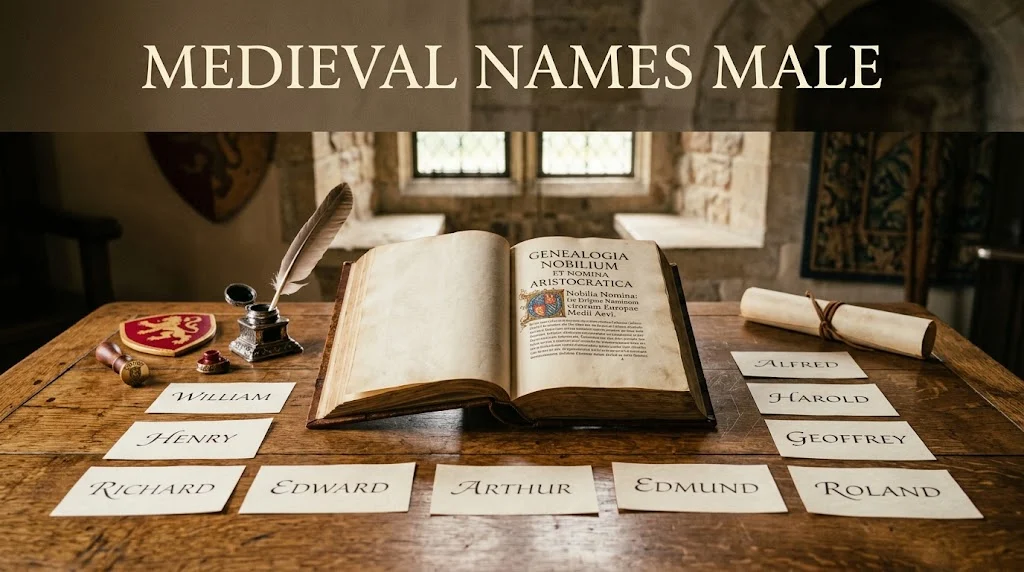
Medieval names have a special kind of atmosphere. They can sound noble, mysterious, heroic, scholarly, or powerful within just a few syllables. Names such as William, Henry, Richard, and Edmund have survived for centuries, while less familiar choices can give a character or baby name a more unusual historical feeling.
If you are searching for medieval names male, the Middle Ages offer a remarkably diverse naming tradition. Medieval Europe included many languages and cultures, so names varied widely across England, France, Germany, Scandinavia, Italy, Spain, and other regions.
Some names became associated with kings and nobles. Others belonged to knights, saints, merchants, scholars, and ordinary families. Their meanings can also range from strength and protection to prosperity, fame, peace, and faith.
Whether you need a name for a baby boy, historical character, fantasy hero, writing project, or simply enjoy old names, this collection offers a useful starting point.
⚔️ William
Meaning: Resolute protector
Origin: Germanic, introduced widely into England after the Norman Conquest
Personality: William feels strong, dependable, dignified, and traditional. It can suggest a thoughtful leader who combines confidence with restraint.
Style: Royal, classic, noble, medieval
Best For: Baby boy, historical character, king, knight, literary character
Popularity: William has remained one of the most enduring names in English-speaking cultures. Its long history gives it a genuinely medieval foundation while keeping it familiar today.
Emotional Appeal: The name feels powerful without sounding overly dramatic. It has the advantage of being both historically significant and easy to recognize.
Pop Culture Reference: William appears throughout medieval history, including William the Conqueror, who became King of England in 1066.
Similar Names: Walter, Edward, Henry, Richard, Edmund
Why It Still Works Today: William demonstrates how a medieval name can remain completely usable in modern life. It also offers familiar short forms such as Will, Willie, and Liam.
👑 Henry
Meaning: Home ruler or ruler of the household
Origin: Germanic
Personality: Henry sounds confident, intelligent, warm, and established. It can suggest someone with leadership qualities and a calm presence.
Style: Royal, classic, refined, traditional
Best For: Baby boy, prince, king, historical character
Popularity: Henry has been used by numerous English kings and European rulers, giving it a particularly strong medieval association.
Emotional Appeal: Henry has a friendly sound despite its royal history. It feels approachable rather than intimidating.
Pop Culture Reference: Several medieval English kings were named Henry, including Henry II, Henry III, Henry IV, Henry V, and Henry VI.
Similar Names: Harry, Harold, Edward, William, Edmund
Why It Still Works Today: Henry successfully bridges history and modern naming. It is short, recognizable, and sophisticated without feeling outdated.
🛡️ Richard
Meaning: Brave ruler or powerful leader
Origin: Germanic
Personality: Richard has a commanding and confident personality. It can evoke leadership, courage, ambition, and determination.
Style: Strong, royal, traditional, warrior-inspired
Best For: Baby boy, king, knight, historical character
Popularity: Richard was particularly prominent among medieval European nobility and English royalty.
Emotional Appeal: The name has a strong sound and a long historical record. It feels especially appropriate for someone looking for a powerful medieval-style name.
Pop Culture Reference: Richard I of England, commonly known as Richard the Lionheart, is one of the best-known medieval figures associated with the name.
Similar Names: Robert, Roger, Raymond, William, Edward
Why It Still Works Today: Richard has a formal full name and several familiar forms, including Rich, Richie, and Rick, making it versatile across different settings.
🏰 Edward
Meaning: Wealthy guardian or prosperous protector
Origin: Old English
Personality: Edward feels thoughtful, dignified, loyal, and composed. It has a refined quality that works equally well for a noble character or modern child.
Style: English, royal, classic, noble
Best For: Baby boy, prince, king, historical character
Popularity: Edward was used by several English kings and remained a prominent English name for centuries.
Emotional Appeal: Edward combines strength with elegance. It does not need an elaborate sound to communicate historical importance.
Pop Culture Reference: Edward the Confessor was an important English king whose reign preceded the Norman Conquest.
Similar Names: Edmund, Edgar, Edwin, Edmund, Alfred
Why It Still Works Today: Edward has survived because it feels formal without being difficult. Short forms such as Ed, Eddie, and Ted provide more casual options.
🦁 Arthur
Meaning: Traditionally associated with the legendary name Arthur; exact etymology remains debated
Origin: Celtic or Brittonic tradition
Personality: Arthur feels courageous, noble, imaginative, and legendary.
Style: Legendary, medieval, royal, heroic
Best For: Baby boy, legendary character, knight, king
Popularity: Arthur has an exceptionally strong medieval association because of the legends surrounding King Arthur and the Knights of the Round Table.
Emotional Appeal: Few names immediately create such a strong medieval image. Arthur brings to mind castles, quests, chivalry, and legendary kingship.
Pop Culture Reference: King Arthur is one of the central legendary figures of medieval British literature.
Similar Names: Alfred, Edmund, Edward, Tristan, Roland
Why It Still Works Today: Arthur is historic without being obscure. Its legendary associations give it a distinctive identity while its simple pronunciation keeps it accessible.
📜 Geoffrey
Meaning: The name has Germanic roots, with interpretations connected to peace or divine protection
Origin: Germanic, used in medieval England and France
Personality: Geoffrey feels scholarly, refined, thoughtful, and somewhat mysterious.
Style: Medieval, literary, traditional, noble
Best For: Historical character, writer, scholar, nobleman
Popularity: Geoffrey was established in medieval England and appears in records connected with the nobility and literature of the period.
Emotional Appeal: It has a distinctly medieval sound without being as familiar as William or Henry.
Pop Culture Reference: Geoffrey of Monmouth was a 12th-century cleric and writer associated with influential Arthurian literature.
Similar Names: Godfrey, Gregory, Gilbert, Gerard, Geoffrey
Why It Still Works Today: Geoffrey is an excellent choice when you want something historical and recognizable but less frequently chosen than the most famous medieval names.
🕯️ Edmund
Meaning: Prosperity or wealth + protection
Origin: Old English
Personality: Edmund feels intelligent, honorable, serious, and quietly strong.
Style: Old English, noble, literary, classic
Best For: Baby boy, prince, historical character, scholar
Popularity: Edmund has deep English roots and was used by Anglo-Saxon and medieval figures.
Emotional Appeal: The name has a gentle beginning but a strong historical character. It feels dignified without sounding harsh.
Pop Culture Reference: Edmund appears in medieval English history and later became recognizable through literary works such as C. S. Lewis’s The Chronicles of Narnia.
Similar Names: Edward, Edgar, Edwin, Alfred, Edmund
Why It Still Works Today: Edmund is ideal for parents or writers who want an old English name with substance and a refined sound.
🏹 Harold
Meaning: Army leader or army ruler
Origin: Old English
Personality: Harold sounds determined, commanding, practical, and brave.
Style: Warrior, Anglo-Saxon, historic, strong
Best For: Warrior character, historical character, baby boy, king
Popularity: Harold has strong pre-Norman English associations and was borne by Harold Godwinson, the last crowned Anglo-Saxon king of England.
Emotional Appeal: Its meaning gives Harold a natural warrior quality, making it especially appealing for historical or medieval storytelling.
Pop Culture Reference: Harold Godwinson is one of the central figures connected with the events of the Norman Conquest.
Similar Names: Harald, Henry, Alfred, Edgar, Edwin
Why It Still Works Today: Harold offers a strong historical identity and can work especially well for anyone seeking an Anglo-Saxon rather than Norman-inspired name.
🌿 Alfred
Meaning: Elf counsel or wise counsel
Origin: Old English
Personality: Alfred feels wise, calm, intelligent, and dependable.
Style: Anglo-Saxon, classic, scholarly, historic
Best For: Baby boy, king, scholar, historical character
Popularity: Alfred has an especially strong connection to Anglo-Saxon England.
Emotional Appeal: Its traditional interpretation involving counsel gives it an intellectual quality rather than a purely warrior-like image.
Pop Culture Reference: Alfred the Great was a 9th-century king of Wessex and one of the best-known rulers of Anglo-Saxon England.
Similar Names: Albert, Edgar, Edmund, Edwin, Alden
Why It Still Works Today: Alfred feels vintage and distinctive while still being easy to pronounce. It can also be shortened to Alf or Alfie.
🗡️ Roland
Meaning: Often interpreted in connection with fame and land
Origin: Germanic
Personality: Roland feels adventurous, loyal, courageous, and heroic.
Style: Knightly, medieval, legendary, romantic
Best For: Knight, warrior character, baby boy, historical fiction
Popularity: Roland became particularly famous through medieval European literature and heroic traditions.
Emotional Appeal: The name carries a strong storytelling quality. It sounds like a name naturally suited to a knight or traveling hero.
Pop Culture Reference: Roland is the legendary hero of The Song of Roland, one of the best-known epic poems associated with medieval French literary tradition.
Similar Names: Reynold, Ronald, Roderick, Roger, Roland
Why It Still Works Today: Roland offers an unmistakably historical sound while remaining straightforward to pronounce and spell.
✨ Quick Comparison Table
| Name | Meaning | Style | Best For |
|---|---|---|---|
| William | Resolute protector | Royal, noble | Baby boy |
| Henry | Home ruler | Royal, classic | Baby boy |
| Richard | Brave ruler | Strong, warrior | Character or baby |
| Edward | Prosperous guardian | English, royal | Baby boy |
| Arthur | Legendary name; debated origin | Heroic, medieval | Character or baby |
| Geoffrey | Peace/divine protection associations | Literary, medieval | Character |
| Edmund | Prosperity and protection | Old English, noble | Baby boy |
| Harold | Army ruler | Warrior, Anglo-Saxon | Character |
| Alfred | Wise counsel | Scholarly, historic | Baby boy |
| Roland | Fame and land associations | Knightly, heroic | Character or baby |
💡 How to Choose the Perfect Medieval Male Name
Start by deciding what kind of medieval atmosphere you want.
For a royal feeling, William, Henry, Richard, and Edward are excellent choices. They are strongly associated with medieval English monarchy and noble families.
For a warrior atmosphere, Harold and Richard have especially strong associations with leadership and military history. Roland works beautifully for a legendary knight or heroic character.
For something scholarly and refined, Alfred, Edmund, and Geoffrey offer a quieter medieval personality.
If you are naming a fictional character, consider the character’s social background as well. A nobleman, monk, merchant, knight, king, or peasant would not necessarily have the same naming patterns.
For a baby, however, usability matters too. Names such as William, Henry, Arthur, Edward, and Alfred have the advantage of being historically grounded while still functioning naturally in modern life.
👑 Most Popular Medieval Male Name Ideas
For readers who want familiar medieval-inspired names, these are excellent starting points:
- William
- Henry
- Richard
- Edward
- Arthur
- Robert
- Thomas
- John
- Edmund
- Alfred
- James
- George
- Stephen
- Hugh
- Walter
These names have varying historical periods and origins, but many became especially prominent in medieval England and Europe.
🏰 Rare Medieval Male Names
If you want something less familiar, consider exploring:
- Anselm
- Athelstan
- Bertram
- Cuthbert
- Eadric
- Godfrey
- Oswin
- Rainier
- Sigbert
- Theobald
Some of these names are much more regionally specific than the famous medieval classics. Their historical use and exact meanings should be checked against reliable regional sources before being presented as belonging to one universal medieval naming tradition.
⚔️ Medieval Warrior Names Male
Names with particularly strong warrior, ruler, or heroic associations include:
- Richard
- Harold
- William
- Roland
- Roderick
- Godfrey
- Reynold
- Walter
- Raymond
- Bernard
Remember that a name sounding powerful does not necessarily mean the historical person who carried it was a warrior. For authentic historical writing, research the individual and period rather than relying only on a name’s modern impression.
👑 Medieval Royal Names Male
If you are looking for names with royal associations, these are strong options:
- William
- Henry
- Richard
- Edward
- Arthur
- Alfred
- Harold
- Stephen
- John
- Robert
Several of these names were used by English monarchs, while others have royal or legendary associations elsewhere in medieval Europe.
📖 Why Medieval Names Are Still Popular
Medieval names have survived because many of them offer something modern naming trends cannot easily reproduce: a deep sense of history.
William and Henry feel established. Arthur feels legendary. Alfred sounds scholarly and traditional. Roland brings a heroic literary quality.
Another reason is familiarity. Some medieval names have never truly disappeared. Parents can choose a name with centuries of history without giving their child something impossible to pronounce or spell.
Writers also love medieval names because names instantly help establish a character’s setting. A name such as Harold can suggest Anglo-Saxon England, while Roland evokes medieval French heroic literature.
🌍 Medieval Names Across Europe
The Middle Ages were not a single cultural world. Naming traditions differed across regions.
England used Old English names before the Norman Conquest and later absorbed many Norman French names. France developed its own naming traditions, while Scandinavia retained distinctive Norse naming patterns. German-speaking regions, Italy, Spain, and other parts of Europe also had their own naming customs.
This means the phrase “medieval name” covers a huge range of languages and historical contexts.
If historical authenticity matters, always consider where and when the person lived. A name appropriate for 9th-century England may not fit a 14th-century French character.
🔎 What Makes a Name Sound Medieval?
Several features can create a medieval impression.
Names with Germanic roots often have elements historically associated with concepts such as protection, leadership, strength, wealth, or fame.
Biblical and saint names were also important throughout medieval Christian Europe. Meanwhile, noble families often repeated names across generations, which helped certain names become strongly associated with royalty.
For fictional writing, spelling and pronunciation can also influence the atmosphere. However, inventing a name and calling it historically authentic should be avoided unless there is evidence supporting its historical use.
🛡️ Are Medieval Names Good for Baby Boys?
Absolutely. Some medieval names are surprisingly modern in their usability.
William, Henry, Arthur, Edward, and Alfred are all examples of names with substantial historical depth that can still sound natural today.
If you want something more unusual, Edmund, Geoffrey, Roland, or Harold may offer a stronger historical flavor.
The important thing is to distinguish between a name that is historically medieval and one that merely sounds medieval. If authenticity matters to your family, research the specific name, location, language, and period.
❓ FAQs
What are some famous medieval male names?
Some of the best-known medieval male names include William, Henry, Richard, Edward, Arthur, Alfred, Harold, Edmund, Geoffrey, and Roland.
What is a strong medieval name for a boy?
William, Richard, Harold, Arthur, and Roland all have strong medieval associations. Richard and Harold have particularly prominent connections with rulers and military history.
What is the most medieval-sounding male name?
Arthur, Roland, Geoffrey, Edmund, and Harold can all create a strong medieval impression. Arthur is especially recognizable because of medieval Arthurian traditions, while Roland is strongly connected with medieval heroic literature.
What are rare medieval male names?
Less familiar choices include Athelstan, Cuthbert, Eadric, Anselm, Theobald, and Oswin. Because medieval naming varied greatly by region and period, check historical records before describing a rare name as specifically English, French, Norse, or German.
What medieval names were used by kings?
William, Henry, Richard, Edward, Harold, Stephen, John, and Alfred were all used by English kings. Arthur is strongly associated with legendary kingship, although King Arthur belongs to legend rather than securely documented medieval royal history.
Conclusion
Medieval names offer an incredible mixture of strength, history, elegance, and storytelling appeal. From the royal familiarity of William and Henry to the legendary character of Arthur and the heroic atmosphere of Roland, there is a medieval-inspired name for almost every style.
When choosing among medieval names male, think beyond the sound. Consider the name’s language, historical period, cultural setting, meaning, and whether you are choosing it for a baby or a fictional character.
For a modern baby, timeless options such as William, Henry, Arthur, Edward, and Alfred can provide history without feeling difficult to use. For fiction, rarer choices can create a much stronger sense of place and period.
Take your favorite names, research their origins carefully, and choose the one that best matches the personality and world you have in mind.
Discover More Related Articlesl:
- 108+ Mythology Names | Legendary, Powerful & Beautiful Ideas In 2026
- 110+ Viking Names Male | Strong Norse Names for Boys