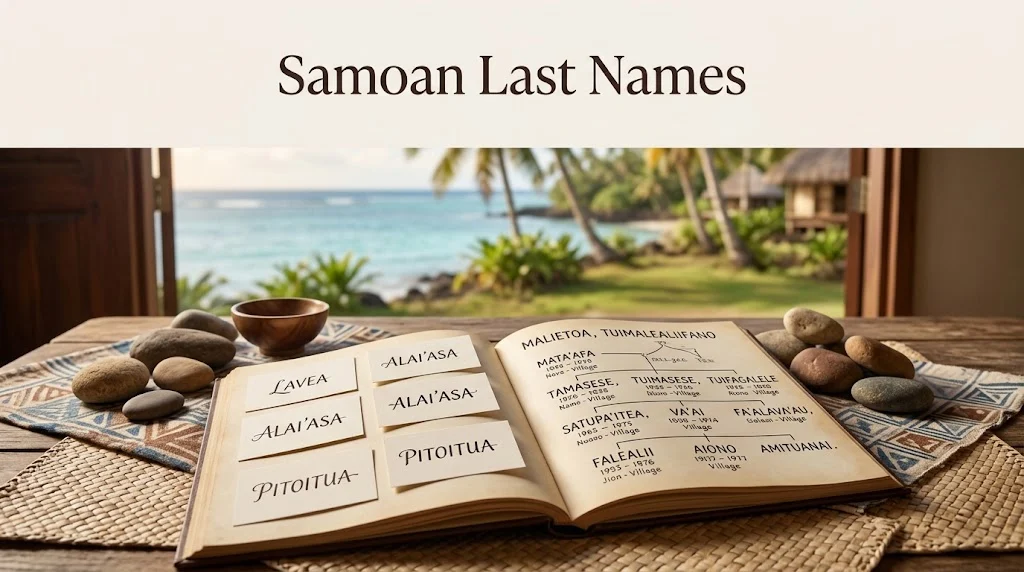
Samoan last names are family surnames associated with Samoa and its Polynesian heritage. They may reflect family lineage, ancestors, chiefly titles, historical connections, or Christian influences. Their exact meanings and origins can vary by family.
A family name can tell a story that reaches far beyond one person. It may connect generations, preserve the memory of ancestors, or reflect a family’s place within a community. Samoan last names are especially interesting because they exist within a culture where family relationships, ancestry, and community responsibilities hold an important place.
Samoa is a Polynesian island nation in the South Pacific with a rich cultural heritage. Samoan naming traditions are shaped by family history, the Samoan language, Christianity, and the fa’a Samoa—the Samoan way of life. Family names can carry deep significance, and some are connected to chiefly titles and the traditional matai system.
Not every Samoan surname has a simple English translation. Some have family-specific histories, and others may have several possible explanations depending on their origin. Understanding that distinction helps you appreciate these names without relying on unsupported meanings.
In this guide, you’ll discover ten Samoan surnames and family-name examples, learn about the cultural background of Samoan naming, and find helpful tips for researching a surname’s meaning and history.
Understanding Samoan Last Names and Their Cultural Origins
Before exploring individual surnames, it helps to understand that Samoan names do not always follow the same conventions as English-language surnames.
In Samoan society, the extended family, known as the ‘āiga, plays an important role. Family identity may be connected to ancestry, land, community responsibilities, and traditional leadership. A person’s name can therefore have significance beyond simple identification.
The matai system is another important part of Samoan culture. A matai is a holder of a chiefly title who carries responsibilities toward the family and community. These titles are distinct from ordinary surnames, although they may be closely connected to family history.
Samoan surnames can also reflect the influence of Christianity, migration, and historical contact with other cultures. Some families use surnames that are also found in English-speaking countries, while others have names strongly associated with Samoan heritage.
The examples below are useful starting points, but a surname’s exact meaning should be verified through family records or reliable cultural and linguistic sources. A name’s cultural association does not automatically establish its literal translation.
1. Tui
Meaning: Depends on the specific family and historical context.
Origin: Polynesian; found in Samoan and other Pacific Island naming contexts.
Personality: Tui has a short, confident sound. For fictional naming, it may suit a character portrayed as composed, determined, or closely connected to family traditions.
Style: Short, traditional, distinctive.
Best For: Family-history research, fictional characters, cultural storytelling, and surname inspiration.
Popularity: Tui is recognizable in several Pacific Island cultures, but its use and significance vary between communities.
Emotional Appeal: Its brevity makes it memorable, while its Pacific associations give it a strong cultural identity.
Cultural Reference: Tui appears in different Polynesian naming traditions. Its meaning should not be assumed to be identical across languages or families.
Similar Names: Tuala, Tupuola, Taula, Taufua.
Why It Still Works Today: Tui is simple to remember and can carry considerable cultural significance in the right family context. Anyone researching it should distinguish a family surname from a title or name element.
2. Tuala
Meaning: The exact meaning depends on its linguistic and family history.
Origin: Samoan and broader Polynesian naming context.
Personality: Tuala has a strong, traditional sound that may suit a character with a close relationship to family, community, or heritage.
Style: Cultural, classic, distinctive.
Best For: Genealogy research, Samoan-inspired fiction, and family-name exploration.
Popularity: Tuala is a recognizable name in Samoan public and cultural contexts, though its frequency as a surname can vary.
Emotional Appeal: The name may feel meaningful to people who associate it with family connections or Samoan identity.
Cultural Reference: Tuala is also encountered in names associated with Samoan leadership and public life. Specific titles and family relationships should be checked rather than inferred from the name alone.
Similar Names: Tui, Taufua, Tupuola, Leota.
Why It Still Works Today: Tuala has a clear Samoan cultural association and a memorable sound. It is a useful example of why surnames should be explored through actual family history rather than assigned an invented translation.
3. Tupuola
Meaning: A precise interpretation should be confirmed through Samoan-language and family sources.
Origin: Samoan.
Personality: Tupuola can evoke a sense of continuity and heritage for readers familiar with Samoan names. For a fictional character, it may suit someone whose story centers on family and belonging.
Style: Traditional, distinctive, culturally rooted.
Best For: Family-history research, character development, and exploring Samoan surnames.
Popularity: Tupuola is an established Samoan family name, although its prevalence is not reliably established by a single universal ranking.
Emotional Appeal: Longer surnames can preserve distinctive sounds and family identity. For people with Samoan connections, the name may carry personal associations that go beyond its spelling.
Cultural Reference: Tupuola is used as a Samoan surname. Any specific historical explanation should be tied to the relevant family or a credible linguistic source.
Similar Names: Tuala, Tui, Leota, Fepulea’i.
Why It Still Works Today: Tupuola is recognizable and culturally grounded. Its strongest meaning may come from the family’s own story, which is often more valuable than an unverified online definition.
4. Leota
Meaning: The exact etymology is not firmly established here.
Origin: Samoan.
Personality: Leota has a smooth, balanced sound that can feel both traditional and approachable.
Style: Classic, elegant, memorable.
Best For: Genealogy, surname research, fictional families, and cultural writing.
Popularity: Leota is an established Samoan surname, but its relative popularity can differ across Samoa, American Samoa, and Samoan diaspora communities.
Emotional Appeal: It is relatively easy to pronounce for many English speakers while retaining a distinctive Samoan identity.
Cultural Reference: Leota is associated with Samoan family and public naming contexts. Its appearance in a name does not, by itself, establish a person’s rank, ancestry, or chiefly status.
Similar Names: Tuala, Tui, Fepulea’i, Taufua.
Why It Still Works Today: Leota combines a concise spelling with a strong cultural association. It is a useful name to explore when studying Samoan family histories, provided its meaning is not guessed from sound alone.
5. Fepulea’i
Meaning: A definitive translation requires reliable Samoan linguistic or family evidence.
Origin: Samoan.
Personality: Fepulea’i has a distinctive appearance and sound. In fictional settings, it can suit a character whose background is intentionally connected to Samoan culture.
Style: Traditional, distinctive, heritage-rich.
Best For: Cultural research, genealogy, and carefully researched fictional characters.
Popularity: Fepulea’i is a recognizable Samoan surname, particularly in Samoan community and public-life contexts.
Emotional Appeal: The name preserves a linguistic pattern that may be meaningful to people familiar with Samoan language and heritage.
Cultural Reference: The apostrophe in the name is important. In Samoan orthography, the ‘okina represents a glottal stop, a meaningful sound distinction rather than a decorative mark.
Similar Names: Tuala, Tupuola, Leota, Taufua.
Why It Still Works Today: Fepulea’i demonstrates how spelling can preserve features of the Samoan language. When reproducing the surname, keep its punctuation accurate where the family’s preferred spelling includes it.
6. Taufua
Meaning: The exact meaning should be checked against reliable linguistic and family records.
Origin: Samoan.
Personality: Taufua has a strong, rhythmic sound. It may suit a fictional character with a grounded, determined, or family-centered personality.
Style: Traditional, bold, memorable.
Best For: Surname research, creative writing, genealogy, and Samoan heritage projects.
Popularity: Taufua is found in Samoan naming contexts, but reliable frequency data would be needed to rank it among the most common surnames.
Emotional Appeal: Its distinctive structure makes it easy to recognize, while its cultural context gives it more depth than a purely invented name.
Cultural Reference: Taufua is used as a Samoan surname. Any link to a specific family, title, or historical event should be established with evidence.
Similar Names: Tuala, Tui, Leota, Tupuola.
Why It Still Works Today: Taufua offers a memorable example of a Samoan family name that can prompt further exploration into family history and language.
7. Faumuina
Meaning: A specific translation should be verified through trustworthy Samoan sources.
Origin: Samoan.
Personality: Faumuina has a distinguished, formal sound that may fit stories about family history, community, or leadership.
Style: Traditional, formal, culturally significant.
Best For: Genealogy research, cultural writing, historical fiction, and family-name exploration.
Popularity: Faumuina is an established Samoan surname and is also encountered in contexts involving Samoan chiefly titles. Its exact status depends on the context.
Emotional Appeal: The name may carry a strong sense of heritage for people connected to families that bear it.
Cultural Reference: Samoan chiefly titles and surnames are not interchangeable. A title’s use and inheritance can follow specific family and community customs, so it is important not to infer a person’s title from a surname alone.
Similar Names: Tuala, Tui, Leota, Tupuola.
Why It Still Works Today: Faumuina highlights the relationship between naming, ancestry, and traditional leadership in Samoan culture. Its history is best understood through reliable cultural sources and family knowledge.
8. Mata’afa
Meaning: A precise literal meaning should be verified before publication.
Origin: Samoan.
Personality: Mata’afa has a distinctive, formal character. In historical or fictional writing, it may suit a family whose story involves Samoan history or leadership.
Style: Traditional, prominent, historic.
Best For: Cultural research, genealogy, historical writing, and character development.
Popularity: Mata’afa is widely recognizable in Samoan historical and chiefly contexts. This recognition should not be confused with a statistical ranking of surname frequency.
Emotional Appeal: Its historical associations can make the name particularly meaningful to readers exploring Samoa’s political and cultural heritage.
Cultural Reference: Mata’afa is associated with an important chiefly title in Samoa and with historical figures who held it. The title is not simply an ordinary surname, and the distinction matters when describing its history.
Similar Names: Faumuina, Tui, Tuala, Leota.
Why It Still Works Today: Mata’afa offers a direct connection to Samoan history and traditional leadership. It is best presented with context rather than as a surname with a casually assigned meaning.
9. Malietoa
Meaning: Its historical significance is well established, but a simple literal translation should be verified before being asserted.
Origin: Samoan.
Personality: Malietoa carries a formal, historic impression because of its connection to Samoan leadership and national history.
Style: Historic, traditional, distinguished.
Best For: Historical research, educational writing, cultural storytelling, and genealogy.
Popularity: Malietoa is best known for its association with one of Samoa’s major chiefly titles rather than as an ordinary surname ranked by frequency.
Emotional Appeal: Its significance comes from the history attached to the title and the role of chiefly leadership within Samoan society.
Cultural Reference: The Malietoa title has played an important role in Samoa’s political history. It should be described as a chiefly title, not automatically treated as an ordinary family surname in every context.
Similar Names: Mata’afa, Faumuina, Tui, Tuala.
Why It Still Works Today: Malietoa is a meaningful subject for anyone learning about Samoan leadership and heritage. Its cultural importance makes careful historical explanation especially valuable.
10. Savea
Meaning: A verified literal meaning is not provided here because the etymology can require further research.
Origin: Samoan and broader Pacific naming context.
Personality: Savea has a short, memorable sound that can feel confident and contemporary.
Style: Modern, distinctive, traditional.
Best For: Family-name research, fictional characters, cultural writing, and surname inspiration.
Popularity: Savea is recognizable in Samoan and Pacific community contexts. Exact popularity rankings require reliable surname data.
Emotional Appeal: The name is concise and easy to remember, making it appealing to readers who want to learn about Samoan family names.
Cultural Reference: Savea is also seen as a personal name or name element in Pacific contexts. Its meaning and use should be checked within the relevant family and language tradition.
Similar Names: Tui, Tuala, Taufua, Leota.
Why It Still Works Today: Savea has a clean, distinctive form and a cultural connection that can inspire further research. As with any surname, family-specific context is the best guide to its history.
Quick Comparison Table of Samoan Last Names
| Name | Meaning or Association | Style | Best For |
|---|---|---|---|
| Tui | Family- and culture-dependent | Short, traditional | Research, characters |
| Tuala | Samoan family-name context | Classic, distinctive | Genealogy |
| Tupuola | Established Samoan surname | Traditional | Family history |
| Leota | Established Samoan surname | Elegant, memorable | Research, fiction |
| Fepulea’i | Samoan linguistic and family context | Distinctive | Cultural writing |
| Taufua | Samoan family-name context | Bold, traditional | Genealogy |
| Faumuina | Also associated with chiefly titles | Formal, traditional | Cultural research |
| Mata’afa | Important chiefly title | Historic, prominent | Samoan history |
| Malietoa | Important chiefly title | Historic, distinguished | Historical research |
| Savea | Pacific naming context | Modern, memorable | Fiction, research |
Note: The association column intentionally avoids assigning unverified literal meanings. A surname’s meaning can depend on its linguistic history, spelling, and family tradition.
How to Choose the Right Samoan Last Name
Choosing a Samoan surname for research or a creative project requires more than picking a name that sounds appealing.
Research the cultural background. Learn whether the name is an ordinary surname, a personal name, a chiefly title, or a name element used in a longer name. These categories are not interchangeable.
Check the spelling. Samoan uses the ‘okina to represent a glottal stop. Names such as Fepulea’i and Mata’afa should retain the correct punctuation when that is part of the established spelling.
Verify the meaning. Do not assume a surname means “warrior,” “king,” “ocean,” or another attractive word simply because a website says so. Look for a reputable dictionary, academic resource, or family account.
Consider family history. If you are researching your own ancestry, relatives and family records may provide context that general surname websites cannot offer.
Be respectful when writing fiction. If you choose a Samoan surname for a character, research the culture and avoid using chiefly titles as decorative labels without understanding their significance.
Think about pronunciation. A name may have sounds that are unfamiliar to English speakers. Listening to Samoan-language speakers or trusted pronunciation resources can help you say it more accurately.
Understand regional differences. Samoa, American Samoa, and Samoan diaspora communities share cultural connections but may have different naming histories and contemporary practices.
Common Samoan Surnames and Family Naming Traditions
Samoan surnames can be found across Samoa, American Samoa, New Zealand, Australia, and other places where Samoan communities have established homes.
Family names may be passed down across generations, but individual naming histories can also reflect migration, marriage, religious influences, and other family decisions. This means a surname can be an important clue to heritage without providing a complete account of someone’s ancestry.
The ‘āiga is central to understanding Samoan family identity. An extended family may share responsibilities and connections that reach beyond the immediate household. Names can help preserve those relationships, although practices vary between families.
It is also important to understand the role of the matai system. A matai title is associated with leadership and responsibilities within a family and community. Some titles are historically prominent, but a title should not be treated as equivalent to a surname in every situation.
For anyone researching family history, the most reliable approach is to combine surname research with oral histories, family documents, and credible historical records.
Popular Samoan Last Names in the Samoan Diaspora
Samoan communities around the world preserve family connections while adapting to life in different countries. In places such as New Zealand, Australia, and the United States, Samoan surnames can be an important marker of cultural identity.
However, it is difficult to establish a definitive list of the “most popular” Samoan surnames without a reliable dataset that identifies Samoan ancestry and surname frequency. General name websites may repeat lists without explaining how the names were selected.
Names such as Tuala, Tupuola, Leota, Faumuina, and Taufua are recognizable in Samoan contexts, but that does not establish a precise popularity order.
If you need a statistically accurate list, consult census data where available, academic demographic research, or carefully documented genealogy sources. Remember that census categories and surname records may not capture every aspect of Samoan identity.
Traditional Samoan Names and Chiefly Titles
Samoan culture includes a traditional system of chiefly titles known as the fa’amatai. The title-holder, or matai, has responsibilities to the extended family and community.
Titles such as Mata’afa and Malietoa have significant historical and political associations. Other names, including Faumuina, may also be associated with chiefly title contexts. The history and use of each title need to be researched individually.
These titles are important because they illustrate how Samoan naming and identity can connect with leadership, land, ancestry, and collective responsibility.
A title may have its own succession practices and family or community significance. It should not be used casually as if it were simply a first name or ordinary surname.
If your goal is to learn about traditional Samoan names, consider researching the fa’a Samoa, the ‘āiga, and the fa’amatai alongside individual names. These concepts provide a much stronger understanding of the culture behind the names.
Modern Samoan Surname Trends
Modern Samoan naming reflects both continuity and change. Families may preserve traditional surnames while also using names influenced by Christianity, English-language traditions, migration, and relationships between communities.
In diaspora settings, Samoan names often become part of a broader cultural identity. They may connect younger generations to relatives, ancestors, and places they know through family stories.
Online name lists have also made Samoan names more visible to people outside the Pacific. This increased interest can be useful, but it creates a need for reliable information. A surname’s popularity online does not necessarily mean it is common in Samoa.
For contemporary research, focus on documented names, accurate spelling, and the distinction between personal names, surnames, and titles. That approach makes your work more informative and respectful.
FAQs
What Do Samoan Last Names Mean?
Samoan last names may reflect family history, ancestry, language, migration, religious influences, or traditional leadership.
Are Samoan Last Names Passed Down Through Families?
Many Samoan surnames are inherited across generations, but naming practices can vary. A person’s surname alone may not reveal their complete family lineage.
Are Samoan Surnames the Same as Polynesian Surnames?
Not exactly. Samoan surnames belong to a specific cultural and linguistic tradition within Polynesia.
What Is the Difference Between a Samoan Surname and a Matai Title?
A surname is a family name, while a matai title is a traditional chiefly title associated with leadership and responsibilities to the family and community.
What Are Some Recognizable Samoan Family Names?
Examples found in Samoan naming contexts include Tuala, Tupuola, Leota, Fepulea’i, Taufua, and Savea. Faumuina is also associated with chiefly title contexts.
Conclusion
Samoan last names offer a fascinating starting point for exploring family heritage, language, history, and cultural identity. Names such as Tuala, Tupuola, Leota, Fepulea’i, and Taufua are recognizable in Samoan contexts, while names such as Mata’afa and Malietoa also provide insight into Samoa’s traditional leadership history.
The most important thing to remember is that a surname’s story may be more complex than a short online definition suggests. Some names have connections to chiefly titles, while others carry meanings or histories specific to individual families. Reliable sources, family knowledge, and cultural context can help you understand those differences.
Whether you are researching your ancestry or creating a character, take time to learn about the name you choose. Share this guide with someone interested in Samoan heritage, and leave a comment with the surname you would like to learn more about.
Discover More Related Articles: