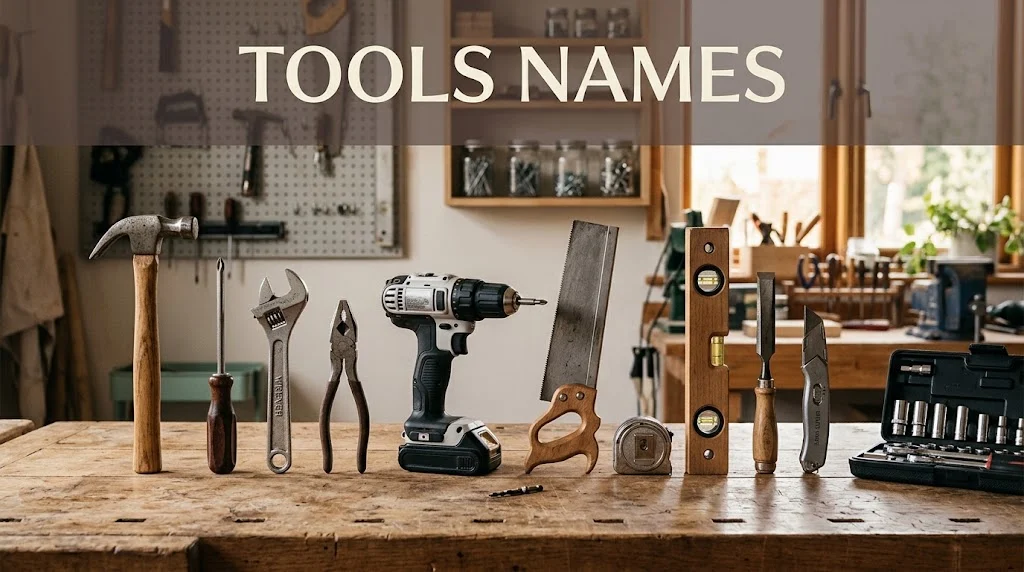
Tools names include hammer, screwdriver, wrench, pliers, drill, saw, chisel, tape measure, level, utility knife, and many others. Tools are designed for tasks such as measuring, cutting, fastening, gripping, drilling, and repairing.
Tools are some of the most useful objects in everyday life. Whether you are fixing something at home, building furniture, working in a workshop, gardening, or completing a school project, knowing common tools names makes it easier to understand what you need.
Some tools are simple hand tools, such as hammers and screwdrivers. Others are powered tools, such as electric drills and circular saws. Each tool has a specific purpose, and choosing the right one can make a job easier and more efficient.
Learning tools names is also useful for students and beginners. It helps build practical vocabulary and makes instructions easier to follow. You may already know what a hammer or screwdriver looks like, but learning the names of less familiar tools can make a big difference when reading repair guides or visiting a hardware store.
In this guide, we explore 50 common tools, their basic uses, categories, and the jobs they are commonly associated with.
Hammer
Meaning: A tool used mainly for striking, driving, or shaping materials.
Origin: Hammers are among the oldest types of tools used by humans. Modern versions come in many specialized designs.
Personality: A hammer is often associated with strength, practicality, and straightforward work.
Style: Basic, traditional, versatile, essential.
Best For: Driving nails, light construction work, woodworking, and general repairs.
Popularity: The hammer remains one of the most recognizable and widely used hand tools.
Why People Use It: Its simple design makes it useful for many everyday tasks.
Common Types: Claw hammer, ball-peen hammer, sledgehammer, mallet, framing hammer.
Similar Tools: Mallet, rubber mallet, sledgehammer, tack hammer.
Why It Still Works Today: Even with modern power tools available, a hammer remains useful for quick jobs that do not require machinery.
Screwdriver
Meaning: A hand tool designed to turn screws.
Origin: Screwdrivers developed alongside screw fasteners and became common workshop tools.
Personality: A screwdriver represents precision, control, and simple problem-solving.
Style: Basic, compact, practical, essential.
Best For: Installing or removing screws in furniture, appliances, electronics, and household fixtures.
Popularity: Screwdrivers are found in most household and professional toolboxes.
Why People Use It: They are inexpensive, easy to store, and available in many sizes and shapes.
Common Types: Flat-head, Phillips, Pozidriv, Torx, precision screwdriver.
Similar Tools: Screwdriver bit, nut driver, drill/driver.
Why It Still Works Today: Many everyday objects use screws, making screwdrivers essential for repairs and assembly.
Wrench
Meaning: A tool used to tighten or loosen nuts and bolts.
Origin: Wrenches have been developed in many forms to work with different fastener sizes.
Personality: A wrench feels sturdy, mechanical, and dependable.
Style: Mechanical, traditional, professional, durable.
Best For: Automotive repairs, plumbing, machinery, construction, and general maintenance.
Popularity: Wrenches are standard tools in garages and workshops.
Why People Use It: They provide controlled turning force for nuts and bolts.
Common Types: Adjustable wrench, combination wrench, open-end wrench, box-end wrench.
Similar Tools: Socket wrench, spanner, pipe wrench.
Why It Still Works Today: Fasteners remain common in machinery, vehicles, furniture, and construction.
Pliers
Meaning: A gripping tool with two handles and jaws.
Origin: Pliers developed from simple gripping tools and became specialized for different tasks.
Personality: Pliers are practical, flexible, and precise.
Style: Compact, versatile, mechanical.
Best For: Gripping, bending, cutting wire, holding small objects, and general repairs.
Popularity: Pliers are common in household, electrical, automotive, and workshop toolboxes.
Why People Use It: Their jaws provide a firm grip when fingers cannot safely or effectively hold an object.
Common Types: Slip-joint pliers, needle-nose pliers, locking pliers, diagonal cutters.
Similar Tools: Clamps, wire cutters, locking grips.
Why It Still Works Today: Pliers perform many small jobs without requiring large equipment.
Drill
Meaning: A tool designed to create holes or drive fasteners.
Origin: Drilling tools have existed for centuries, while modern electric drills provide powered operation.
Personality: A drill represents efficiency, speed, and precision.
Style: Modern, powerful, practical, professional.
Best For: Drilling holes and driving compatible screws or fasteners.
Popularity: Drills are widely used in construction, woodworking, home improvement, and manufacturing.
Why People Use It: A powered drill can complete repetitive drilling tasks much faster than many manual methods.
Common Types: Cordless drill, corded drill, hammer drill, drill press.
Similar Tools: Driver, impact driver, rotary tool.
Why It Still Works Today: Drilling and fastening are fundamental tasks in construction and repair.
Saw
Meaning: A cutting tool with a toothed or abrasive edge.
Origin: Saws have been used for thousands of years and are available in many specialized forms.
Personality: A saw represents precision, cutting power, and craftsmanship.
Style: Traditional, practical, professional.
Best For: Cutting wood, metal, plastic, or other materials depending on the saw.
Popularity: Saws are essential in construction, carpentry, woodworking, and many DIY projects.
Why People Use It: Different saw designs allow users to make straight, curved, or specialized cuts.
Common Types: Hand saw, hacksaw, circular saw, jigsaw, miter saw.
Similar Tools: Utility knife, shears, cutting wheel.
Why It Still Works Today: Cutting materials remains a fundamental part of building and repair work.
Tape Measure
Meaning: A flexible measuring tool used to determine length or distance.
Origin: Modern tape measures evolved from earlier measuring devices and rulers.
Personality: A tape measure represents accuracy, planning, and preparation.
Style: Simple, compact, practical.
Best For: Measuring furniture, walls, wood, rooms, materials, and construction spaces.
Popularity: It is one of the most common measuring tools used at home and professionally.
Why People Use It: Accurate measurements help prevent mistakes during construction and repair projects.
Common Types: Retractable tape measure, long tape, measuring tape.
Similar Tools: Ruler, folding rule, measuring wheel.
Why It Still Works Today: Almost every building or DIY project benefits from accurate measurements.
Chisel
Meaning: A tool with a sharp edge used for cutting, carving, or shaping materials.
Origin: Chisels have ancient origins and have been used in woodworking, stonework, and metalworking.
Personality: A chisel suggests craftsmanship, patience, and precision.
Style: Traditional, specialized, professional.
Best For: Wood carving, woodworking joints, masonry, and certain metalworking tasks.
Popularity: Chisels remain important in specialist trades and woodworking.
Why People Use It: They allow controlled material removal and detailed shaping.
Common Types: Wood chisel, cold chisel, masonry chisel, mortise chisel.
Similar Tools: Gouge, carving tool, punch.
Why It Still Works Today: Hand-controlled shaping remains important when precision matters.
Utility Knife
Meaning: A compact cutting tool with a replaceable or retractable blade.
Origin: Utility knives developed as practical cutting tools for everyday work.
Personality: Compact, practical, convenient, and versatile.
Style: Modern, simple, portable.
Best For: Cutting cardboard, packaging materials, carpet, and other suitable materials.
Popularity: Utility knives are widely used in workshops, warehouses, offices, and homes.
Why People Use It: The small design makes it convenient for controlled cutting tasks.
Common Types: Retractable utility knife, snap-off knife, craft knife.
Similar Tools: Craft knife, box cutter, scissors.
Why It Still Works Today: Packaging and general cutting tasks remain common in homes and workplaces.
Level
Meaning: A measuring tool used to check whether a surface is horizontal or vertical.
Origin: Traditional levels used liquid-filled tubes to indicate alignment.
Personality: A level represents accuracy, balance, and precision.
Style: Professional, practical, measuring tool.
Best For: Hanging shelves, installing cabinets, aligning frames, and construction work.
Popularity: Levels are standard tools for builders, carpenters, installers, and DIY users.
Why People Use It: It helps ensure that objects and surfaces are properly aligned.
Common Types: Spirit level, box level, torpedo level, digital level.
Similar Tools: Laser level, plumb bob, measuring tools.
Why It Still Works Today: Correct alignment is essential in construction, furniture installation, and home improvement.
Socket Wrench
Meaning: A wrench that uses interchangeable sockets to turn nuts and bolts.
Origin: Socket wrench systems became popular because they allow one handle to work with multiple socket sizes.
Personality: A socket wrench feels organized, mechanical, efficient, and professional.
Style: Professional, mechanical, versatile.
Best For: Automotive work, machinery, maintenance, and assembly.
Popularity: Socket sets are common in garages and mechanical workshops.
Why People Use It: Interchangeable sockets make it possible to work with many fastener sizes.
Common Types: Ratchet wrench, breaker bar, torque wrench.
Similar Tools: Combination wrench, adjustable wrench, spanner.
Why It Still Works Today: Its flexible socket system makes it useful for a wide range of mechanical jobs.
Allen Key
Meaning: A small hexagonal tool used to turn hex-socket screws.
Origin: Also called a hex key or hex wrench.
Personality: Compact, precise, simple, and practical.
Style: Minimal, mechanical, compact.
Best For: Furniture assembly, bicycles, machinery, and equipment using hex-socket fasteners.
Popularity: Allen keys are commonly included with flat-pack furniture and equipment.
Why People Use It: The simple L-shaped design provides access to recessed fasteners.
Common Types: L-shaped hex key, T-handle hex key, folding hex set.
Similar Tools: Torx key, screwdriver, socket driver.
Why It Still Works Today: Hex fasteners are widely used in furniture, bicycles, machinery, and manufactured products.
Toolbox
Meaning: A container designed to store and organize tools.
Origin: Tool storage has existed in many forms, from wooden boxes to modern portable cases.
Personality: A toolbox represents preparation, organization, and practical skill.
Style: Traditional, practical, portable.
Best For: Storing household, workshop, automotive, or professional tools.
Popularity: Toolboxes remain useful for keeping frequently needed tools organized.
Why People Use It: A good storage system makes tools easier to find and transport.
Common Types: Plastic toolbox, metal toolbox, rolling toolbox, tool chest.
Similar Tools: Tool bag, tool cabinet, organizer.
Why It Still Works Today: Whether working at home or professionally, organized tool storage saves time.
Quick Comparison Table
| Tool | Main Use | Type | Common Setting |
|---|---|---|---|
| Hammer | Striking and driving | Hand tool | Home & construction |
| Screwdriver | Turning screws | Hand tool | Home & workshop |
| Wrench | Turning nuts and bolts | Hand tool | Garage |
| Pliers | Gripping and cutting | Hand tool | Workshop |
| Drill | Drilling and fastening | Power tool | Construction |
| Saw | Cutting materials | Hand/power tool | Woodworking |
| Tape Measure | Measuring | Measuring tool | Home & construction |
| Chisel | Cutting and shaping | Hand tool | Woodworking |
| Utility Knife | Cutting | Hand tool | Home & workplace |
| Level | Checking alignment | Measuring tool | Construction |
More Common Tools Names
Here are additional tools names worth learning:
- Adjustable wrench
- Combination wrench
- Pipe wrench
- Torque wrench
- Wire cutters
- Needle-nose pliers
- Mallet
- Sledgehammer
- Hacksaw
- Jigsaw
- Circular saw
- Miter saw
- Screw gun
- Impact driver
- Sander
- Angle grinder
- Clamps
- Nail puller
- Crowbar
- Pry bar
- File
- Rasp
- Plane
- Awl
- Punch
- Staple gun
- Caulking gun
- Level
- Ruler
- Measuring wheel
- Wire stripper
- Multimeter
- Heat gun
- Paint scraper
- Garden shears
- Pruning saw
- Shovel
- Hoe
- Rake
- Trowel
Types of Tools
Tools can be grouped according to the work they perform.
Hand Tools:
These are operated primarily by hand. Examples include hammers, screwdrivers, wrenches, pliers, chisels, and hand saws.
Power Tools:
These use an external power source, such as electricity or batteries. Examples include drills, circular saws, sanders, and angle grinders.
Measuring Tools:
These help determine size, distance, alignment, or angles. Examples include tape measures, rulers, levels, and measuring wheels.
Cutting Tools:
These are designed to cut or shape materials. Examples include saws, utility knives, shears, and certain types of cutters.
Gardening Tools:
These are designed for planting, digging, trimming, and maintaining outdoor spaces. Examples include shovels, rakes, hoes, trowels, and pruning tools.
Automotive Tools:
These are commonly used for vehicle maintenance and mechanical work. Examples include socket sets, torque wrenches, jacks, and specialized automotive tools.
How to Choose the Right Tool
Choosing the right tool starts with understanding the task.
Identify the job.
Ask whether you need to cut, measure, grip, fasten, drill, shape, or move something.
Choose the correct tool type.
A screwdriver is designed for screws, while a wrench is designed for many nuts and bolts. Using the right tool can make work easier and reduce the chance of damaging the fastener or material.
Consider the material.
Different materials require different tools and tool designs. Wood, metal, masonry, and plastic may each require specialized equipment.
Think about size.
The tool should match the size of the job and the fastener or material involved.
Check the tool’s condition.
Damaged or worn tools may not perform properly. Inspect tools before use.
Follow the manufacturer’s instructions.
For power tools and specialized equipment, read the instructions and follow appropriate safety guidance.
Most Popular Tools Today
Some tools remain popular because they are useful for many different tasks:
- Hammer
- Screwdriver
- Drill
- Pliers
- Adjustable wrench
- Tape measure
- Utility knife
- Level
- Socket set
- Saw
- Clamps
- Allen keys
- Wire cutters
- Screwdriver bits
- Tool storage boxes
These basic tools can form the foundation of a household or workshop collection.
Traditional Tools Still Used Today
Many traditional hand tools continue to have an important place in modern workshops.
- Hammer
- Hand saw
- Chisel
- Wood plane
- File
- Rasp
- Screwdriver
- Wrench
- Pliers
- Mallet
Modern technology has introduced faster alternatives, but hand tools remain valuable when users need control, portability, simplicity, or precision.
Modern Tool Trends
Today’s tools increasingly combine traditional designs with modern technology.
Cordless equipment has become popular because rechargeable batteries allow greater mobility. Digital measuring tools can provide quick readings, while laser levels make alignment easier over longer distances.
Tool storage has also become more organized. Modular cases, rolling cabinets, wall-mounted systems, and compact organizers help users keep different tools accessible.
Another major trend is specialization. Instead of one tool being expected to perform every task, manufacturers create tools designed for specific jobs. This can improve efficiency but also means beginners need to understand which tool is appropriate for a particular task.
Tools Names for Students
Learning tools vocabulary can be useful for students studying science, technology, engineering, design, construction, or general English.
Start with these basic examples:
- Hammer
- Screwdriver
- Wrench
- Pliers
- Saw
- Drill
- Chisel
- Tape measure
- Level
- Utility knife
Students can create flashcards with the tool name on one side and its purpose on the other. Matching activities and labeled pictures can also make learning easier.
FAQs
What are the most common tools names?
Some of the most common tools include hammers, screwdrivers, wrenches, pliers, drills, saws, tape measures, levels, chisels, utility knives, and socket wrenches.
What are the basic hand tools?
Basic hand tools include hammers, screwdrivers, pliers, wrenches, chisels, hand saws, utility knives, files, and measuring tools.
What are power tools?
Power tools are tools that use an external source of power, commonly electricity or rechargeable batteries.
What tools should every beginner learn?
Beginners can start by learning the names and basic purposes of a hammer, screwdriver, pliers, adjustable wrench, tape measure, level, utility knife, and drill.
What are measuring tools?
Measuring tools are designed to determine dimensions, distances, angles, or alignment.
Conclusion
Learning tools names is a simple way to build practical knowledge for home repairs, workshops, construction, gardening, woodworking, and many other activities. From the familiar hammer and screwdriver to specialized tools such as socket wrenches and levels, every tool has a specific purpose.
Understanding what each tool does can help beginners choose equipment more confidently and communicate clearly when following instructions. It also makes it easier to organize a toolbox and recognize unfamiliar equipment.
Start with the basic tools, learn what each one is designed to do, and gradually expand your vocabulary as you gain experience. If you found this guide useful, share it with students, DIY beginners, or anyone learning about tools and equipment.
Discover More Related Articles:
- Wheel of Names | Fun Ways to Pick the Perfect Name In 2026
- 3D Shapes Names | Faces, Edges & Vertices In 2026