Quick Answer
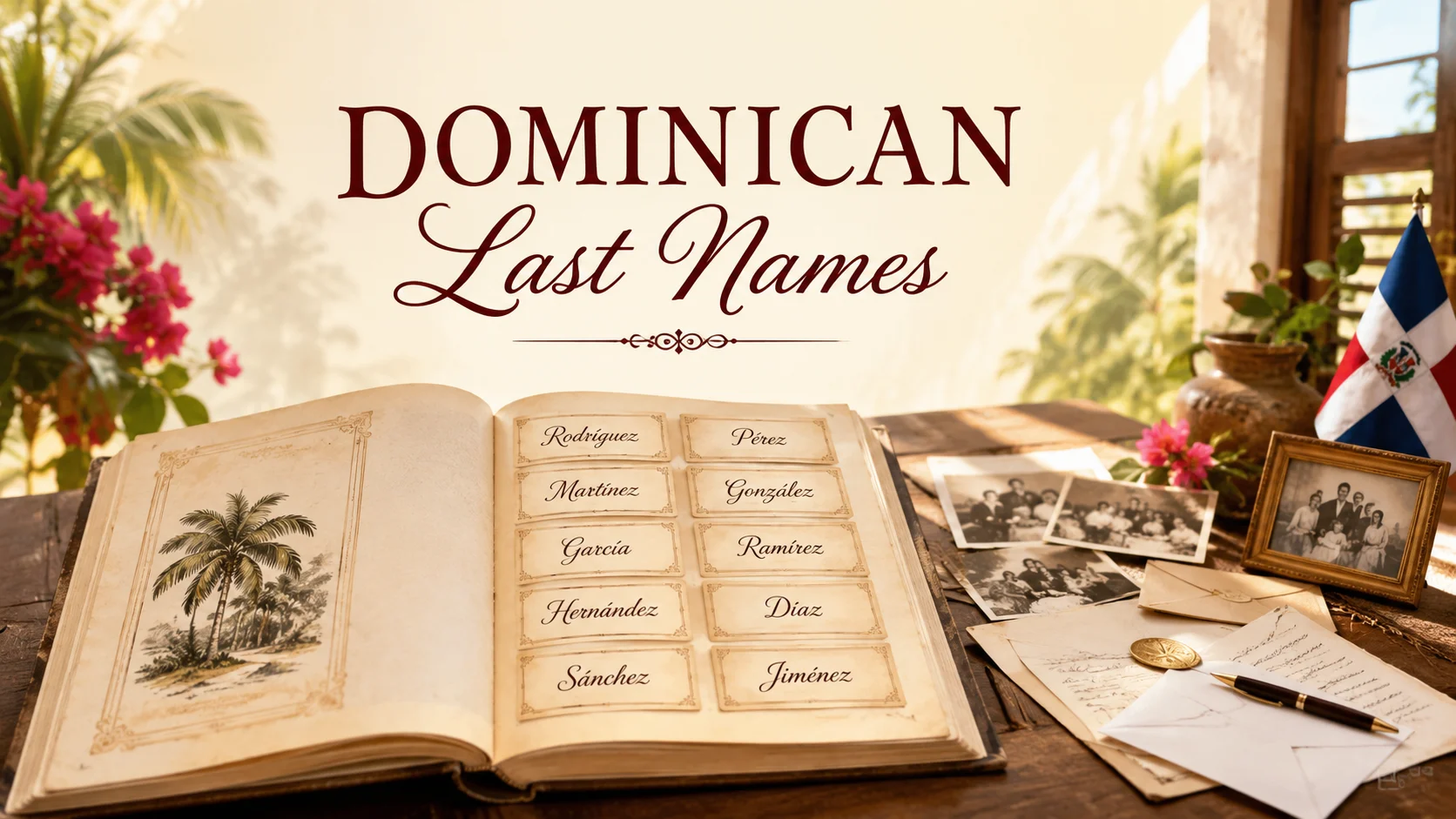
Dominican Last Names are surnames commonly found in the Dominican Republic, with many having Spanish, European, African, and Indigenous influences. Popular examples include Rodríguez, Martínez, García, Hernández, Santana, Ramírez, Díaz, Reyes, Pérez, and Castillo.
A last name can tell a story. It can connect generations, preserve family history, and offer a small glimpse into the cultures that shaped a community.
Dominican last names are especially interesting because the Dominican Republic has a rich and layered history. Spanish naming traditions form a major part of the country’s surname landscape, while migration and Caribbean cultural influences have added further diversity.
Many Dominican families use two surnames, traditionally combining the father’s surname with the mother’s surname. This practice helps preserve family connections across generations and gives a person’s full name a distinctive structure.
Names such as Rodríguez, Martínez, García, Hernández, and Sánchez are widely recognized throughout the Spanish-speaking world and can also be found throughout the Dominican Republic. At the same time, less common family names can provide fascinating clues about regional history, migration, and ancestry.
In this guide, we explore Dominican surnames, focusing on their general meanings, linguistic origins, style, cultural associations, and historical appeal.
🇩🇴 Rodríguez
Meaning
Rodríguez traditionally means “son of Rodrigo.”
Origin
Rodríguez is a Spanish patronymic surname derived from the personal name Rodrigo.
Personality
As a surname, Rodríguez has a strong, established, and traditional character. It feels unmistakably Hispanic and has deep historical roots.
Style
Classic, Spanish, traditional, strong, and widely recognized.
Best For
- Dominican family names
- Character creation
- Genealogy research
- Hispanic heritage projects
- Fictional family names
Popularity
Rodríguez is one of the most widespread Spanish-language surnames and is particularly familiar throughout Latin America and the Caribbean.
Cultural Appeal
Its broad use across Spanish-speaking countries makes Rodríguez an excellent example of how a surname can connect families across national borders.
Similar Surnames
- González
- Hernández
- Martínez
- Ramírez
- Fernández
Why It Still Works Today
Rodríguez remains recognizable, easy to pronounce, and strongly connected with Spanish-language heritage.
🌿 Martínez
Meaning
Martínez traditionally means “son of Martín.”
Origin
It is a Spanish patronymic surname derived from Martín, ultimately connected with the Roman name Martinus.
Personality
Martínez feels classic, dependable, and familiar. It has a traditional quality that works naturally across generations.
Style
Classic, Hispanic, traditional, familiar, and strong.
Best For
- Dominican families
- Genealogy
- Character names
- Spanish-language naming
- Heritage projects
Popularity
Martínez is widespread in Spanish-speaking communities, including the Dominican Republic.
Cultural Appeal
Its connection to the given name Martín reflects the traditional Spanish practice of creating surnames from an ancestor’s first name.
Similar Surnames
- Rodríguez
- Fernández
- Ramírez
- González
- Hernández
Why It Still Works Today
Its simple structure and historical depth make Martínez a lasting surname choice.
🌸 García
Meaning
García has an ancient Iberian origin, but its exact original meaning remains uncertain.
Origin
García is an old Iberian surname that became widespread in Spain and later throughout the Spanish-speaking world.
Personality
García feels established, sophisticated, and distinctly Hispanic.
Style
Traditional, elegant, Spanish, familiar, and timeless.
Best For
- Dominican heritage
- Spanish family histories
- Fictional characters
- Genealogy
- Cultural storytelling
Popularity
García is among the most common surnames in the Spanish-speaking world.
Cultural Appeal
Its widespread presence demonstrates the long reach of Iberian naming traditions.
Similar Surnames
- García
- Garza
- González
- Gómez
- Gutiérrez
Why It Still Works Today
García is short, recognizable, and deeply rooted in Spanish-language history.
🌺 Hernández
Meaning
Hernández traditionally means “son of Hernando” or “son of Fernando,” depending on the historical form being considered.
Origin
It is a Spanish patronymic surname related to medieval forms of Fernando.
Personality
Hernández feels traditional, strong, and established.
Style
Classic, Hispanic, historical, strong, and familiar.
Best For
- Dominican family names
- Hispanic characters
- Genealogy
- Heritage research
- Fictional families
Popularity
Hernández is widely used across Latin America, Spain, and other Spanish-speaking communities.
Cultural Appeal
Its patronymic structure connects the surname to the long-standing Spanish tradition of identifying family lineage through an ancestor’s given name.
Similar Surnames
- Fernández
- Hernández
- González
- Rodríguez
- Martínez
Why It Still Works Today
Hernández carries a recognizable Hispanic identity while remaining suitable across generations.
💫 Sánchez
Meaning
Sánchez traditionally means “son of Sancho.”
Origin
It is a Spanish patronymic surname derived from Sancho, an old Iberian personal name.
Personality
Sánchez feels energetic, traditional, and confident.
Style
Spanish, classic, strong, familiar, and timeless.
Best For
- Dominican heritage
- Hispanic characters
- Family trees
- Cultural writing
- Genealogy
Popularity
Sánchez is a common Spanish surname and is widely found throughout Latin America.
Cultural Appeal
Its connection to Sancho gives it a distinctly Iberian historical background.
Similar Surnames
- Díaz
- Pérez
- Ramírez
- Rodríguez
- Martínez
Why It Still Works Today
Sánchez is recognizable and easy to use while retaining a strong historical identity.
🏛️ Pérez
Meaning
Pérez traditionally means “son of Pedro.”
Origin
Pérez is a Spanish patronymic surname derived from Pedro.
Personality
Pérez feels familiar, grounded, and traditional.
Style
Classic, Hispanic, simple, established, and strong.
Best For
- Dominican families
- Genealogy
- Character names
- Spanish heritage
- Family histories
Popularity
Pérez is widespread throughout Spanish-speaking communities.
Cultural Appeal
Its origin reflects the traditional Spanish practice of forming a family name from a parent’s or ancestor’s given name.
Similar Surnames
- Díaz
- Sánchez
- Gómez
- López
- Martínez
Why It Still Works Today
Pérez is concise, recognizable, and deeply connected with Spanish naming history.
🌎 González
Meaning
González traditionally means “son of Gonzalo.”
Origin
It is a Spanish patronymic surname derived from Gonzalo.
Personality
González feels strong, traditional, and established.
Style
Classic, Spanish, powerful, familiar, and historical.
Best For
- Dominican heritage
- Family trees
- Hispanic characters
- Genealogy
- Cultural storytelling
Popularity
González is one of the best-known Spanish surnames across Latin America and Spain.
Cultural Appeal
Its patronymic structure gives it a direct connection to medieval Spanish naming traditions.
Similar Surnames
- Rodríguez
- Fernández
- Hernández
- Ramírez
- Martínez
Why It Still Works Today
González has survived across centuries and remains instantly recognizable.
🌙 Ramírez
Meaning
Ramírez traditionally means “son of Ramiro.”
Origin
Ramírez is a Spanish patronymic surname derived from Ramiro.
Personality
Ramírez feels confident, historic, and traditional.
Style
Strong, classic, Spanish, established, and masculine-leaning.
Best For
- Dominican family names
- Hispanic characters
- Genealogy
- Heritage projects
- Fiction
Popularity
Ramírez is common throughout Spanish-speaking regions.
Cultural Appeal
Its history reflects the widespread Spanish tradition of patronymic surnames.
Similar Surnames
- Martínez
- Rodríguez
- Sánchez
- Fernández
- González
Why It Still Works Today
Ramírez combines historical depth with a recognizable modern sound.
🌼 Díaz
Meaning
Díaz traditionally means “son of Diego.”
Origin
Díaz is a Spanish patronymic surname associated with Diego.
Personality
Díaz feels concise, confident, and memorable.
Style
Short, classic, Hispanic, elegant, and strong.
Best For
- Dominican surnames
- Family histories
- Characters
- Genealogy
- Hispanic heritage
Popularity
Díaz is widespread throughout Spanish-speaking countries.
Cultural Appeal
Its short form gives it a distinctive sound while maintaining traditional Spanish roots.
Similar Surnames
- Díaz
- Díez
- Pérez
- Sánchez
- López
Why It Still Works Today
Díaz is easy to remember and carries a strong Spanish-language identity.
🌹 Jiménez
Meaning
Jiménez traditionally means “son of Jimeno.”
Origin
Jiménez is a Spanish patronymic surname derived from the medieval personal name Jimeno.
Personality
Jiménez feels historic, refined, and established.
Style
Traditional, Spanish, sophisticated, historical, and distinctive.
Best For
- Dominican family histories
- Hispanic characters
- Genealogy
- Heritage projects
- Cultural storytelling
Popularity
Jiménez is widely recognized across Spanish-speaking communities.
Cultural Appeal
Its medieval roots make it an interesting surname for anyone researching Spanish family history.
Similar Surnames
- Giménez
- Fernández
- Hernández
- Martínez
- Sánchez
Why It Still Works Today
Jiménez combines historical character with a familiar Hispanic identity.
📋 Quick Comparison Table
| Surname | General Meaning | Style | Best For |
|---|---|---|---|
| Rodríguez | Son of Rodrigo | Classic | Family heritage |
| Martínez | Son of Martín | Traditional | Genealogy |
| García | Ancient Iberian surname; meaning uncertain | Timeless | Heritage |
| Hernández | Son of Hernando/Fernando | Strong | Family names |
| Sánchez | Son of Sancho | Classic | Hispanic heritage |
| Pérez | Son of Pedro | Familiar | Family histories |
| González | Son of Gonzalo | Traditional | Genealogy |
| Ramírez | Son of Ramiro | Historic | Heritage |
| Díaz | Son of Diego | Short & classic | Characters |
| Jiménez | Son of Jimeno | Historical | Family research |
🧬 + Dominican Last Names
Here is a broader collection of surnames commonly encountered in the Dominican Republic or within Dominican family and Hispanic naming contexts:
- Rodríguez
- Martínez
- García
- Hernández
- Sánchez
- Pérez
- González
- Ramírez
- Díaz
- Jiménez
- López
- Gómez
- Núñez
- Reyes
- Santana
- Castillo
- Cruz
- Rosario
- Rivera
- Medina
- Peña
- Torres
- Fernández
- Díaz
- Vargas
- Guerrero
- Rojas
- Ortiz
- de la Cruz
- Valdez
- Vásquez
- De los Santos
- Santos
- Ramírez
- Acosta
- Méndez
- Herrera
- Marte
- Morel
- Morillo
- Cabrera
- Peralta
- Batista
- Polanco
- Pimentel
- Contreras
- Espinal
- Abreu
- Durán
- Guzmán
- Valerio
- Féliz
- Arias
- Núñez
- Encarnación
- Santana
- Matos
- Rosario
- Tejada
- Lora
- Estévez
- Taveras
- Soriano
- Brito
- Aquino
- De León
- Valdez
- Marte
- Ventura
- Castillo
- Báez
- Cuevas
- Reynoso
- Almonte
- Cáceres
- Sosa
- Céspedes
- Mota
- Guzmán
- Peña
- Mejía
- Feliz
- Cordero
- Santana
- Suárez
- Guerrero
- Batista
- Tavárez
- Valera
- Henríquez
- Lantigua
- Perdomo
- Espaillat
- Bonilla
- Figueroa
- Quezada
- Aquino
- Corporán
- Mercedes
- Severino
- Then
- Nova
- Encarnación
- Rosario
- Moronta
- Alcántara
- Severino
- De la Rosa
- De Jesús
- Mejía
🗺️ How Dominican Last Names Developed
Dominican surnames are closely connected with the history of Spanish settlement in the Caribbean. Spanish naming traditions became deeply established on Hispaniola, and many surnames found in the Dominican Republic have Iberian roots.
Over time, migration, intermarriage, and movement throughout the Caribbean contributed to the country’s diverse family-name landscape.
It is important to remember that having a particular surname does not automatically prove a specific ancestry. The same surname may appear in many countries and among unrelated families.
For genealogy, researchers should combine surnames with birth records, marriage records, immigration documents, church registers, census information, and other historical sources.
👨👩👧 How Dominican Naming Traditions Work
Traditional Spanish naming customs often use two family surnames.
A person’s first surname may traditionally come from the father, while the second may come from the mother. However, naming laws and practices can vary over time and between countries.
This two-surname tradition can make Dominican names especially useful for genealogy because both sides of a family may appear in a person’s formal name.
Modern families may also follow different naming practices depending on personal preferences, legal requirements, family traditions, or the country where they live.
⭐ Most Popular Dominican Last Names
Some of the most recognizable surnames associated with Dominican communities include:
- Rodríguez
- Martínez
- García
- Hernández
- Sánchez
- Pérez
- González
- Ramírez
- Díaz
- Jiménez
- López
- Gómez
- Reyes
- Santana
- Castillo
- Cruz
- Rosario
- Rivera
- Medina
- Peña
Popularity can vary by source, location, and year, so these should be viewed as commonly encountered surnames rather than a precise current ranking.
🏛️ Traditional Dominican Family Names
Traditional family names often carry a strong Spanish or broader Hispanic identity. Examples include:
- Rodríguez
- Fernández
- Hernández
- González
- Martínez
- Sánchez
- Pérez
- Ramírez
- Díaz
- Jiménez
- López
- Gómez
- Núñez
- Castillo
- Reyes
These surnames are particularly useful when researching Spanish-language family history.
💎 Unique Dominican Last Names
Some surnames can feel more distinctive because they are less frequently encountered in everyday conversation or have especially interesting sounds.
Examples include:
- Espaillat
- Lantigua
- Corporán
- Perdomo
- Alcántara
- Morillo
- Taveras
- Severino
- Valerio
- Polanco
- Pimentel
- Encarnación
- Almonte
- Reynoso
- Lora
A surname being less familiar does not necessarily mean it is uniquely Dominican. Many family names have histories that cross national and regional boundaries.
🌴 Dominican Last Names With Caribbean Appeal
Dominican surnames can have a distinctly Caribbean identity because they exist within a wider cultural landscape shaped by Hispaniola and neighboring Caribbean communities.
Names such as Santana, Rosario, Castillo, Cruz, Reyes, Peña, Ventura, and Valdez can sound especially familiar within Dominican and broader Caribbean contexts.
However, surname distribution is not limited by modern borders. Families move, marry, and establish communities in different countries, so a surname may belong to several cultural traditions at once.
🧭 How to Research Your Dominican Family Name
If you are researching your family history, start with information you already know.
Begin With Older Relatives
Ask relatives about grandparents, great-grandparents, birthplaces, and old family documents.
Collect Full Names
Record both surnames when available. Small spelling differences can matter when searching historical records.
Look for Official Records
Birth certificates, marriage records, death certificates, church records, and immigration documents can provide valuable clues.
Check Historical Spelling
Older records may contain spelling variations. A surname might appear differently because of handwriting, transcription, or changes made after migration.
Build a Family Tree
Organize names, dates, locations, and relationships. This makes it easier to identify patterns and distinguish people with similar names.
Verify Each Generation
A surname alone is not enough to establish a family connection. Try to support each relationship with reliable documentation.
📈 Why Dominican Last Names Are Interesting
Dominican surnames are fascinating because they sit at the intersection of language, family, migration, and history.
A surname can preserve an old Spanish naming tradition while belonging to a family whose story has developed entirely in the Caribbean.
Some names are patronymic, meaning they originated from an ancestor’s given name. Others may have geographic, occupational, descriptive, or historical origins.
This variety makes Dominican genealogy especially rewarding for people interested in understanding where their families came from and how different generations became connected.
FAQs
What Are Common Dominican Last Names?
Commonly encountered Dominican surnames include Rodríguez, Martínez, García, Hernández, Sánchez, Pérez, González, Ramírez, Díaz, Jiménez, López, Gómez, Reyes, Santana, Castillo, and Cruz.
What Is a Typical Dominican Last Name?
There is no single “typical” Dominican surname. Many Dominican family names have Spanish roots, but the country’s surname landscape is diverse.
Why Do Dominicans Have Two Last Names?
The traditional Spanish naming system commonly uses two family surnames, one associated with the father’s family and one with the mother’s family.
Are Dominican Last Names Spanish?
Many Dominican surnames have Spanish or Iberian origins, reflecting the country’s colonial history.
What Are Some Rare Dominican Last Names?
Names such as Espaillat, Lantigua, Corporán, Perdomo, Alcántara, Morillo, and Valerio may feel less familiar to some readers.
Conclusion
Dominican last names offer a fascinating window into family history, language, migration, and Caribbean culture. Many have Spanish and Iberian roots, while others reflect the diverse historical influences that have shaped Dominican communities over generations.
Whether you are researching a family tree, creating a Dominican character, exploring your heritage, or simply looking for an authentic surname, names such as Rodríguez, Martínez, García, Santana, Rosario, Castillo, Reyes, and Polanco offer plenty of inspiration.
Remember that a surname alone cannot tell an entire ancestry story. For meaningful genealogy research, combine family names with historical records, dates, locations, and documented family relationships.
Choose your favorite surname, explore its history, and see where your own family-name journey leads. If you found this guide helpful, share it with someone interested in Dominican heritage or family history.
Discover More Related Articles:
- 234+ European Last Names | Beautiful Surnames In 2026
- 57+ Romanian Last Names | Meanings, Origins & History In 2026
- 100+ Welsh Last Names | Traditional, Rare & Beautiful Surnames In 2026