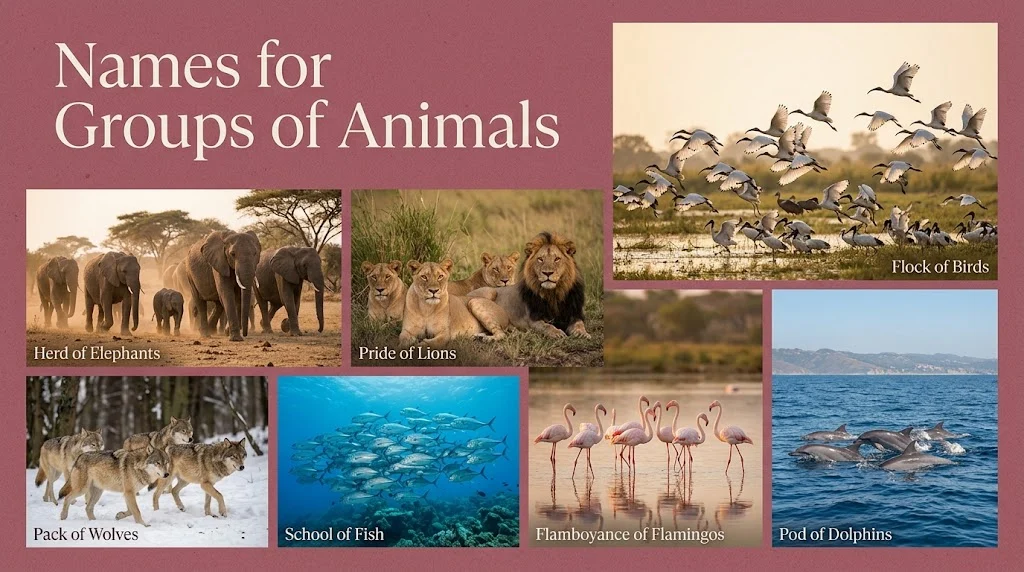
Names for groups of animals are called collective nouns. Common examples include a pride of lions, herd of elephants, pack of wolves, school of fish, flock of birds, troop of monkeys, and pod of dolphins.
Have you ever wondered why we say a pride of lions but a herd of elephants? English has hundreds of fascinating collective nouns that describe groups of animals. Some are familiar, while others sound surprisingly creative.
These terms make language more colorful and help us describe animals in a precise way. A group of wolves is commonly called a pack, while a group of bees is a swarm. Birds may gather in a flock, fish can form a school, and dolphins often travel in a pod.
Some animal group names are widely used in everyday English. Others are traditional terms that appear mainly in books, dictionaries, literature, quizzes, and word games. A few have multiple accepted terms depending on the species or context.
In this guide, we explore names for groups of animals, including mammals, birds, insects, reptiles, amphibians, and aquatic animals. You’ll also find a quick-reference table, unusual examples, and answers to common questions about collective animal nouns.
A Pride of Lions
Meaning: A group of lions.
Origin: English collective noun.
Personality: “Pride” creates a strong image of confidence, power, and social connection.
Style: Dramatic, memorable, classic.
Best For: Lions living or traveling together, especially a social lion group.
Popularity: Very common and widely recognized.
Emotional Appeal: The word “pride” fits the lion’s traditional image of strength and dignity.
Pop Culture Reference: The phrase is frequently used in wildlife documentaries, children’s books, nature writing, and educational materials.
Similar Animal Group Terms: Pack, troop, herd, pride, colony.
Why It Still Works Today: “A pride of lions” is one of the most recognizable collective nouns in English. Its simple wording makes it especially popular in education and general conversation.
A Herd of Elephants
Meaning: A group of elephants.
Origin: Traditional English usage.
Personality: “Herd” feels natural, organized, and grounded. It reflects the social nature of elephants.
Style: Classic, familiar, descriptive.
Best For: Groups of elephants, particularly those traveling or living together.
Popularity: Extremely common.
Emotional Appeal: Elephants are strongly associated with family groups and social bonds, making “herd” an intuitive term.
Pop Culture Reference: The term frequently appears in wildlife programs and educational content about elephants.
Similar Animal Group Terms: Herd, troop, pod, pack, colony.
Why It Still Works Today: “Herd of elephants” is simple, recognizable, and useful for describing elephant groups in both everyday and educational writing.
A Pack of Wolves
Meaning: A group of wolves.
Origin: Traditional English collective noun.
Personality: “Pack” suggests cooperation, movement, and social organization.
Style: Strong, familiar, natural, adventurous.
Best For: Wolves traveling, hunting, or living together.
Popularity: Very common.
Emotional Appeal: The word captures the idea of wolves functioning as a social group.
Pop Culture Reference: “Wolf pack” appears frequently in wildlife documentaries, books, films, and popular discussions about wolves.
Similar Animal Group Terms: Herd, pride, troop, colony, swarm.
Why It Still Works Today: “Pack” is instantly recognizable and has become one of the most familiar animal collective nouns.
A School of Fish
Meaning: A group of fish swimming together.
Origin: Traditional English usage.
Personality: “School” suggests coordinated movement and togetherness.
Style: Classic, educational, visual.
Best For: Fish moving together in water.
Popularity: Extremely common.
Emotional Appeal: Watching a large group of fish move in the same direction makes “school” an easy and memorable expression.
Pop Culture Reference: The term is widely used in documentaries, textbooks, aquariums, and children’s educational materials.
Similar Animal Group Terms: Shoal, school, pod, swarm, colony.
Why It Still Works Today: It is one of the easiest collective nouns for young learners to remember because it creates a familiar comparison.
A Flock of Birds
Meaning: A group of birds.
Origin: Old and established English usage.
Personality: “Flock” feels light, active, and natural.
Style: Classic, versatile, simple.
Best For: Groups of birds flying, feeding, or gathering.
Popularity: Extremely common.
Emotional Appeal: The word creates an immediate picture of birds moving together through the sky.
Pop Culture Reference: “Flock” is common in nature writing, literature, documentaries, and everyday speech.
Similar Animal Group Terms: Flock, flight, colony, covey, gaggle.
Why It Still Works Today: Unlike many unusual collective nouns, “flock” remains part of everyday English and works for many different kinds of birds.
A Troop of Monkeys
Meaning: A group of monkeys.
Origin: Traditional English collective noun.
Personality: “Troop” suggests a lively and organized group.
Style: Playful, classic, descriptive.
Best For: Social groups of monkeys.
Popularity: Commonly recognized.
Emotional Appeal: Monkeys are social and active animals, so “troop” creates a fitting image of movement and interaction.
Pop Culture Reference: The term appears regularly in wildlife programs and children’s educational materials.
Similar Animal Group Terms: Troop, herd, pack, colony, band.
Why It Still Works Today: “Troop of monkeys” is easy to remember and provides a colorful alternative to simply saying “a group of monkeys.”
A Pod of Dolphins
Meaning: A group of dolphins.
Origin: Traditional English and marine-animal terminology.
Personality: “Pod” sounds compact, peaceful, and aquatic.
Style: Modern, natural, memorable.
Best For: Dolphins traveling, feeding, or socializing together.
Popularity: Widely recognized.
Emotional Appeal: Dolphins are highly social animals, and “pod” reflects their tendency to travel and interact in groups.
Pop Culture Reference: The phrase is frequently used in marine documentaries, aquariums, and ocean education.
Similar Animal Group Terms: Pod, school, shoal, herd.
Why It Still Works Today: “Pod” is now strongly associated with dolphins and whales, making it an easy collective noun to recognize.
A Gaggle of Geese
Meaning: A group of geese, especially when on the ground.
Origin: Traditional English collective noun.
Personality: “Gaggle” sounds playful, noisy, and slightly chaotic.
Style: Funny, memorable, traditional.
Best For: Geese gathered together, particularly on land.
Popularity: Well known because of its amusing sound.
Emotional Appeal: The word “gaggle” matches the noisy and sometimes disorderly impression people associate with groups of geese.
Pop Culture Reference: The phrase often appears in jokes, children’s books, language quizzes, and word lists.
Similar Animal Group Terms: Flock, gaggle, skein, team.
Why It Still Works Today: Its unusual sound makes it one of the most memorable animal collective nouns in English.
A Swarm of Bees
Meaning: A large group of bees.
Origin: Traditional English usage.
Personality: “Swarm” suggests movement, activity, and a large number of insects.
Style: Familiar, energetic, descriptive.
Best For: Bees moving or gathering in large numbers.
Popularity: Extremely common.
Emotional Appeal: The word immediately communicates the busy movement associated with a large number of flying insects.
Pop Culture Reference: “Swarm” is widely used in nature documentaries, gardening resources, and educational materials.
Similar Animal Group Terms: Swarm, colony, hive, cloud.
Why It Still Works Today: It is a familiar collective noun that accurately communicates the visual impression of many bees moving together.
A Colony of Ants
Meaning: A group or organized community of ants.
Origin: Biological and traditional English usage.
Personality: “Colony” suggests organization, cooperation, and a structured community.
Style: Scientific, descriptive, educational.
Best For: Ant communities living and working together.
Popularity: Very common.
Emotional Appeal: The word emphasizes the highly organized social structure of ants.
Pop Culture Reference: “Ant colony” is common in science education, documentaries, children’s books, and discussions about insect behavior.
Similar Animal Group Terms: Colony, swarm, nest, hive.
Why It Still Works Today: It is both scientifically useful and familiar in everyday language.
Quick Comparison Table
| Animal | Group Name | Style |
|---|---|---|
| Lions | Pride | Strong & classic |
| Elephants | Herd | Familiar & descriptive |
| Wolves | Pack | Powerful & memorable |
| Fish | School | Classic & visual |
| Birds | Flock | Simple & versatile |
| Monkeys | Troop | Playful & traditional |
| Dolphins | Pod | Natural & memorable |
| Geese | Gaggle | Funny & unusual |
| Bees | Swarm | Energetic & familiar |
| Ants | Colony | Organized & scientific |
Names for Groups of Animals
Here is a larger quick-reference list of commonly known and traditional collective nouns. Some terms are species-specific, regional, literary, or less common in modern everyday speech.
| Animal | Collective Name |
|---|---|
| Alligators | Congregation |
| Antelope | Herd |
| Ants | Colony |
| Apes | Shrewdness |
| Baboons | Troop |
| Badgers | Cete |
| Bats | Colony |
| Bears | Sleuth |
| Bees | Swarm |
| Buffalo | Herd |
| Camels | Caravan |
| Cats | Clowder |
| Cattle | Herd |
| Cheetahs | Coalition |
| Chickens | Brood |
| Chimpanzees | Troop |
| Clams | Bed |
| Cobras | Quiver |
| Crows | Murder |
| Deer | Herd |
| Dogs | Pack |
| Dolphins | Pod |
| Donkeys | Pace |
| Doves | Dole |
| Ducks | Flock |
| Eagles | Convocation |
| Elephants | Herd |
| Elk | Herd |
| Falcons | Cast |
| Ferrets | Business |
| Flamingos | Flamboyance |
| Flies | Swarm |
| Foxes | Skulk |
| Frogs | Army |
| Gazelles | Herd |
| Giraffes | Tower |
| Goats | Herd |
| Geese | Gaggle |
| Gorillas | Troop |
| Grasshoppers | Cloud |
| Guinea pigs | Herd |
| Hamsters | Horde |
| Hawks | Cast |
| Hippopotamuses | Bloat |
| Horses | Herd |
| Hyenas | Cackle |
| Jackals | Pack |
| Jellyfish | Smack |
| Kangaroos | Mob |
| Lemurs | Conspiracy |
| Leopards | Leap |
| Lions | Pride |
| Llamas | Herd |
| Magpies | Tiding |
| Mice | Mischief |
| Monkeys | Troop |
| Moose | Herd |
| Mosquitoes | Swarm |
| Otters | Raft |
| Owls | Parliament |
| Oxen | Team |
| Parrots | Pandemonium |
| Peacocks | Ostentation |
| Penguins | Colony |
| Pheasants | Bouquet |
| Pigs | Sounder |
| Pigeons | Flock |
| Polar bears | Celebration |
| Porcupines | Prickle |
| Rabbits | Fluffle / colony |
| Ravens | Unkindness |
| Rhinoceroses | Crash |
| Seals | Herd |
| Sharks | Shiver |
| Sheep | Flock |
| Skunks | Surfeit |
| Snakes | Nest |
| Sparrows | Host |
| Squirrels | Scurry |
| Starlings | Murmuration |
| Swans | Bevy |
| Tigers | Ambush |
| Toads | Knot |
| Turkeys | Rafter |
| Turtles | Bale |
| Vultures | Committee |
| Walruses | Herd |
| Whales | Pod |
| Wolves | Pack |
| Woodpeckers | Descent |
| Zebras | Dazzle |
How to Remember Animal Group Names
Learning dozens of collective nouns can feel difficult at first. A few simple strategies make them much easier.
Connect the word with the animal.
Think about why the term might have been chosen. A “dazzle” of zebras creates an image of their striking striped appearance, while a “tower” of giraffes connects naturally with their height.
Group them by habitat.
Learn land animals, birds, insects, and aquatic animals separately. This makes a long vocabulary list easier to organize.
Create visual associations.
Imagine the animal group in action. Picture a flock of birds flying together or a pod of dolphins moving through the ocean.
Use the words in sentences.
For example: “We saw a herd of elephants near the water.” Using the terms naturally helps move them from recognition to active vocabulary.
Learn the common terms first.
Start with pride, herd, pack, flock, school, swarm, troop, and pod. Then move on to unusual terms.
Most Common Animal Group Names
Some collective nouns are much more widely used than others. If you only want to remember the essentials, start with these:
- Pride of lions
- Herd of elephants
- Pack of wolves
- Flock of birds
- School of fish
- Troop of monkeys
- Pod of dolphins
- Swarm of bees
- Colony of ants
- Gaggle of geese
- Herd of cattle
- Flock of sheep
- Herd of horses
- Pack of dogs
- Colony of penguins
These are useful in everyday English, school assignments, quizzes, nature writing, and general conversation.
Unusual Names for Groups of Animals
English collective nouns become especially interesting when the terms are unusual.
Examples include:
- A murder of crows
- A parliament of owls
- A flamboyance of flamingos
- A crash of rhinoceroses
- A tower of giraffes
- A dazzle of zebras
- A shiver of sharks
- An unkindness of ravens
- A skulk of foxes
- A business of ferrets
- A conspiracy of lemurs
- A bloat of hippopotamuses
- An ostentation of peacocks
- A murmuration of starlings
- A prickle of porcupines
Some of these terms are traditional or literary and may not be used frequently in everyday conversation. They remain popular because they are vivid, memorable, and fun to learn.
Names for Groups of Birds
Birds have some of the most interesting collective nouns in English. Common examples include:
- Flock of birds
- Gaggle of geese
- Murder of crows
- Parliament of owls
- Murmuration of starlings
- Convocation of eagles
- Bouquet of pheasants
- Ostentation of peacocks
- Dole of doves
- Cast of falcons
- Host of sparrows
- Tiding of magpies
- Descent of woodpeckers
- Bevy of swans
Some bird terms describe a specific situation, such as birds flying, resting, or gathering together. The general word “flock” remains useful when a more specific collective noun is unknown.
Names for Groups of Mammals
Mammals have a wide range of collective nouns.
Examples include:
- Pride of lions
- Herd of elephants
- Pack of wolves
- Troop of monkeys
- Tower of giraffes
- Crash of rhinoceroses
- Bloat of hippopotamuses
- Skulk of foxes
- Sleuth of bears
- Leap of leopards
- Mob of kangaroos
- Raft of otters
- Shiver of koalas
- Herd of deer
- Herd of horses
These terms are useful for describing social behavior, movement, and groups in wildlife writing.
Names for Groups of Insects
Insects also have distinctive collective nouns.
Common examples include:
- Swarm of bees
- Colony of ants
- Swarm of flies
- Cloud of grasshoppers
- Swarm of mosquitoes
- Colony of termites
- Kaleidoscope of butterflies
- Army of caterpillars
The exact collective noun can depend on the insect and context. “Swarm” is among the most familiar terms for large groups of flying insects.
Names for Groups of Sea Animals
Marine animals have their own fascinating vocabulary.
Examples include:
- Pod of dolphins
- Pod of whales
- School of fish
- Shoal of fish
- Shiver of sharks
- Smack of jellyfish
- Herd of seals
- Herd of walruses
- Bed of clams
- Raft of otters
Some terms are common scientific or everyday expressions, while others are traditional collective nouns that are mainly encountered in word lists and educational materials.
Funny Names for Groups of Animals
Some collective nouns are amusing simply because of the words used.
A few memorable examples include:
- Gaggle of geese
- Murder of crows
- Parliament of owls
- Business of ferrets
- Unkindness of ravens
- Pandemonium of parrots
- Ostentation of peacocks
- Mischief of mice
- Flamboyance of flamingos
- Dazzle of zebras
These unusual names are particularly popular in trivia games, classroom activities, social media posts, and animal-themed quizzes.
Why Do Animals Have Collective Names?
Collective nouns give English speakers a concise way to describe groups. Instead of repeatedly saying “a group of lions,” we can say “a pride of lions.”
Many of these terms developed through historical English usage, literature, hunting terminology, farming language, and everyday observation. Some became widely established, while others remained rare or literary.
It is also important to remember that not every collective noun has the same level of modern usage. Some are common and practical, while others are traditional expressions that people may recognize mainly from dictionaries, books, or quizzes.
FAQs
What is the collective name for a group of animals?
The collective name for a group of animals is called a collective noun.
What is the most famous animal group name?
There is no single official “most famous” collective noun, but terms such as pride of lions, herd of elephants, pack of wolves, and flock of birds are among the most widely recognized in English.
What is a group of animals called?
A group of animals can simply be called a group, but English also has many specific collective nouns.
Why are animal group names different?
Collective nouns developed through different historical and linguistic traditions.
What is a group of zebras called?
A group of zebras is commonly known as a dazzle. This colorful traditional term is memorable because it creates an image connected with the striking appearance of zebra stripes.
Conclusion
Learning the names for groups of animals is a fun way to expand vocabulary while discovering some of the more colorful expressions in English. From a pride of lions and a herd of elephants to a murder of crows and a flamboyance of flamingos, these collective nouns make animal descriptions more vivid.
Some terms are extremely common, while others are traditional expressions that appear mostly in literature, dictionaries, quizzes, and educational resources. That difference is worth remembering when using them in everyday writing.
Whether you’re studying English, preparing a school project, writing a story, or simply curious about animal vocabulary, these collective names are useful and memorable. Pick a few favorites to learn first, then explore the unusual ones. If you enjoyed this guide, share it with someone who loves animals or interesting English words.
Discover More Related Articles:
- Wheel of Names | Fun Ways to Pick the Perfect Name In 2026
- 3D Shapes Names | Faces, Edges & Vertices In 2026