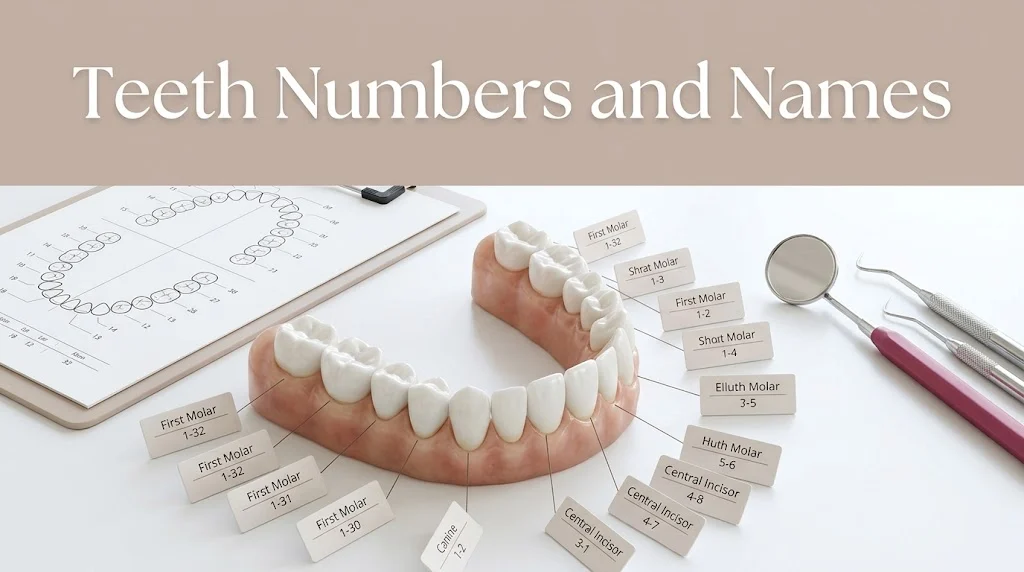
Adult teeth are named incisors, canines, premolars, and molars. Dentists identify individual teeth using numbering systems, with the Universal system commonly using numbers 1–32 for permanent teeth and letters A–T for primary teeth.
Have you ever looked at a dental chart and wondered why a dentist says something like tooth number 14 instead of simply saying “upper molar”? Every tooth has a name, location, and, in many dental systems, a specific number.
Understanding teeth numbers and names makes dental charts much easier to read. It can also help you understand what your dentist means when discussing a cavity, filling, extraction, crown, or other dental treatment.
Human teeth are divided into several main types: incisors, canines, premolars, and molars. Each type has a different shape and job. Incisors help cut food, canines help tear it, while premolars and molars are mainly involved in crushing and grinding.
Adults normally have up to 32 permanent teeth, while children typically have 20 primary teeth. Below, we explain the names, numbers, locations, and basic functions of these teeth in a simple way.
Incisors
Meaning: Front teeth used mainly for cutting food.
Location: At the front of the upper and lower jaws.
Types: Central incisors and lateral incisors.
Function: Incisors are shaped with relatively thin cutting edges. They help bite and cut food into manageable pieces.
Number: In the Universal Numbering System, permanent incisors are numbered 6–11 and 22–27.
Style: Flat, sharp-edged, front-facing teeth.
Best Known For: Biting and cutting.
Popularity: Incisors are among the most easily recognized teeth because they are visible when you smile.
Emotional Appeal: Although teeth are primarily functional structures, incisors are closely associated with smiles and facial appearance because of their prominent position.
Pop Culture Reference: Front teeth frequently appear in cartoons and illustrations because they are easy to recognize visually.
Why They Still Matter Today: Incisors perform an important first step in eating by helping cut food before it moves toward the back teeth.
Central Incisors
Meaning: The two front incisors in each dental arch.
Location: One pair is located in the upper jaw and another pair in the lower jaw.
Function: Central incisors help bite and cut food.
Universal Numbers: Permanent upper central incisors are #8 and #9, while lower central incisors are #24 and #25.
Style: Broad, relatively flat front teeth.
Best For: Biting, cutting, and supporting the appearance of the smile.
Popularity: They are some of the most recognizable teeth because they sit directly in the center of the smile.
Emotional Appeal: Central incisors have a strong connection with smiling and facial expression because they are usually visible when a person smiles.
Similar Teeth: Lateral incisors, canines, primary central incisors.
Why They Still Matter Today: Their position and cutting edges make them especially important for biting into many foods.
Lateral Incisors
Meaning: Incisors positioned beside the central incisors.
Location: Next to the central incisors in both the upper and lower jaws.
Function: Lateral incisors help cut food and contribute to the transition between the front teeth and canines.
Universal Numbers: Permanent upper lateral incisors are #7 and #10. Lower lateral incisors are #23 and #26.
Style: Smaller and positioned beside the central front teeth.
Best For: Cutting food and supporting the front dental arch.
Popularity: Like central incisors, lateral incisors are commonly visible when people smile.
Emotional Appeal: Their position helps create the overall appearance of the front teeth.
Similar Teeth: Central incisors, canines.
Why They Still Matter Today: Lateral incisors help create a functional and continuous cutting surface at the front of the mouth.
Canines
Meaning: Pointed teeth positioned between incisors and premolars.
Location: Four canines are normally found in a complete adult dentition—two upper and two lower.
Function: Canines help grip and tear food.
Universal Numbers: Upper canines are #6 and #11, while lower canines are #22 and #27.
Style: Pointed, strong, and prominent.
Best For: Gripping and tearing food.
Popularity: Canines are easy to identify because their pointed shape differs from the flatter incisors.
Emotional Appeal: Their distinctive shape often makes them particularly recognizable when people learn about dental anatomy.
Pop Culture Reference: Canines sometimes receive attention in fictional vampire imagery, although normal human canines are simply ordinary teeth with an important chewing function.
Why They Still Matter Today: Canines help guide the jaw during certain movements and contribute to tearing food.
Premolars
Meaning: Teeth located between the canines and molars.
Location: Behind the canines and in front of the molars.
Function: Premolars help crush and grind food.
Number: Adults normally have eight premolars, with four in each jaw.
Universal Numbers: Upper premolars are #4, #5, #12, and #13. Lower premolars are #20, #21, #28, and #29.
Style: Larger than incisors and canines but generally smaller than molars.
Best For: Crushing and beginning the grinding process.
Popularity: Premolars are less visible than front teeth, so people often notice their names only when looking at a dental chart.
Emotional Appeal: Their role is mostly functional rather than cosmetic.
Similar Teeth: Molars, canines.
Why They Still Matter Today: Premolars form an important bridge between the tearing function of the canines and the heavier grinding work of the molars.
First Molars
Meaning: The first large molars behind the premolars.
Location: Four first molars are normally found in adult dentition.
Function: They help crush and grind food.
Universal Numbers: Upper first molars are #3 and #14, while lower first molars are #19 and #30.
Style: Broad chewing surfaces with multiple cusps.
Best For: Heavy chewing and grinding.
Popularity: First molars are important landmarks on dental charts because they are among the larger permanent teeth.
Emotional Appeal: Unlike front teeth, first molars are usually not visible during an ordinary smile, so their importance is primarily functional.
Similar Teeth: Second molars and third molars.
Why They Still Matter Today: First molars do much of the grinding work required to break food down before swallowing.
Second Molars
Meaning: Molars positioned behind the first molars.
Location: Four second molars are normally present in a complete adult dentition.
Function: Crushing and grinding food.
Universal Numbers: Upper second molars are #2 and #15, while lower second molars are #18 and #31.
Style: Broad, sturdy chewing teeth.
Best For: Grinding and processing food.
Popularity: Second molars are familiar to dentists but are less noticeable to most people because they sit toward the back of the mouth.
Emotional Appeal: Their main importance comes from function rather than appearance.
Similar Teeth: First molars and third molars.
Why They Still Matter Today: Second molars provide additional chewing surfaces and help maintain efficient food processing.
Wisdom Teeth
Meaning: Third molars, commonly called wisdom teeth.
Location: At the very back of each dental arch.
Function: Like other molars, they can contribute to grinding when they are present and functional.
Universal Numbers: The four third molars are #1, #16, #17, and #32.
Style: Back-most permanent molars.
Best For: Grinding, although their practical usefulness varies from person to person.
Popularity: Wisdom teeth are among the most discussed teeth because they can become impacted or create crowding and other dental concerns.
Emotional Appeal: The phrase “wisdom teeth” comes from the fact that these teeth typically emerge much later than the other permanent teeth.
Pop Culture Reference: Wisdom teeth are frequently mentioned in conversations about growing older and dental treatment.
Why They Still Matter Today: Third molars are a normal part of human dental anatomy, but not everyone has all four, and some may never fully erupt.
Baby Teeth
Meaning: The first set of teeth, also called primary or deciduous teeth.
Location: The upper and lower jaws of young children.
Function: Baby teeth help children bite, chew, speak, and maintain space for developing permanent teeth.
Number: Children typically have 20 primary teeth.
Universal System: Primary teeth are labeled A through T.
Style: Smaller teeth designed for a child’s developing mouth.
Best For: Early chewing, speech development, and maintaining space for permanent teeth.
Popularity: Baby teeth are widely discussed because parents often monitor when each tooth appears and eventually falls out.
Emotional Appeal: A child’s first tooth is an important developmental milestone for many families.
Similar Terms: Primary teeth, deciduous teeth, milk teeth.
Why They Still Matter Today: Baby teeth are temporary, but they still need proper care because they play important roles before permanent teeth take their place.
Quick Comparison Table
| Tooth Type | Main Function | Adult Number | Universal Numbers |
|---|---|---|---|
| Central Incisors | Cutting | 4 | 8, 9, 24, 25 |
| Lateral Incisors | Cutting | 4 | 7, 10, 23, 26 |
| Canines | Tearing | 4 | 6, 11, 22, 27 |
| First Premolars | Crushing | 4 | 5, 12, 21, 28 |
| Second Premolars | Crushing | 4 | 4, 13, 20, 29 |
| First Molars | Grinding | 4 | 3, 14, 19, 30 |
| Second Molars | Grinding | 4 | 2, 15, 18, 31 |
| Third Molars | Grinding | 4 | 1, 16, 17, 32 |
Universal Teeth Numbering System
The Universal Numbering System is commonly used in the United States and is also encountered in some educational resources.
For permanent teeth, numbering begins with #1, the upper-right third molar from the patient’s perspective. The numbers continue across the upper arch to #16, then continue from the lower-left third molar through #32.
This means:
- #1: Upper-right wisdom tooth
- #8: Upper-right central incisor
- #9: Upper-left central incisor
- #16: Upper-left wisdom tooth
- #17: Lower-left wisdom tooth
- #24: Lower-left central incisor
- #25: Lower-right central incisor
- #32: Lower-right wisdom tooth
The numbering is based on the patient’s perspective, not the dentist’s left and right.
FDI Tooth Numbering System
The FDI World Dental Federation system uses two digits rather than a single number for permanent teeth.
The first digit identifies the quadrant, while the second identifies the tooth within that quadrant.
For example:
- 11: Upper-right central incisor
- 12: Upper-right lateral incisor
- 13: Upper-right canine
- 14: Upper-right first premolar
- 16: Upper-right first molar
- 21: Upper-left central incisor
- 31: Lower-left central incisor
- 41: Lower-right central incisor
The FDI system is widely used internationally, so you may see these numbers on dental records outside the United States.
Palmer Tooth Numbering System
The Palmer system identifies teeth according to four sections of the mouth, called quadrants. It uses numbers for permanent teeth and letters for primary teeth, along with a symbol indicating the quadrant.
The system is especially useful for showing the exact position of a tooth in relation to the center of the mouth.
Because different countries and dental practices use different systems, the same tooth can have different numbers depending on the numbering method.
Baby Teeth Numbers and Names
Primary teeth are usually identified by letters A through T in the Universal system.
The 20 primary teeth include:
- 4 central incisors
- 4 lateral incisors
- 4 canines
- 4 first molars
- 4 second molars
Unlike permanent teeth, children do not have premolars or wisdom teeth in their primary dentition.
The primary teeth are eventually replaced by permanent teeth as a child grows.
How to Read a Dental Tooth Chart
A dental chart may look confusing at first, but the basic structure is simple.
First, identify whether the chart shows primary or permanent teeth. Primary teeth may be labeled with letters, while permanent teeth may use numbers or another numbering system.
Next, identify the upper and lower jaws. Then determine whether the chart uses the Universal, FDI, or Palmer system.
For example, if you see #8 on a U.S.-style dental chart, it refers to the upper-right central incisor from the patient’s perspective.
Why Do Dentists Number Teeth?
Tooth numbers give dental professionals a precise way to communicate about individual teeth.
Instead of saying “the second tooth behind the canine on the upper right,” a dentist can use a standardized number. This makes dental records, treatment plans, insurance documentation, and communication between dental professionals more efficient.
The exact numbering system can differ by country or dental practice, so it is useful to know which system is being used.
Most Common Tooth Names
The main names you should know are:
- Incisors: Cutting teeth at the front.
- Canines: Pointed teeth used mainly for gripping and tearing.
- Premolars: Teeth behind the canines that help crush food.
- Molars: Large back teeth designed primarily for grinding.
- Wisdom teeth: The third molars at the back of the mouth.
Together, these groups make up the normal adult permanent dentition.
FAQs
How Many Teeth Do Adults Have?
A complete adult dentition has 32 permanent teeth, including four third molars or wisdom teeth.
Which Teeth Are Numbers 1 and 32?
In the Universal Numbering System, #1 is the upper-right third molar and #32 is the lower-right third molar, viewed from the patient’s perspective.
Which Teeth Are Numbers 8 and 9?
In the Universal system, #8 and #9 are the two upper central incisors.
What Are Teeth Numbers 14 and 19?
In the Universal system, #14 is the upper-left first molar, while #19 is the lower-left first molar, viewed from the patient’s perspective.
What Are Teeth Numbers 24 and 25?
#24 and #25 are the lower central incisors in the Universal Numbering System.
Conclusion
Understanding teeth numbers and names can make dental charts and conversations much easier to follow. The basic tooth groups are incisors, canines, premolars, and molars, with wisdom teeth representing the third molars at the back.
Adults can have up to 32 permanent teeth, while children generally have 20 primary teeth. Individual teeth can then be identified using systems such as the Universal, FDI, or Palmer numbering systems.
Whether you are studying dental anatomy, preparing for a dental appointment, helping a child learn about teeth, or simply curious about what your dentist means by a specific tooth number, knowing these basics gives you a useful foundation. Save this guide for reference and share it with anyone who wants a simple explanation of tooth names and numbers.
Discover More Related Articles:
- Wheel of Names | Fun Ways to Pick the Perfect Name In 2026
- 3D Shapes Names | Faces, Edges & Vertices In 2026